
Namaste meaning is simple at first glance and deeper underneath: the word comes from Sanskrit and literally means “I bow to you”, spoken while pressing the palms together and giving a slight bow. It is a greeting, a farewell and a mark of respect used across India and Nepal, in Hindu, Buddhist and Jain traditions, and by yoga practitioners around the world. The short answer to what namaste means is respect offered with the whole body, and the longer answer reaches into scripture, language and the way a small gesture can carry a whole philosophy.
This guide explains the word’s roots, the gesture that goes with it, where it is used, and how to use it well, without turning a living greeting into a slogan.
Key takeaways
- Namaste comes from Sanskrit: namas, meaning “bow” or “obeisance”, and te, meaning “to you”.
- It literally means “I bow to you”, and is often rendered as “the divine in me bows to the divine in you”.
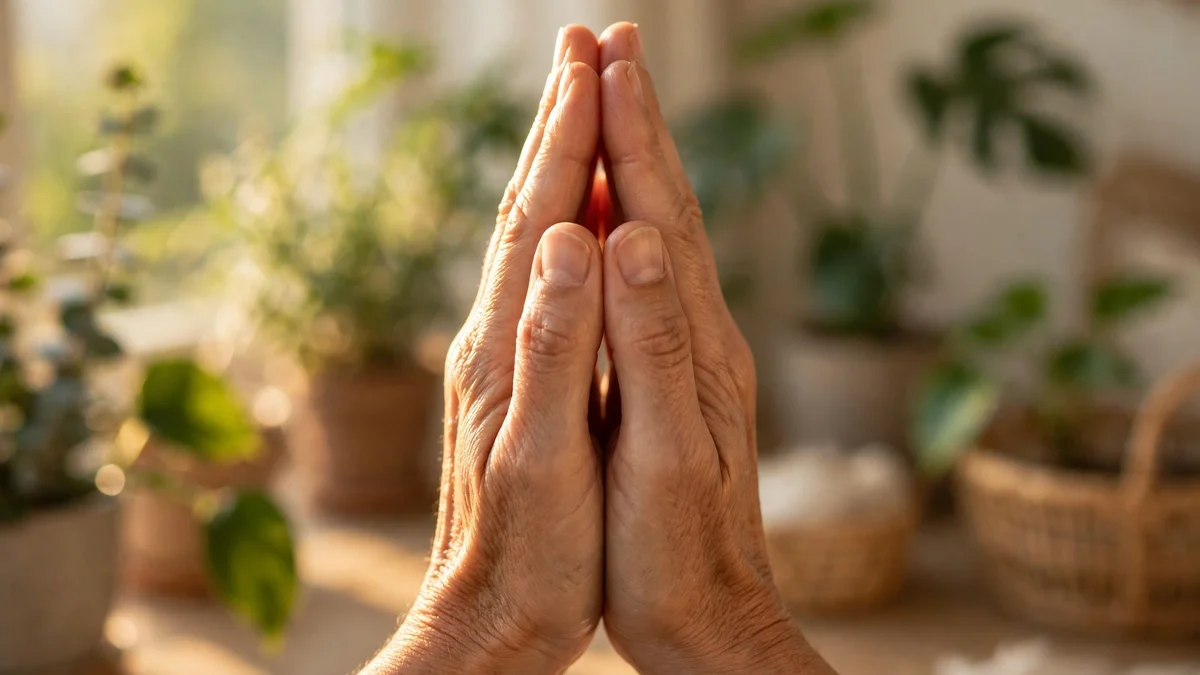
- The gesture is called anjali mudra: palms pressed together, fingers pointing up, thumbs close to the chest, with a slight bow.
- It is used as a greeting and a farewell, at any time of day, and to express thanks.
- The word appears in early Hindu scripture, including the Rigveda and the Atharvaveda.
- It is used by people of Hindu, Buddhist and Jain traditions, and by yoga practitioners worldwide.
What namaste literally means
Namaste is formed from two Sanskrit parts. The first is namas, which means “bow”, “obeisance”, “reverential salutation” or “adoration”, and comes from the verb namati, meaning “bends” or “bows”. The second is te, the dative form of the pronoun tvam, meaning “you”. Put together, namas plus te becomes namaste, and the literal meaning is “bowing to you” or “I bow to you”. In the Devanagari script used for Sanskrit and Hindi, it is written नमस्ते, and it is pronounced nah-muh-STAY.
The grammar carries a quiet piece of meaning that scholars have long noted. The pronoun te is the form used for someone familiar, intimate, divine or a child, rather than the formal word for “you”. As the Indologist Stephen Phillips has argued, that choice gives the greeting an embedded second sense, something like “salutations to the divine child in your heart”. It is a small grammatical detail, but it helps explain why the word feels warmer than a plain hello.
The popular rendering, “the divine in me bows to the divine in you”, captures the spiritual sense that sits behind the literal meaning. In Hindu thought, it reflects the belief that the divine and the self, the atman, are the same in you and in me, so bowing to another person is also bowing to what is sacred in them. As the sociologist Holly Oxhandler has put it, it means “the sacred in me recognises the sacred in you”. That reading is widely quoted, including in yoga studios, though it is a later interpretation rather than the literal translation.
The gesture: anjali mudra
Namaste is usually spoken with a slight bow and the hands pressed together, palms touching and fingers pointing upwards, thumbs close to the chest. The gesture is called anjali mudra, and the standing posture that incorporates it is called pranamasana. The word mudra means a seal or gesture, and anjali means an offering, so the gesture is, in effect, an offering made with the hands.
The gesture can be used with the word or without it. In India, a person may say namaste while pressing the palms together, or simply press the palms together and bow, and the meaning is understood either way. It can also be used to thank someone, to welcome a guest, or to take leave, and it works at any time of day, unlike greetings tied to the morning or evening. A less common variant is used when addressing three or more people: namo vah, which combines namah with vah, the plural “you”.
The gesture is not only a greeting. It appears in temple art and sculpture across India, where figures press their palms together before a deity, and it is part of prayer and worship in the same traditions that use it to greet people. The same hands that greet a stranger greet the sacred, which is the point: the gesture treats the person in front of you as worthy of the same reverence. During the coronavirus pandemic in 2020, the gesture gained fresh attention when world leaders adopted it as a non-contact alternative to the handshake.

Where the word comes from
Namaste is old. The word namas appears in the Vedic literature, the oldest layer of Hindu scripture. Related terms appear in the Rigveda, in the Vivaha Sukta, verse 10.85.22, in the sense of “worship” or “adore”, and the phrase namas-te appears in Rigveda 8.75.10, in Atharvaveda verse 6.13.2, and in the Taittirya Samhita 2.6.11.2, among many other early texts. It is also found in ancient and medieval temple sculpture, where figures press their palms together in greeting and worship.
The word travelled with the people who used it. Today it is found across the Indian subcontinent and South-East Asia, and among the Indian diaspora worldwide, and the gesture, even where the word is not used, is common across parts of South-East Asia where Indian religions are strong. In Nepal it is the standard everyday greeting. In English, the word was attested as a greeting by 1880, and the sense of the physical gesture was recorded by 1948. Related forms include namaskar and namaskaram, which are used in much the same way in different regions and languages of India.
Yoga carried the word further still. As yoga spread beyond India in the twentieth century, namaste travelled with it, and it is now used to open and close classes in studios around the world. That spread has also changed how the word is heard: in a yoga studio it often carries the spiritual reading, while on a street in India it is, first and foremost, an ordinary hello, said to shopkeepers, neighbours and strangers alike.
Namaste and similar greetings compared
Pressing the palms together is not unique to India, and comparing namaste with its cousins shows what is shared and what is distinct. The table below sets out five greetings that use the hands, the body or the voice to show respect.
| Greeting | Where it is used | The gesture | What it means |
|---|---|---|---|
| Namaste | India, Nepal, diaspora worldwide | Palms together, slight bow | “I bow to you” |
| Namaskar | India, in several languages | Palms together, slight bow | A form of namaste, used the same way |
| Pranam | India, to elders and teachers | Deep bow, sometimes touching feet | Deep respect for an elder |
| Wai | Thailand and Laos | Palms together, bow of the head | Respect, greeting and thanks |
| Gassho | Japan, in Buddhism | Palms together at the chest | Reverence and gratitude |
| Handshake | Europe, the Americas and beyond | Right hands clasped | A formal greeting between equals |
When and how to use namaste
Using namaste well is mostly a matter of sincerity and context. In India and Nepal, it is an everyday greeting, so using it there is natural and welcome, whether you are meeting someone, thanking them or saying goodbye. Press the palms together at chest level, give a small bow or nod of the head, and say the word clearly. There is no need to overdo it: a calm, brief gesture carries more weight than a theatrical one.
In a yoga class, namaste usually comes at the start and the end, and it is a way of acknowledging the teacher, the other students and the practice itself. The teacher may say it first, and the class answers. Outside India and outside yoga, the word is best used where it fits: as a greeting to someone who uses it themselves, or as a genuine expression of thanks. Using it as a joke, a punchline or a catchphrase empties it of meaning, and using it to sound spiritual, rather than to show respect, is usually obvious to the person on the receiving end.
A few practical points help. Namaste is a non-contact greeting, which is one reason it spread so widely during the pandemic, and it works well where a handshake would be awkward or unwelcome. It is appropriate for people of any age and standing, and it is not tied to any single religion: Hindus, Buddhists and Jains all use it, and many people with no religious affiliation use it too. If you are unsure whether it fits, watch what the other person does and follow their lead, which is good manners in any culture.
A checklist for using namaste well
- Press the palms flat together, fingers pointing up, thumbs close to the chest.
- Add a slight bow or nod of the head, and say the word clearly: nah-muh-STAY.
- Use it to greet, to thank and to say goodbye, at any time of day.
- Mean it: a calm, brief gesture carries more weight than a theatrical one.
- Follow the other person’s lead when you are unsure whether it fits.
- Do not use it as a joke, a punchline or a way of sounding spiritual.
- Remember it is an everyday greeting in India and Nepal, not only a yoga word.
- Use namo vah when greeting three or more people, if you want the plural form.
Frequently asked questions
What does namaste mean in English?
Namaste literally means “I bow to you” in Sanskrit, from namas, meaning “bow” or “obeisance”, and te, meaning “to you”. It is often rendered as “the divine in me bows to the divine in you”, which captures the spiritual sense behind the literal meaning.
How do you pronounce namaste?
Namaste is pronounced nah-muh-STAY, with the stress on the last syllable. In the Devanagari script it is written नमस्ते, and the word is sometimes spelled namasthe in older English writing.
What is the difference between namaste and namaskar?
Very little in everyday use. Namaskar is a related form of the same greeting, used in much the same way in different regions and languages of India, and both are spoken with the palms pressed together. Namaste is the form most widely known outside India.
Is namaste a religious word?
It has religious roots and a spiritual reading, but it is also an everyday greeting. It is used by people of Hindu, Buddhist and Jain traditions, and by many people with no religious affiliation, in India, Nepal and the Indian diaspora, and in yoga studios worldwide.
Can I say namaste if I am not Indian?
Yes, if you use it sincerely and in a fitting context. It is a greeting, not a restricted ritual, and people in India and Nepal use it with strangers every day. Use it as a genuine greeting or thanks, not as a joke or a decoration.
What is anjali mudra?
Anjali mudra is the gesture that goes with namaste: the palms pressed together, fingers pointing up, thumbs close to the chest, usually with a slight bow. Anjali means an offering, and mudra means a gesture or seal, so the hands make an offering of respect.
The bottom line
Namaste meaning is both plain and profound: literally “I bow to you”, spoken with the palms pressed together in anjali mudra, it is a greeting, a farewell and a mark of respect that has travelled from Vedic scripture to yoga studios around the world. Used sincerely, it says more in a second than a handshake says in a minute. For more reading on calm living, our guide to dandelion tea is a gentle place to start, our guide to line dancing covers a very different kind of togetherness, and our guide to where to meet people is useful if you want more good greetings in your life.