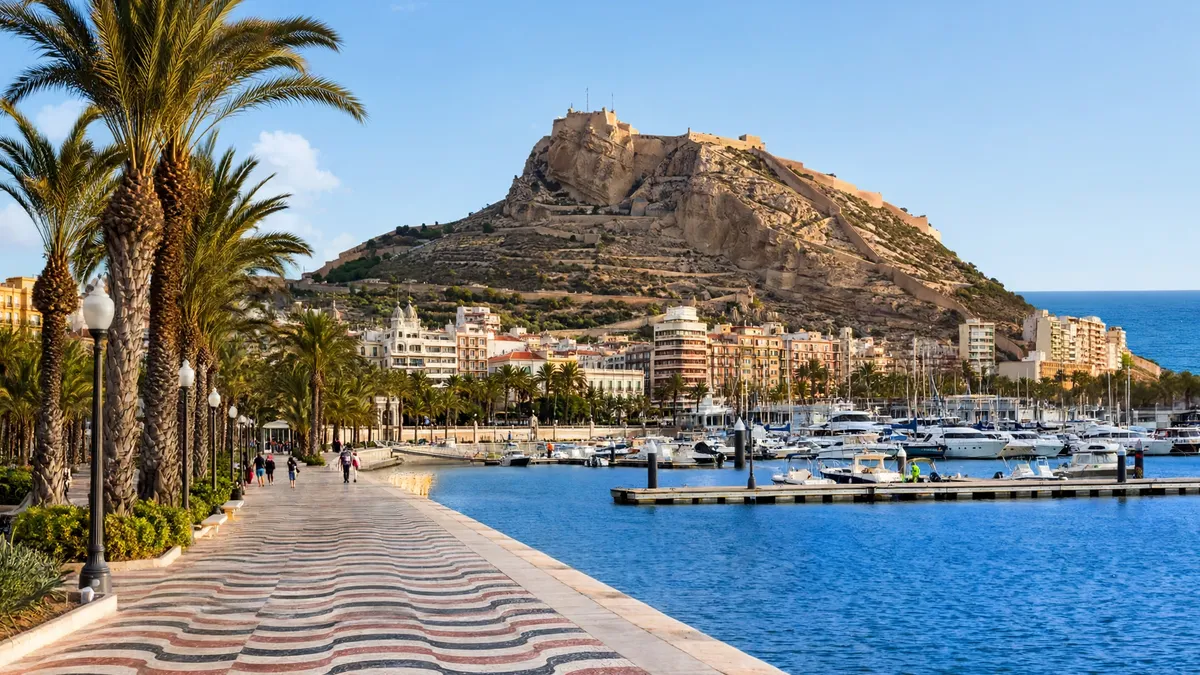

Alicante is a port city on Spain’s Mediterranean coast that manages to be a working harbour, a beach resort and a historic old town all at once, and that is exactly why it works so well as a holiday. With a population of 358,608 in 2024, it is the second-largest city in the Valencian Community after Valencia and the tenth-largest in Spain, yet the centre feels compact and easy to walk. So what makes Alicante worth a trip, rather than just a stop on the way to somewhere else? The answer is the combination: a castle on a hill above the harbour, a palm-lined promenade along the seafront, a city beach you can walk to from the old town, and food and drink that cost far less than in Barcelona or Madrid. This guide covers the history, the places to see, the food, and how to plan a visit.
Key takeaways
- Alicante is the capital of the province of Alicante, in the Valencian Community of Spain.
- The city had 358,608 residents in 2024, making it the tenth-largest city in Spain.
- Its name comes from the Arabic Laqant, which echoes the older Latin name Lucentum.
- The Castle of Santa Barbara stands on Mount Benacantil, above the harbour and the old town.
- El Postiguet beach sits at the foot of the castle, right beside the city centre.
- The city was founded in 324 BC and has been a Mediterranean port for more than two thousand years.
Alicante in a nutshell
Alicante, officially Alacant in Valencian and Alicante in Spanish, is a city and municipality in the Valencian Community, on the south-east coast of the Iberian Peninsula. It is the capital of the province of Alicante and a historic Mediterranean port, and together with Elche and other nearby towns it forms a conurbation of nearly one million people. The city covers 201.27 square kilometres and sits almost at sea level, at an elevation of just 3 metres, with the hills of Benacantil, Tossal and Serra Grossa rising over the largely flat ground where the city is built. The official languages are Valencian and Spanish, and locals are called alicantinos in Spanish and alacantins in Valencian. The old town clusters around the castle hill, the modern centre spreads along the seafront, and the port has reinvented itself in recent years as a base for cruise ships as well as freight. The airport, El Altet, replaced the old airfield at Rabasa when tourism took off in the 1960s, and it is still the way most visitors arrive. What strikes first-time visitors is how close everything is: you can swim at the beach, climb to the castle and sit down to lunch in the old town without ever getting in a car.
A short history
The area around Alicante has been inhabited for more than 7,000 years, and the first settlements stood on the slopes of Mount Benacantil. Greek and Phoenician traders were visiting the eastern coast of Spain by 1000 BC, and the Carthaginian general Hamilcar Barca established the fortified settlement of Akra Leuke, meaning white mountain, in the mid-230s BC, on the site of the modern city. The Romans ruled for more than 700 years, and their town was called Lucentum, a name that echoes in the city’s modern name through the Arabic Laqant. After the Visigoths came the Moors, who ruled from the early 8th century until the Reconquista, and Alicante was conquered for the Castilian king Alfonso X in 1247, before passing to the Crown of Aragon in 1296. The city became a major Mediterranean trading station, exporting rice, wine, olive oil, oranges and wool, though the expulsion of the Jewish community in 1492 and of the Moriscos between 1609 and 1614 cost the region many skilled workers. The 18th and 19th centuries were slow, with shoes, oranges, almonds and fishing keeping the economy going, until international trade and the growth of the harbour brought a sharp recovery at the end of the 19th century. Alicante was the last city loyal to the Republican government to be occupied by General Franco’s troops, on 1 April 1939, and its harbour saw the last Republican officials fleeing the country. Tourism transformed the city from the late 1950s onwards, with large buildings rising at Albufereta and Playa de San Juan, and the benign climate doing most of the work of attracting visitors from northern Europe.
The places to see first
Start with the Castle of Santa Barbara, which stands on Mount Benacantil above the harbour and gives the best view in the city. From the top you can see the whole sweep of the bay, the port, the old town roofs and the beaches stretching away to the north. Below the castle, the Explanada de Espana is the city’s famous promenade, paved in a wave pattern of red, white and blue tiles and lined with palm trees, cafes and market stalls. It runs along the harbour, and it is where locals stroll in the evening, which tells you it is the real heart of the city rather than a tourist invention. At the foot of the castle hill is El Postiguet beach, a sweep of sand right beside the centre, with a photograph of it from 1957 showing that the beach has been the city’s front room for generations. A little further north, Playa de San Juan is the long, open beach where the big hotels and apartment blocks rose in the 1960s, and it is the better choice if you want space and a quieter stretch of sand. The old town, tucked between the castle and the harbour, is a maze of narrow streets, small squares and whitewashed houses, and it rewards wandering without a plan. The port itself is worth an evening too: in recent years the Port Authority has developed it as one of the most important cruise ports in Spain, and the quayside bars and restaurants fill up as the sun goes down.
Neighbourhoods and beaches at a glance
Alicante is easy to navigate because the main areas each have a clear character. The table below gives a quick sense of what each one offers, so you can pick a base that suits the kind of trip you want.
| Area | What it is | Best for |
|---|---|---|
| Old town | Narrow streets below the castle | Evening meals and wandering |
| Explanada | Palm-lined seafront promenade | Strolling and people watching |
| El Postiguet | City beach by the castle | A quick swim near the centre |
| Playa de San Juan | Long beach north of the city | Space, sand and family days |
| The port | Harbour, marina and quayside | Sunset drinks and boat trips |
| Albufereta | Residential bay north of the port | Quiet stays near the water |

If you only have a weekend, stay near the old town or the Explanada and walk everywhere. If you have a week, consider splitting your time between the centre and Playa de San Juan, so you get both the city and the beach. The island of Tabarca, listed among the city’s population entities as Isla Plana or Nueva Tabarca, makes a good day trip by boat, and the hills behind the city offer walking with views back over the bay.
Eating and drinking
Alicante’s food is rooted in its history as a trading port. Rice, wine, olive oil and oranges were among the exports that made the city rich centuries ago, and rice dishes and seafood still dominate the menus in the old town. The bars around the castle hill and the Explanada serve tapas and local wines at prices that feel gentle beside the bigger Spanish cities, and the market halls are worth a visit even if you are not cooking, just to see the fish, fruit and nuts on display. Breakfast is usually coffee and toast or a pastry, lunch is the main meal of the day, and dinner starts late, which suits the evening stroll along the promenade. If you are self-catering, a picnic is easy to put together from the markets, and the best picnic recipes guide has ideas that travel well to a beach. For a slower meal, a slow cooker is no use on holiday, but the city’s rice dishes repay the same patience: they are cooked slowly, served to share, and best eaten without rushing. The Puerto Rican food guide is a reminder of how Spanish food traditions travelled the world, and Alicante is a good place to taste the originals.
Planning checklist
- Fly into El Altet airport and take the bus or a taxi into the centre, which is a short ride.
- Stay near the old town or the Explanada if you want to walk everywhere.
- Climb to the Castle of Santa Barbara early in the day, before the heat builds.
- Pack swimwear even for a city trip, since El Postiguet beach is beside the centre.
- Learn a few words of Spanish, and know that Valencian is also an official language here.
- Carry cash for small bars and market stalls, as not everywhere takes cards.
- Plan lunches as your main meal and expect restaurants to open late for dinner.
- Check the cruise schedule if you want a quieter port, since cruise calls bring crowds.
Questions visitors ask
Where is Alicante?
Alicante is a city on the south-east coast of Spain, in the Valencian Community, on the shores of the Mediterranean Sea. It is the capital of the province of Alicante and sits about halfway between Valencia to the north and Murcia to the south-west.
Is Alicante a good city for a beach holiday?
Yes. El Postiguet beach is right beside the city centre at the foot of the castle, and Playa de San Juan offers a longer stretch of sand a short ride to the north. The city also has a long history as a seaside resort, with tourism transforming it from the late 1950s onwards.
What is the Castle of Santa Barbara?
It is the fortress on Mount Benacantil above the harbour, and it is the city’s best-known landmark. The climb is worth it for the view alone, which takes in the bay, the port, the old town and the beaches.
What language do people speak in Alicante?
The official languages are Valencian and Spanish. Most visitors get by easily with Spanish, and English is widely understood in the tourist areas, though a few Spanish phrases go a long way in the old town bars.
When is the best time to visit Alicante?
The city is known for its benign climate, which was the main draw for the tourists who arrived from the 1960s onwards. Spring and autumn offer warm weather with fewer crowds, while summer is hot and busy, and winter is mild enough for walking and sightseeing.
How big is Alicante?
The city had 358,608 residents in 2024, making it the second-largest city in the Valencian Community and the tenth-largest in Spain. With Elche and the surrounding towns, the wider conurbation holds nearly one million people.
The bottom line
Alicante works because it does not ask you to choose between a city break and a beach holiday. The castle gives you history and a view, the Explanada gives you the evening stroll, the old town gives you food and drink at honest prices, and the beach is right there when you want it. Come for a long weekend and you will see the best of it; come for a week and you will start to understand why so many northern Europeans never really leave. Read more about the city on Wikipedia.