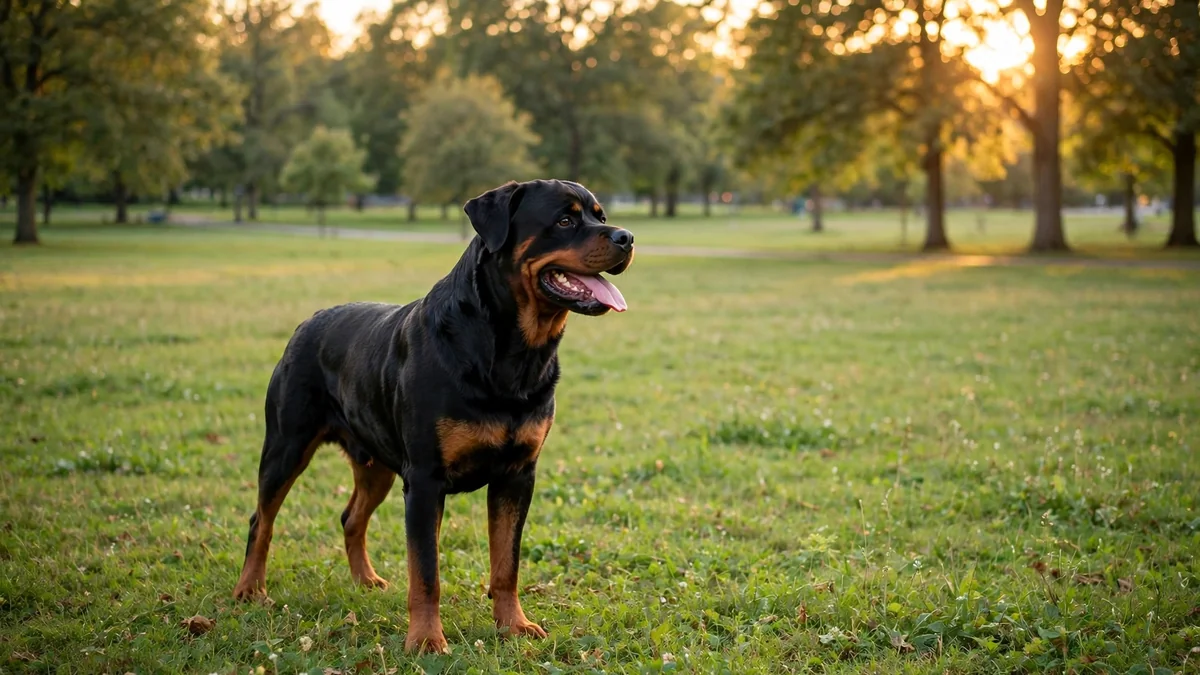

The German Rottweiler is one of the most misunderstood dogs in the world: a big, black-and-tan working dog that looks intimidating and behaves, in the right home, like a devoted and rather silly family companion. If you are thinking about bringing one home, the honest answer is that it can be a wonderful dog, but only for an owner who understands what a powerful, intelligent and protective breed actually needs.
First, a clarification that matters. A German Rottweiler is not a separate breed from any other Rottweiler. It is the same breed, bred in Germany to the standard of the German Rottweiler club, the ADRK, and often described as slightly stockier and broader-headed than dogs bred elsewhere. The temperament, the training and the care are the same either way, and this guide covers all of it.
Key takeaways
- A German Rottweiler is a Rottweiler bred in Germany, not a separate breed.
- The breed is calm, confident, loyal and protective, and reserved with strangers.
- Adults commonly weigh 80 to 135 pounds, so this is a genuinely powerful dog.
- Plan on 60 to 90 minutes of exercise and training a day, with plenty of mental work.
- Early socialisation and reward-based training are essential, not optional.
- Watch for hip and elbow dysplasia, bloat and certain cancers, and choose a breeder who health-tests.
Where the Rottweiler comes from
The Rottweiler’s story goes back a very long way. The breed descends from the drover dogs that travelled with the Roman legions, herding cattle and guarding supplies, and it takes its name from Rottweil, the German town where cattle dealers used the dogs to drive herds and guard against robbers on the road. That heritage still shapes the breed: it wants a job, it wants to be near its people, and it notices everything.
The first breed standard was written in 1901, and the American Kennel Club recognised the Rottweiler in 1931, placing it in the Working Group. The dogs still excel in obedience, tracking and other dog sports. That history is worth knowing because it explains the dog you will actually live with: strong, clever, watchful and happiest when it has something useful to do. The American Kennel Club’s Rottweiler breed page sets out the official standard and the breed’s background.
Temperament: what a Rottweiler is really like
A well-bred, well-socialised Rottweiler is calm and self-assured rather than aggressive. The breed standard describes the ideal temperament as basically calm, confident and courageous, with a natural aloofness towards strangers that should never tip into shyness or unprovoked aggression. At home with their own people, Rottweilers are famously affectionate, playful and loyal, and they have a habit of leaning against you, following you from room to room, and trying to climb into laps that are far too small for them.
With strangers, the same dog is reserved and watchful, which is the protective instinct that made the breed a guardian in the first place. That protectiveness needs managing: a Rottweiler that has not been properly socialised can become suspicious, and a dog of this size cannot afford bad manners. Children in the family are usually adored, but play should always be supervised because of the dog’s sheer weight. If you are comparing family dogs, our guide to the best cat breeds is a useful reminder that every breed has its own temperament trade-offs.
Training and socialisation: the non-negotiable part
Rottweilers are highly intelligent and among the more trainable working breeds, which is both good news and a warning. An untrained clever dog will find its own ways to stay busy, usually involving chewing, digging or barking. Short, consistent sessions of ten to fifteen minutes, built around treats, praise and play, work far better than long drilling sessions, and reward-based training is the approach that produces a confident, trusting dog.
Socialisation should start early and never really stop. Puppies need to meet many different people, dogs, places and sounds in their first months, and adult dogs need that exposure kept up, or they can become narrow in what they accept. Formal obedience classes give the dog a job to do alongside its owner, which is exactly what the breed wants. Harsh corrections damage trust and can make a strong dog defensive, so avoid them entirely. For ideas on keeping any active dog fit, our roundup of the best exercises for speed shows how structured activity builds a healthier animal.
| Trait | German Rottweiler | German Shepherd | Doberman |
|---|---|---|---|
| Size | Large, adults commonly 80 to 135 pounds | Large, lighter and leaner than a Rottweiler | Large, tall and athletic rather than bulky |
| Temperament | Calm, confident, loyal, reserved with strangers | Alert, loyal, highly trainable, watchful | Energetic, loyal, sensitive, very people-focused |
| Exercise | 60 to 90 minutes a day, plus mental work | High, needs work as well as walks | High, needs running and play every day |
| Training | Reward-based, consistent, firm and fair | Thrives on training and tasks | Responds best to gentle, consistent handling |
| Grooming | Weekly brush, moderate shedding | Heavy shedding, needs regular brushing | Minimal, short coat, low shedding |
These three breeds are often confused with each other, and they suit different owners. A Rottweiler is the calmest at home but the most physically powerful; a German Shepherd is the most driven to work; a Doberman is the most attached to its owner. All three need experienced handling, and none of them is a good first dog for someone who wants a low-effort pet.

Exercise, food and everyday care
Most guides suggest 60 to 90 minutes of exercise a day for a healthy adult Rottweiler, split across several sessions, and that is a sensible starting point. Brisk walks, hiking, swimming and structured play all count, and mental work matters just as much: puzzle toys, scent games and short training sessions stop the boredom that shows up as chewing and barking. The Kennel Club’s guidance runs higher, at over two hours a day. Puppies need far less, and it should be gentle while their joints grow.
Food should be a good-quality diet formulated for large breeds, with portions adjusted for age, weight and activity. Rottweilers put on weight easily, and extra weight is hard on their joints, so measure meals rather than leaving food down all day, and go easy on treats. Grooming is the easy part: a weekly brush, a bath when dirty, and regular nail trims and ear checks. Shedding is moderate for most of the year and heavier twice a year, usually in spring and autumn. For feeding, our guide to the best cat food brands is a reminder of how much difference a good diet makes, whatever the pet.
Health: what to watch for
Rottweilers are generally hardy dogs, but they have a shorter lifespan than many breeds, commonly around 8 to 10 years, and there are conditions every owner should know about. Hip and elbow dysplasia are the best-known problems, and a good breeder will have the parents screened and show you the results. Bloat, a dangerous twisting of the stomach, is a risk in deep-chested breeds, so feed smaller meals, avoid exercise straight after eating, and learn the warning signs.
The breed is also prone to certain cancers, including bone cancer, and to torn cruciate ligaments in the knee. None of this should put you off, but it should shape how you choose a dog: buy from a breeder who health-tests, ask direct questions about the parents, and budget for vet care. Pet insurance is worth considering, because treatment for joint or cancer problems is expensive. Regular vet check-ups, a healthy weight and sensible exercise make the biggest difference.
Is a German Rottweiler right for you?
This is the question to sit with, because the breed rewards the right owner and frustrates the wrong one. A Rottweiler suits an experienced, engaged owner with time to train, space to exercise, and the confidence to set clear rules and keep them. It suits a household that wants a loyal, watchful companion and is prepared for a dog that weighs as much as a person. It does not suit someone who works long hours away from home, lives in a small flat with no garden, or wants a dog that looks after itself.
Think honestly about your life before you fall for the puppy. Can you give the dog an hour or more of your attention every day, for the next decade, and afford the food, vet bills and insurance for a large dog? If the answers are yes, and you find a good breeder or a reputable rescue, a Rottweiler can be one of the most rewarding dogs you will ever own. If any answer is no, there is no shame in choosing a smaller or easier breed instead.
Your German Rottweiler checklist
Run through this list before you commit to the breed.
- Meet adult Rottweilers first, ideally through a breed club or a rescue, before choosing a puppy.
- Choose a breeder who health-tests the parents for hips and elbows and shows you the results.
- Plan for 60 to 90 minutes of exercise and training every day, plus mental stimulation.
- Budget for the food, vet care and insurance that a large, powerful dog needs.
- Start socialisation early and keep it going through the dog’s whole life.
- Use reward-based training in short sessions, and avoid harsh corrections entirely.
- Feed measured meals for a large breed, and keep the dog at a healthy weight.
- Make sure your home, garden and daily routine genuinely have room for a dog this size.
FAQs
Are German Rottweilers aggressive?
Not by nature. A well-bred and well-socialised Rottweiler is calm, confident and affectionate with its own family, and reserved rather than aggressive with strangers. Problems usually come from poor breeding, lack of socialisation or harsh handling, which is why the breeder you choose and the training you do matter so much.
How big does a German Rottweiler get?
Adults commonly weigh 80 to 135 pounds, with males at the heavier end and females lighter. Males stand up to 27 inches at the shoulder and females up to 25 inches. This is a large, muscular dog, and its strength is something every owner needs to respect, especially on the lead.
How much exercise does a Rottweiler need?
Most guides suggest 60 to 90 minutes a day of walks, play and training for a healthy adult, with mental work such as puzzle toys and scent games on top. The Kennel Club’s guidance is higher, at over two hours a day. Puppies need much less, and their exercise should stay gentle while they are growing.
Are Rottweilers good with children?
They can be, and many are devoted to the children in their family. The breed is loyal and protective, and usually gentle at home. Because of the dog’s size, play should always be supervised, and children should be taught to treat the dog calmly.
Do Rottweilers shed a lot?
Moderately. The short coat sheds throughout the year and more heavily twice a year, usually in spring and autumn. A weekly brush keeps it under control, and the coat itself is easy to look after, needing a bath only when the dog gets dirty.
What health problems do Rottweilers have?
The most common concerns are hip and elbow dysplasia, bloat, cruciate ligament injuries and certain cancers, including bone cancer. Choosing a breeder who health-tests the parents, keeping the dog at a healthy weight, and regular vet check-ups are the best ways to reduce the risks.
The bottom line
A German Rottweiler is a powerful, loyal and intelligent dog that asks a lot of its owner and gives a lot back. It needs training, socialisation, exercise and a confident hand, and it is not a breed for everyone. But for the right person, it is a devoted companion with a heart far softer than its reputation suggests. Choose carefully, train kindly, and you will have a friend for life.