
The capital Mogadishu is the capital and most populous city of Somalia, a historic port on the Indian Ocean coast that has traded with the wider world for well over a thousand years. Its story runs from an ancient harbour named Sarapion through sultans, colonial rule, independence and civil war, to the rebuilding of recent years. This guide sets out where the city sits, how it grew, and what still marks it out today.
Key takeaways
- Mogadishu, Somali Muqdisho and locally Xamar or Hamar, is the capital and most populous city of Somalia.
- It stands on the Indian Ocean coast in the Banaadir region, in time zone UTC plus 03:00.
- The city population is given as 3,262,129 for 2025, with an estimated urban population of 4,126,815.
- It was founded in 720 CE, on the site of the ancient port of Sarapion.
- It served as capital of the Sultanate of Mogadishu from the 9th to the 13th century.
- Its best-known places include Lido Beach, the old Hamar Weyne district and the 13th-century Fakr ad-Din Mosque.
Where Mogadishu sits
Mogadishu stands on the Indian Ocean coast of the Horn of Africa, in the Banaadir region of Somalia, at 02°02′21″N 45°20′31″E. It covers 370 square kilometres, and its time zone is UTC+03:00, East Africa Time. The sea is not a backdrop here: the city grew because of the harbour, and the port still shapes daily life, from fishing boats in the old harbour to cargo moving through the Port of Mogadishu.
| Fact | Detail |
|---|---|
| Country | Somalia |
| Region | Banaadir |
| Coast | Indian Ocean |
| Founded | 720 CE |
| Area | 370 square kilometres |
| Time zone | UTC+03:00, East Africa Time |

Population figures need a careful read, because two are in common use. The city’s population is given as 3,262,129 for 2025, while the estimated urban population is 4,126,815. The first is the city figure, the second covers the wider urban area, and neither should be quoted as exact. What is not in doubt is the scale: Mogadishu is by far the largest city in Somalia, and the centre of its politics, trade and culture. A guide to the Pyramids of Giza covers another historic African landmark, and the Wikipedia page on Mogadishu sets out the city’s geography and history in full.
A port with a very long past
Mogadishu’s history reaches back further than the city’s founding date suggests. The ancient city of Sarapion, mentioned in the first-century Periplus of the Erythraean Sea as a commercial port, is believed to be Mogadishu’s predecessor, which would put a trading harbour on this stretch of coast some two thousand years ago. Ships moving between the Red Sea, Arabia, India and the East African coast needed safe harbours, and this one, with its sheltered water and its position on the Horn, was a natural stop.
The city itself was founded in 720 CE, and by the ninth century it was the capital of the Sultanate of Mogadishu, which held that role until the thirteenth century and controlled part of the Indian Ocean gold trade. Trade was the point of the place from the start: gold, ivory, textiles and spices moved through the port, and the wealth it brought paid for mosques, houses and walls. That trading character has never really left the city, even through its hardest decades.
The city’s golden centuries
Mogadishu’s height of prosperity came in the fourteenth and fifteenth centuries, when it was described as the wealthiest city on the East African coast in the early modern period and a centre of a thriving textile industry. Cloth made in Mogadishu was traded across the Indian Ocean, and the city was known far beyond its own shores. The wealth of the period still shows in the old districts, where the historic buildings stand alongside newer ones.
Power changed hands more than once after that. The city came under the Ajuran Sultanate in the thirteenth century, then the Hiraab Imamate in the seventeenth century and the Geledi Sultanate in the nineteenth. Each left its mark, but the city stayed what it had always been: a port where goods, people and ideas met. The old Hamar Weyne district, with its narrow lanes and old stone buildings, is the part of the city where that long past is easiest to feel, and the Fakr ad-Din Mosque, built in the thirteenth century, is its oldest surviving landmark.
Colonial rule, independence and war
The twentieth century was harder. Italian colonial rule began in 1906, after treaties signed in the 1880s and 1890s, and Mogadishu became the capital of Italian Somaliland. After the Second World War came British Military Administration, then, in the 1950s, an Italian-administered United Nations Trust Territory, which prepared the country for independence. Somalia became independent in 1960, with Mogadishu as its capital, and the city grew fast as the seat of the new state.
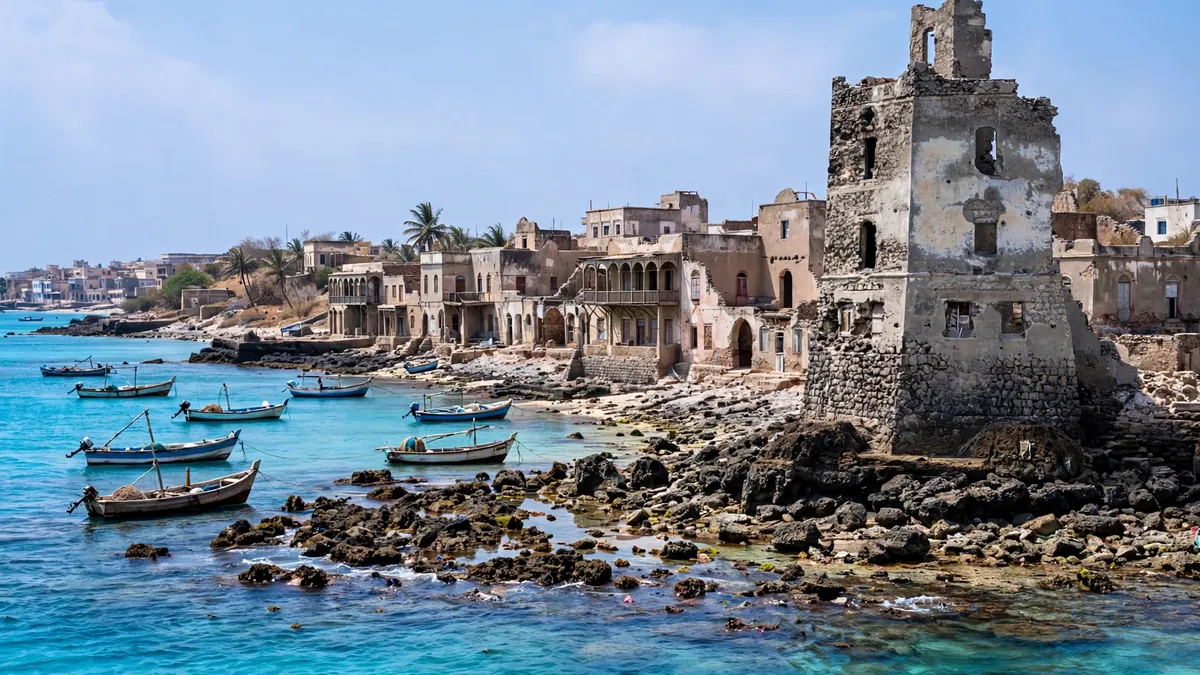
The Siad Barre era ran from 1969 to 1991, and the Somali Civil War that followed devastated the city. Buildings were ruined, the port and the airport were damaged, and large parts of the population were displaced. The ruined lighthouse tower still stands in the old harbour, over the fishing boats. Major reconstruction began in the late 2010s and into the 2020s.
What marks the city out today
For a visitor reading about the city, a few places come up again and again. Lido Beach is the city’s seafront, a long stretch of sand where fishermen work from small boats. The old Hamar Weyne district holds the historic core, including the Fakr ad-Din Mosque. Mogadishu Stadium is a landmark of the independence era, and the Port of Mogadishu remains the working heart of the city’s trade, the same role the harbour has played since the days of Sarapion.
The seafront tells the city’s story in a single view. Fishing boats work the turquoise water in front of the old harbour, the ruined lighthouse tower stands over them, and the weathered seafront buildings behind carry the marks of every era the city has lived through, from the sultanates to the rebuilding of recent years. It is a working coast rather than a postcard one, and that is what makes it worth understanding before anything else about Mogadishu.
The name itself carries a story. Mogadishu may come from the Somali Muuq and Disho, meaning sight killer or blinder, a reference to blinding beauty, the kind of name a port earns when sailors first see it from the sea. The local nickname Xamar, or Hamar, may refer to the colour red, or to red sand, and it is the name most Somalis use day to day. A guide to the best places to visit in Norway and a guide to standout destinations in Canada show how differently a place guide can be shaped, but the Mogadishu story is its own: a port city that has been trading, building and rebuilding for thirteen centuries.
Your Mogadishu checklist
- Place the city first: capital of Somalia, on the Indian Ocean coast in the Banaadir region.
- Keep the two population figures apart: 3,262,129 for the city in 2025, and 4,126,815 for the wider urban area.
- Remember the founding date, 720 CE, and the older port of Sarapion before it.
- Note the golden centuries, the 14th and 15th, when the city led the East African coast in wealth and textiles.
- Know the colonial sequence: Italian rule from 1906, British administration, then the UN Trust Territory.
- Mark independence in 1960, the Siad Barre era from 1969 to 1991, and the civil war that followed.
- Look for Lido Beach, Hamar Weyne, the Fakr ad-Din Mosque, the stadium and the port.
- Remember the name: possibly from Muuq and Disho, with Xamar as the local nickname.
What is the capital of Somalia?
Mogadishu is the capital and most populous city of Somalia. Its Somali name is Muqdisho, and it is known locally as Xamar or Hamar.
Where is Mogadishu?
It stands on the Indian Ocean coast in the Banaadir region, at 02°02′21″N 45°20′31″E, in time zone UTC+03:00, East Africa Time.
How old is Mogadishu?
The city was founded in 720 CE. Its predecessor is believed to be Sarapion, a commercial port mentioned in the first-century Periplus of the Erythraean Sea.
How big is Mogadishu?
It covers 370 square kilometres. The city population is given as 3,262,129 for 2025, with an estimated urban population of 4,126,815, so the figure depends on which measure is used.
What is Mogadishu known for?
It is known as a historic Indian Ocean port and trading hub, and for Lido Beach, the old Hamar Weyne district, the 13th-century Fakr ad-Din Mosque, Mogadishu Stadium and the Port of Mogadishu.
When did Somalia become independent?
Somalia became independent in 1960, with Mogadishu as its capital, after Italian colonial rule, British Military Administration and an Italian-administered UN Trust Territory in the 1950s.
The bottom line
Mogadishu is far more than a name on a map of the Horn of Africa. It is a port city founded in 720 CE, on the site of an older harbour, that grew rich on Indian Ocean trade, served as a sultan’s capital, survived colonial rule and civil war, and is now rebuilding. Its harbour, its old district and its mosque carry that long story in stone, and they are the reason the city still matters.
Anyone planning a visit should check current official travel advice for Somalia before booking anything, as conditions and guidance change.