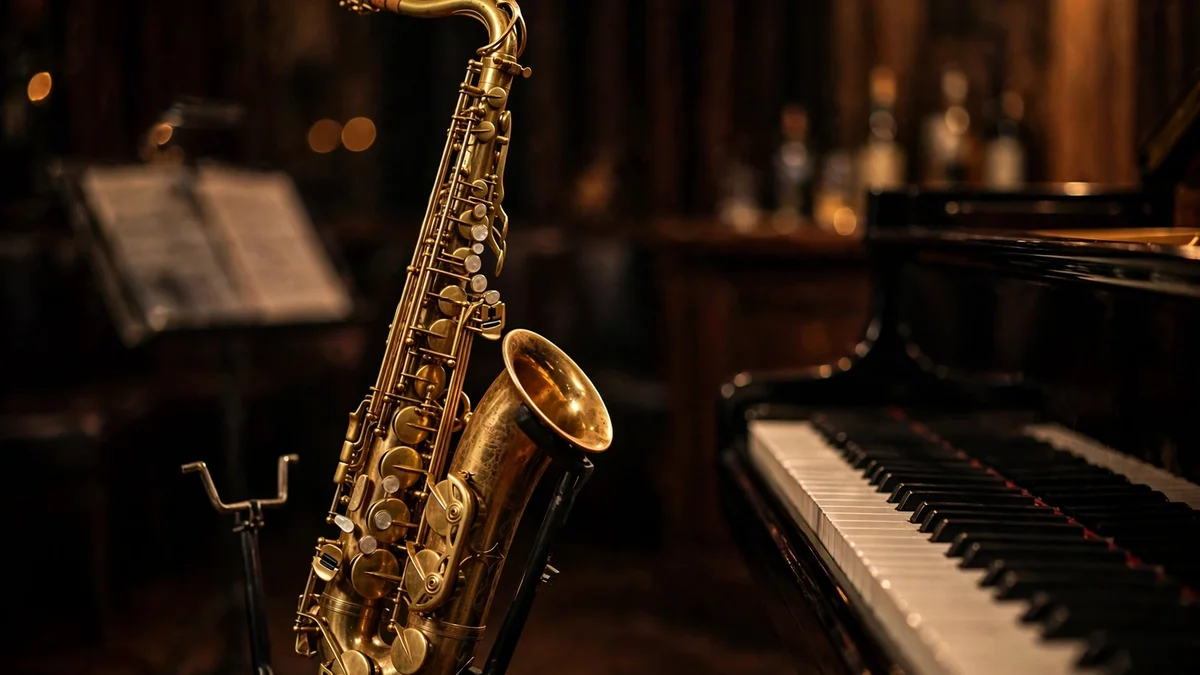

A tenor saxophone is a medium-sized member of the saxophone family, pitched in B flat, and it is the warm, rich voice you hear carrying the melody in countless jazz recordings. If you have ever wondered what makes that deep, singing sound so different from the brighter alto, the answer lies in the tenor’s larger body and lower pitch. This guide explains what a tenor saxophone is, how it came to be, who made it famous, and what to know if you want to learn or buy one.
Key takeaways
- A tenor saxophone is pitched in B flat and sounds an octave and a major second lower than written.
- Adolphe Sax patented the saxophone family in 1846, designing it to bridge woodwind and brass in military bands.
- The tenor became a leading jazz voice in the 1930s, above all through Coleman Hawkins.
- Its sound is warm, full and flexible, from a soft whisper to a powerful, room-filling roar.
- Learning takes steady daily practice, a good teacher and patience with tone and breathing.
- Before buying, try the instrument, check the pads and keys, and consider renting first.
What a tenor saxophone is
The tenor saxophone is one of the most commonly played members of the saxophone family, alongside the alto. Like all saxophones, it is made from a conical tube of thin brass, bent into its familiar curved shape, with a single reed fitted to a mouthpiece. The player blows across the reed, which vibrates and sets the air inside the tube moving, while the fingers open and close keys to change the pitch. The tenor saxophone is described on Wikipedia as a transposing instrument in B flat: the note that comes out sounds an octave and a major second below the written pitch.
Compared with the alto, the tenor is noticeably bigger and heavier, with a larger mouthpiece, a bigger reed and a wider ligature, the metal band that holds the reed in place. You can tell a tenor from an alto at a glance by the crook in its neck. That extra length gives the tenor its deeper voice, and modern tenors with a high F sharp key have a concert range from A flat 2 to E 5, exactly one octave below the soprano.
The tenor appears in many kinds of music, from concert bands and big band jazz to rhythm and blues, rock and pop, where its punchy sound cuts through guitars and drums.
A short history of the tenor saxophone
The story starts with Adolphe Sax, a Belgian-born instrument maker, flautist and clarinettist working in Paris in the 1840s. Sax wanted an instrument that could link the woodwind and brass sections of military bands, combining the agility of a woodwind with the power of brass. Drawing on ideas from the clarinet, flute, oboe and ophicleide, he designed a family of fourteen saxophones, and his patent was granted on 28 June 1846.
At first, the saxophone’s home was exactly where Sax intended it: the military band. Its great moment came with jazz. In the 1930s, Coleman Hawkins lifted the tenor from its supporting role and showed it could carry a melody with as much expression as any singer. The clarinet had once been the star reed instrument of early jazz, and the guide to the clarinet shows how that older woodwind cousin shaped the music the saxophone would later transform.
From Hawkins onwards, the tenor passed through players who each remade its sound. Lester Young played it light and floating, John Coltrane pushed it into searching, intense sheets of sound, Stan Getz gave it a cool, lyrical smoothness, Sonny Rollins a swaggering rhythmic drive, and Dexter Gordon a big, warm tone that filled a room without effort.
The sound and range of the tenor saxophone
People often describe the tenor’s sound as warm, husky or human, and the comparison is fair: of all the saxophones, the tenor sits closest to the range of the human voice, which is one reason it suits ballads so well. At low volume it can murmur and sigh, while at full volume it has a bold, brassy edge. Players shape the tone with their embouchure, with breath support from the diaphragm, and with the choice of reed and mouthpiece.
The standard written range covers about two and a half octaves, and skilled players extend it higher using altissimo fingerings, a technique especially common in jazz solos. Because the tenor is a transposing instrument, a player reading a written C will actually produce a B flat below middle C, so the music must be written a major ninth higher for the tenor part than the concert pitch. Listening shows the range best: a slow ballad lets the tenor bend notes, while a fast big band number makes it bark out short phrases.
Tenor saxophone compared with other saxophones
The saxophone family has four sizes that most people meet, and the table below sets out how the tenor fits among them.
| Saxophone | Pitched in | Size and weight | Sound | Common role |
|---|---|---|---|---|
| Soprano | B flat | Smallest, lightest, straight body | Bright, sweet, sometimes piercing | Jazz solos, classical pieces |
| Alto | E flat | Medium, curved body | Clear, bright, agile | School bands, jazz, classical |
| Tenor | B flat | Large, heavier, crooked neck | Warm, rich, full | Jazz lead, big bands, rock and pop |
| Baritone | E flat | Largest of the four, very heavy | Deep, powerful, growling | Big band bass lines, jazz |

Famous tenor saxophone players
Coleman Hawkins is the natural starting point. His 1939 recording of Body and Soul is often named as one of the great jazz performances, a flowing improvisation that barely states the melody and yet holds the listener throughout. Hawkins showed that the tenor could be a serious solo instrument, and every tenor player since has measured themselves against him in some way.
Lester Young took the opposite path, playing with a light, airy tone and a relaxed sense of time. John Coltrane began in a hard, bluesy style and moved towards long, searching improvisations. Sonny Rollins, famous for practising alone on the Williamsburg Bridge in New York, brought a playful, rhythmic inventiveness to his solos. Stan Getz, known as The Sound for his smooth tone, helped bring Brazilian bossa nova to a worldwide audience, while Dexter Gordon and Wayne Shorter complete a list any new listener can explore for months. Hearing these players is the best education a beginner can get, and many listeners plan evenings around it: a candlelight concert is one atmospheric way to hear woodwind and strings up close, while travellers who want to hear live music abroad often start with a destination guide, such as the guide to the best places to visit in Norway.
Learning the tenor saxophone
Learning the tenor is rewarding, but it asks for patience in the first months. The instrument is heavier than the alto, so a comfortable neck strap and a relaxed posture matter from the start, and younger or smaller players sometimes begin on the alto. The first weeks are mostly about sound: getting a steady tone, learning to breathe from the diaphragm, and building the embouchure so the reed speaks cleanly instead of squeaking.
A good teacher makes a large difference, spotting a tight embouchure, a poor breathing habit or a fingering problem before it becomes fixed, and setting a practice routine that balances long tones, scales and simple tunes. Most teachers suggest twenty to thirty minutes a day, five or six days a week, rather than one long weekly session. Reeds are a running cost: a reed that is too hard will feel like blowing through a wall, while one that is too soft will sound thin, so start soft and move up gradually. Joining a band, even a casual community band, is the point at which practice turns into music, teaching timing, listening and blending in a way solo practice cannot.
Buying a tenor saxophone
Before buying, decide whether to rent or own. Renting is the sensible first step for a beginner, especially a child who may grow or lose interest, because it keeps the first cost low and usually includes maintenance. A used instrument from a reputable shop can be excellent value, since a well-made saxophone lasts for decades, but it should be checked by a technician before money changes hands.
When trying an instrument, play every note from the bottom to the top and listen for notes that do not speak or sound stuffy, which can point to leaking pads. Press each key and feel whether the action is smooth and even, with no wobble or sticking, and check that the pads sit flat and seal cleanly. Look for dents, especially around the bow at the bottom, and make sure the neck fits snugly. Budget for the extras too: a sturdy case, a neck strap, reeds, a cleaning swab and cork grease are all needed from day one, and a yearly service keeps the pads and mechanism in good order.
Your tenor saxophone checklist
- Know the basics: the tenor is pitched in B flat and sounds an octave and a major second below written pitch.
- Remember the history: Adolphe Sax patented the family in 1846 for military bands, and jazz made the tenor famous.
- Listen to the greats: Hawkins, Lester Young, Coltrane, Rollins, Getz, Gordon and Shorter.
- Sort out the essentials: a comfortable neck strap, soft reeds to start, and a swab for cleaning.
- Practise little and often: twenty to thirty minutes a day beats one long weekly session.
- Find a teacher and, when ready, join a band to learn timing and listening.
- Before buying, test every note, check the pads and keys, and consider renting first.
Is the tenor saxophone harder to play than the alto?
It is heavier and needs more air, so it can feel harder at first. The fingerings match the alto, though, so a player who learns one can move to the other without relearning the keys.
What is the tenor saxophone range?
The standard written range covers about two and a half octaves. On a modern tenor with a high F sharp key, the concert range runs from A flat 2 to E 5, and skilled players extend higher with altissimo fingerings.
Why is the tenor saxophone pitched in B flat?
Adolphe Sax designed the family in alternating B flat and E flat sizes to fit the brass and woodwind of military bands. The tenor took the B flat place, one octave below the B flat soprano.
How much practice does a beginner need?
Short, regular practice works best: around twenty to thirty minutes a day, five or six days a week. That builds embouchure strength and breath control steadily.
Should a beginner rent or buy a tenor saxophone?
Renting is usually wiser first, since it keeps the first cost low and often includes maintenance. A used instrument from a reputable shop, checked by a technician, can be excellent value.
What reeds should a tenor beginner use?
Start with a soft reed, usually strength 1.5 or 2, and move up gradually as your embouchure strengthens. A reed that is too hard makes the instrument feel blocked, while a soft reed speaks easily.
The bottom line
The tenor saxophone is the warm, singing voice of the saxophone family: a B flat instrument with a history that runs from Adolphe Sax’s 1846 patent and the military band to the jazz stage, where Hawkins, Coltrane, Rollins and Getz made it one of the most expressive sounds in music. It rewards steady practice with a tone that can whisper or roar. Whether you want to listen, learn or buy, start by hearing the great players, try the instrument in your hands before committing, and give yourself time.