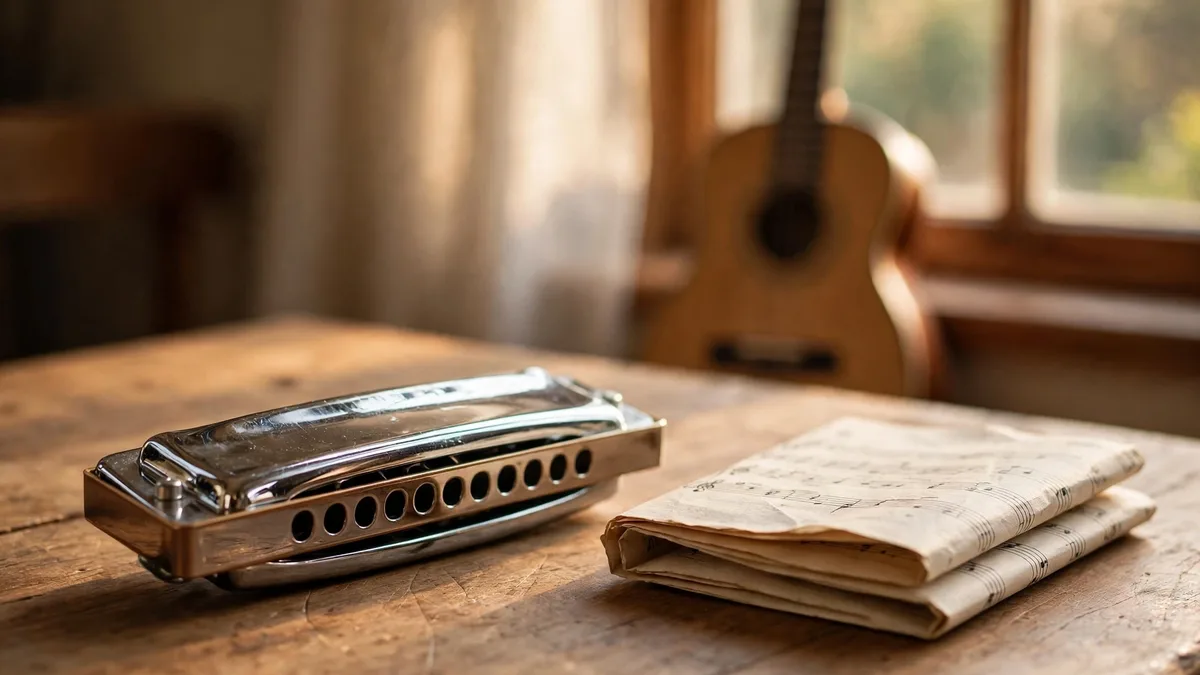

The harmonica is one of the smallest instruments in the world, yet it can carry a whole tune on its own, from a lonesome blues wail to a bright folk melody. The question most beginners ask is simple: which type should you buy, and how hard is it to learn? The short answer is to start with a diatonic harmonica in the key of C, learn to play clean single notes, and practise a little every day. Within weeks, most beginners can play simple tunes, and the instrument costs little, fits in a pocket and needs no tuning or mains power.
Also known as the mouth organ, the harmonica is a free reed wind instrument: you play it by blowing air out and drawing air in through a row of holes, and each hole holds reeds that vibrate to make a note. The Wikipedia page on the harmonica traces its history from early nineteenth-century Europe to its place in blues, folk, country and rock. The instrument’s appeal has always been its size and its voice: it is portable, immediate, and capable of great expression in skilled hands.
Key takeaways
- The harmonica is a free reed wind instrument played by blowing and drawing air.
- A diatonic harmonica in the key of C is the best choice for most beginners.
- Each hole gives a different note when you blow and when you draw.
- Clean single notes come first; bending notes comes later.
- Short daily practice beats occasional long sessions.
- Keep the harmonica dry, tap out moisture after playing, and store it in its case.
How a harmonica works
Inside every harmonica is a set of thin metal reeds, fixed at one end and free to vibrate at the other. When you blow into a hole, air passes over one reed and makes it vibrate; when you draw air in through the same hole, a second reed sounds instead. That is why each hole gives two different notes, one on the blow and one on the draw, and why the instrument can produce a full scale across its ten holes.
The player shapes the sound with the mouth, the hands and the breath. Cupping the hands around the instrument creates a small chamber that can be opened and closed for a wah-wah effect, while the tongue and throat shape the tone of each note. Breathing is the heart of the technique: the harmonica is played with the diaphragm, not with the cheeks, and a relaxed, steady airflow gives a fuller sound than a forced blast.
The main types of harmonica compared
The diatonic harmonica is the most common type and the one most people picture when they think of the instrument. It has ten holes, it is built to play in one key, and it is the harmonica of the blues, folk and country traditions. Its limitation is also its charm: it cannot play every note of the chromatic scale without a technique called bending, in which the player changes the shape of the mouth to lower the pitch of a draw note. Bending is what gives blues harmonica its crying, vocal quality.
The chromatic harmonica is larger, with a button on the side that slides a bar across the reeds to give every note of the scale. It is the instrument of jazz and classical players, and of Stevie Wonder, whose chromatic playing is famous for its fluency. Tremolo harmonicas have two reeds per note tuned slightly apart, which creates a shimmering sound popular in folk music. Octave harmonicas pair reeds an octave apart for a fuller sound, while chord and bass harmonicas are large instruments used in harmonica ensembles.
| Type | Holes | Sound | Best for |
|---|---|---|---|
| Diatonic | 10 | Bright and bluesy | Beginners, blues, folk, rock |
| Chromatic | 12 or 16 | Smooth and complete | Jazz, classical, melodies |
| Tremolo | Often 24 | Shimmering and wavering | Folk tunes, Asian folk music |
| Octave | Often 20 | Full and rich | Folk melodies, ensembles |
| Chord | Many | Full chords | Harmonica orchestras |
| Bass | Many | Deep and low | Ensembles, accompaniment |

A short history of the harmonica
The harmonica emerged in Europe in the early nineteenth century, when makers began experimenting with free reeds. Christian Friedrich Ludwig Buschmann, a young German instrument maker, is often credited with an early version in 1821, and other makers in Vienna and Bohemia soon followed. The instrument spread quickly because it was cheap, portable and easy to learn, and it travelled with migrants across Europe and to North America, where it found a home in folk music. Mass production began in Trossingen, Germany, where Matthias Hohner started making harmonicas in the 1850s, and the instrument soon became a staple of American blues, folk and country music.
How to choose your first harmonica
For a first instrument, a diatonic harmonica in the key of C is the standard recommendation, and for good reason. Most beginner books, lessons and online tutorials are written for a C harmonica, and the key of C sits comfortably in the middle of the range. Buying a cheap novelty instrument is a false economy: a harmonica that leaks air or has reeds that stick will frustrate a beginner and sound poor no matter how well it is played. A modest, well-made instrument from an established maker is the right starting point.
Look at the comb, the central part of the instrument. Plastic combs are durable, airtight and easy to clean, and they suit beginners well. Wooden combs give a warmer tone but can swell if they are not looked after, while metal combs are sturdy and bright. The covers should feel solid and sit flush against the comb, with no sharp edges.
One harmonica is enough to start, but players who continue often add more keys. Blues players commonly carry several diatonics, because each key suits different songs and different singers. A chromatic harmonica is a later step for most learners, once the basics of breathing, single notes and rhythm are secure. If you play other wind instruments, our guide to the clarinet shows how a different reed instrument is learned, and the habits of regular practice transfer well.
Learning to play: first steps
Start by holding the harmonica correctly, with the low notes on the left and the high notes on the right, and the numbers on top facing you. Cup it in both hands, with the left hand holding the instrument and the right hand forming a cup around the back. Bring it to your mouth, rest your lips on the holes, and breathe gently through it. The first goal is a clean single note: narrow your lips to cover one hole, blow softly, and listen for a clear tone.
Once single notes are clean, learn a simple scale. On a C diatonic, blowing and drawing across holes four to seven gives the notes of the C major scale, and this is the pattern behind many simple tunes. Practise the scale slowly, then try a melody you know well, such as a nursery rhyme or a folk song, picking out the notes by ear.
Rhythm matters as much as notes. Tap your foot as you play, keep the tempo steady, and practise with a simple backing track or a metronome once you are comfortable. Bending notes, the technique that lowers a draw note, is the next milestone, and it takes patience: it is a matter of changing the shape of the mouth and throat, and most players need weeks of practice before it clicks. Listening helps enormously, and our guide to candlelight concerts is a reminder of how live music, heard up close, can inspire practice. The harmonica also appears in film music, and our guide to Song Sung Blue showtimes covers a film where music sits at the centre of the story.
Looking after your harmonica
A harmonica is a simple instrument, but it needs a little care. Moisture from your breath collects inside it as you play, so tap the instrument gently against your palm after a session, holes down, to clear the water, and let it dry before you put it back in its case. Never run water through it or soak it, unless the maker says otherwise, because water can swell a wooden comb and damage the reeds. A soft cloth is enough for the outside.
Do not lend your harmonica to others, and do not share one, because the instrument sits in the mouth and collects saliva. If it needs cleaning, follow the maker’s instructions, which usually mean wiping the covers and letting the inside dry. Store it in its case, away from heat and dust, and keep it out of a hot car, where the reeds and comb can be damaged.
A checklist for starting the harmonica
- Buy a diatonic harmonica in the key of C from an established maker.
- Check the comb and covers: solid, smooth, airtight and comfortable to hold.
- Hold it with low notes on the left, numbers on top, cupped in both hands.
- Learn clean single notes first, one hole at a time, blow and draw.
- Practise the C major scale across holes four to seven.
- Play simple tunes by ear, keeping a steady rhythm and tapping your foot.
- Practise a little every day rather than in occasional long sessions.
- Tap out moisture after playing, let it dry, and store it in its case.
Frequently asked questions
Is the harmonica hard to learn?
No, the harmonica is one of the easiest instruments to start. Most beginners can play clean single notes and simple tunes within a few weeks of regular practice. Advanced techniques such as bending notes take longer, but the basics are accessible to almost anyone.
Which harmonica should a beginner buy?
A diatonic harmonica in the key of C is the standard choice for beginners. Most lessons and tutorials are written for it, and it suits folk, blues and rock. Buy a well-made instrument from an established maker rather than a cheap novelty one, which will leak air and frustrate practice.
What is the difference between a diatonic and a chromatic harmonica?
A diatonic harmonica is built to play in one key and has ten holes, while a chromatic harmonica has a button that slides a bar across the reeds to give every note of the scale. Diatonics suit blues and folk; chromatics suit jazz, classical music and complex melodies.
What does bending a note mean?
Bending is a technique on the diatonic harmonica in which the player changes the shape of the mouth and throat to lower the pitch of a draw note. It produces the crying, vocal sound heard in blues harmonica, and it takes weeks of practice to learn.
Can you play the harmonica and guitar at the same time?
Yes. Many players use a harmonica rack, a frame worn around the neck that holds the harmonica in front of the mouth, leaving the hands free for the guitar. Bob Dylan and Neil Young both made this a familiar sight on stage.
How do I clean my harmonica?
Tap it gently against your palm after playing, holes down, to clear moisture, and let it dry before storing it in its case. Wipe the outside with a soft cloth. Do not run water through it or soak it unless the maker says otherwise, and do not share your harmonica with others.
The bottom line
The harmonica is a small instrument with an outsized voice, and it is one of the most rewarding places to start making music. Choose a diatonic in the key of C, learn clean single notes, practise a little every day, and let your ear guide you to simple tunes. Bending notes and new keys can come later; the first joy of the harmonica is how quickly it sings. Keep it dry, keep it in its case, and keep it within reach, because an instrument that fits in a pocket gets played far more than one in a cupboard.