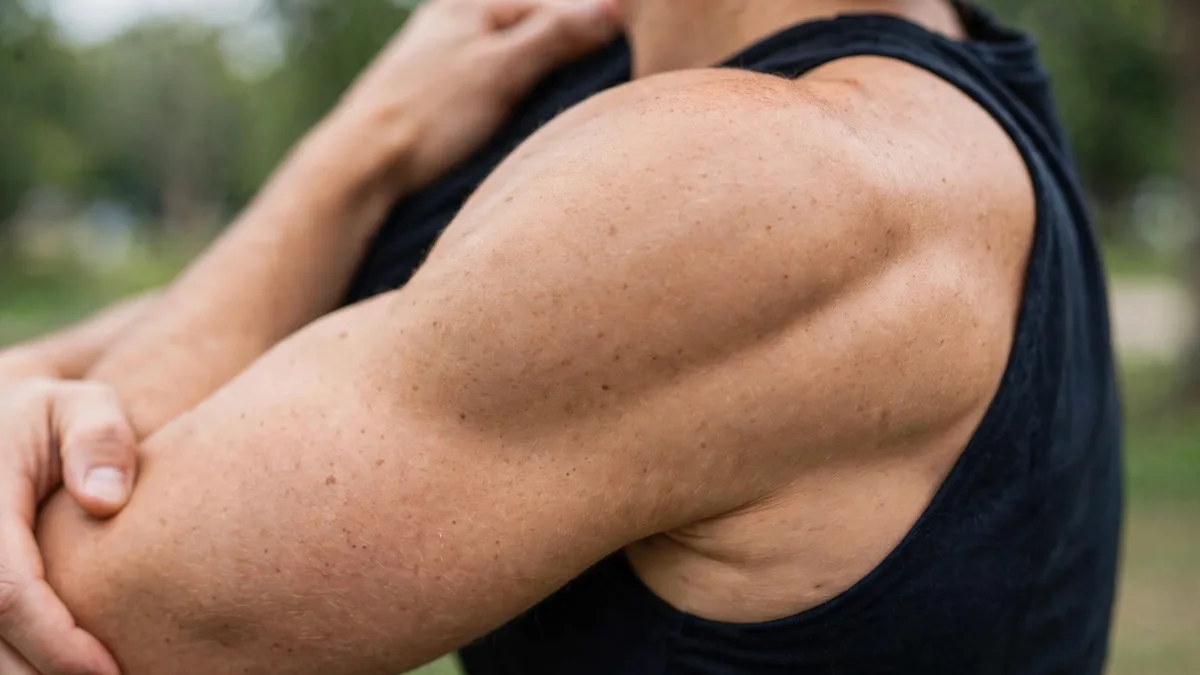

The deltoid muscle is the triangular muscle that forms the rounded contour of the human shoulder, and the question most people ask about it is a simple one: what does it actually do? The short answer is that the deltoid lifts the arm away from the body, helps raise it forwards and backwards, and holds the top of the arm bone steady in its socket while the arm moves.
Most people meet the deltoid in the gym, where it is often called the delt, or in an anatomy book, where it is drawn as a neat cap over the shoulder joint. It is one of the most visible muscles in the body, yet its job is more subtle than its outline suggests, because it works in three parts that pull in different directions.
Key takeaways
- The deltoid muscle forms the rounded shape of the shoulder and is named after the Greek letter delta.
- It has three parts: anterior, intermediate and posterior, each with its own starting point.
- Its main job is lifting the arm away from the body, with help from the rotator cuff muscles.
- It attaches to the deltoid tuberosity, a roughened patch halfway down the upper arm bone.
- The axillary nerve carries the signals that make the deltoid contract.
- Everyday actions such as reaching, carrying and waving all rely on the deltoid.
What the deltoid muscle is
The deltoid is a thick, triangular muscle that wraps around the shoulder joint like a cap. Its name comes from its shape: it resembles the Greek capital letter delta, a triangle, and early anatomists named it for that resemblance. It sits on the outside of the shoulder, covering the top of the humerus, the long bone of the upper arm, and the muscles beneath it. When you look at a shoulder from the side, the smooth curve you see is mostly deltoid.
The muscle is larger than many people expect. A study of thirty shoulders found an average deltoid mass of 192 grams, with a range from 84 grams to 366 grams. The Wikipedia page on the deltoid muscle sets out its anatomy in full, including the nerves and blood vessels that supply it.
Underneath the deltoid lie several structures it protects and works alongside: the humerus itself, the rotator cuff muscles, the shoulder joint, and the axillary nerve.
The three parts of the deltoid
Although the deltoid looks like a single muscle from the outside, anatomists describe it as three sets of fibres with different starting points. The anterior, or clavicular, part arises from the front edge and upper surface of the outer third of the collarbone. The intermediate, or acromial, part arises from the top of the acromion, the bony point at the tip of the shoulder blade. The posterior, or spinal, part arises from the lower edge of the ridge along the back of the shoulder blade.
All three sets of fibres converge as they run downwards and meet at a single insertion: the deltoid tuberosity, a roughened area on the middle of the outer side of the humerus. The intermediate fibres run almost straight down, while the front fibres run backwards and outwards and the back fibres run forwards and outwards. This fan-like arrangement is what lets one muscle pull the arm in several directions.
Electromyography suggests the picture is more detailed still: at least seven groups of fibres can be coordinated independently, three in the front part, one in the middle and three in the back. For everyday purposes, though, the three-part model is the one worth remembering.
What the deltoid does
When all of its fibres contract together, the deltoid is the prime mover of arm abduction, the movement that lifts the arm sideways away from the body in the frontal plane. It works best when the arm is turned slightly inwards. This is the movement you use when you raise your arm to wave, reach for a high shelf from the side, or lift a bag away from your leg. Our guide to the best exercises for speed looks at training that also depends on strong, well-coordinated shoulders.
Each part of the deltoid has its own main job. The front fibres help the chest muscle to flex the shoulder, swinging the arm forwards, and they also help turn the arm inwards. The middle fibres perform basic abduction, lifting the arm out to the side, and they also help with sideways movement when the arm is turned outwards. The back fibres help the large back muscle, the latissimus dorsi, to extend the shoulder, swinging the arm backwards, and they work with the infraspinatus and teres minor to turn the arm outwards.
The deltoid has another important job that is easy to overlook: it helps keep the head of the humerus in place. When you carry a heavy load, the deltoid helps prevent the ball of the shoulder joint from slipping downwards out of its socket.
The three parts compared
| Part | Where it starts | Main job |
|---|---|---|
| Anterior | Outer third of the collarbone | Swings the arm forwards and turns it inwards |
| Intermediate | Top of the acromion of the shoulder blade | Lifts the arm out to the side |
| Posterior | Ridge along the back of the shoulder blade | Swings the arm backwards and turns it outwards |

How the deltoid works with the shoulder
The deltoid never works alone. The shoulder is the most mobile joint in the body, and that mobility comes at a price: the socket is shallow, and the ball of the humerus needs active support from the surrounding muscles. The rotator cuff, a group of four smaller muscles, plays a key role here. As the deltoid contracts to lift the arm, the infraspinatus and subscapularis contract at the same time to hold the head of the humerus down, stopping it from pressing upwards against the underside of the acromion and squeezing the supraspinatus tendon.
The balance between the deltoid pulling up and the rotator cuff holding down is delicate, and it is one reason shoulder movement rewards smooth, controlled action rather than jerky effort. A good water bottle is a small but useful companion for the kind of steady training that keeps shoulders working well.
The nerve supply of the deltoid is the axillary nerve, which comes from the fifth and sixth cervical nerves through the brachial plexus. The nerve winds around the surgical neck of the humerus, close to the muscle, which is why intramuscular injections are usually given in the lower half of the deltoid, to keep clear of it. Its blood supply comes mainly from the thoracoacromial and circumflex humeral arteries.
Everyday movements that use the deltoid
You use your deltoids far more often than you might think. Reaching up to a cupboard, lifting a child, carrying shopping bags, hanging washing on a line, waving to a friend, putting on a coat: all of these ask the deltoid to lift, steady or guide the arm. Because the muscle works through such a wide range, it is involved in almost every overhead task, from changing a light bulb to serving a tennis ball.
The deltoid is also essential for precise hand and arm work. Its contraction helps position the hand exactly where it needs to be, whether you are writing on a whiteboard, reaching across a table, or threading a needle at arm’s length.
People who work with their arms overhead, such as painters, electricians and warehouse staff, place heavy demands on the deltoid through the working day. So do swimmers, climbers and anyone who lifts weights. Regular rest, varied movement and attention to posture all help the muscle recover between bouts of effort, and a quiet start to the day, perhaps with a cup of medium ground coffee, helps before physical work begins.
A checklist for understanding the deltoid
- Picture the deltoid as a triangular cap over the shoulder joint, named after the Greek letter delta.
- Learn its three parts: anterior from the collarbone, intermediate from the acromion, posterior from the shoulder blade ridge.
- Remember its single insertion: the deltoid tuberosity halfway down the upper arm bone.
- Know its main job: lifting the arm away from the body, with the front part swinging it forwards and the back part swinging it backwards.
- Remember the axillary nerve, which carries the signals that make the deltoid contract.
- Note that the rotator cuff works with the deltoid to keep the shoulder joint steady.
- Notice the deltoid in everyday life: reaching, carrying, waving and lifting all use it.
- Think of the deltoid as a stabiliser as well as a mover: it helps hold the arm bone in its socket.
Frequently asked questions
What is the deltoid muscle?
The deltoid muscle is the triangular muscle that forms the rounded shape of the shoulder. It covers the shoulder joint, starts from the collarbone, the acromion and the ridge of the shoulder blade, and attaches to the deltoid tuberosity on the upper arm bone. Its main job is lifting the arm away from the body.
Why is it called the deltoid?
It is called the deltoid because its shape resembles the Greek capital letter delta, which is a triangle. Early anatomists named it for that resemblance, and the name has stuck. In everyday speech it is often shortened to the delt, especially in gyms and sports settings.
What are the three parts of the deltoid?
The three parts are the anterior or clavicular part, the intermediate or acromial part, and the posterior or scapular part. The anterior part starts from the collarbone, the intermediate part from the top of the acromion, and the posterior part from the ridge along the back of the shoulder blade. Each part pulls the arm in a different direction.
Which nerve controls the deltoid?
The deltoid is controlled by the axillary nerve, which comes from the fifth and sixth cervical nerves through the brachial plexus. The nerve winds around the surgical neck of the humerus, close to the muscle. Damage to this nerve can weaken the deltoid and reduce the ability to lift the arm sideways.
What movement does the deltoid perform?
When all its fibres work together, the deltoid lifts the arm sideways away from the body. Its front fibres also swing the arm forwards and turn it inwards, while its back fibres swing the arm backwards and turn it outwards. It also helps hold the head of the arm bone in the shoulder socket when carrying heavy loads.
Where does the deltoid attach?
The deltoid attaches to the deltoid tuberosity, a roughened patch on the middle of the outer side of the humerus, the long bone of the upper arm. All three sets of fibres converge towards this single insertion, with the intermediate fibres running almost straight down and the front and back fibres running at an angle.
The bottom line
The deltoid muscle is the triangular cap that gives the shoulder its rounded shape and does much of the work of moving the arm. Its three parts start from the collarbone, the acromion and the shoulder blade, meet at the deltoid tuberosity of the humerus, and are driven by the axillary nerve. Together they lift the arm sideways, swing it forwards and backwards, and help hold the shoulder joint steady.
This article is general information only and is not medical advice. It describes the anatomy of the deltoid muscle for general interest. If you have shoulder pain, weakness or an injury, or you are considering treatment or exercise for a shoulder problem, speak to a qualified healthcare professional.