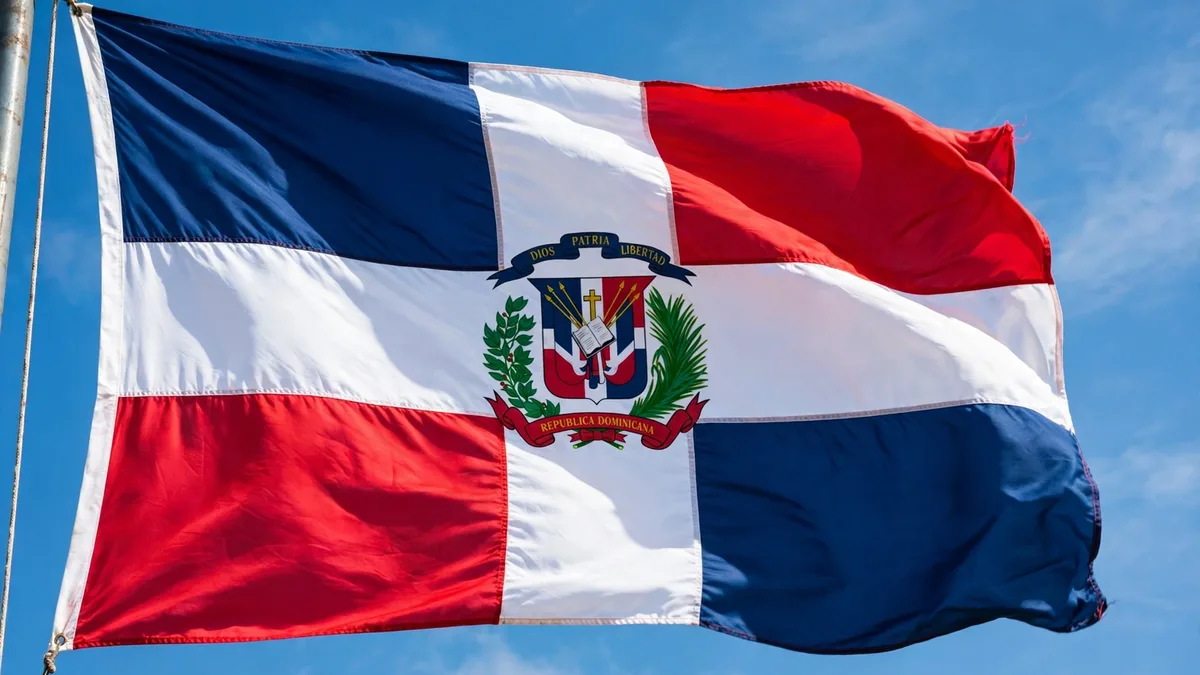

The Dominican flag is one of the most distinctive national flags in the Caribbean, and the question most people ask when they first look at it is simple: what do its colours and its central emblem actually mean? The short answer is that a white cross divides the flag into blue and red quarters, blue stands for liberty, white for salvation, red for the blood of heroes, and the coat of arms at the centre carries an open Bible, a cross and the motto God, Fatherland, Liberty.
The flag belongs to the Dominican Republic, the Spanish-speaking nation that shares the island of Hispaniola with Haiti. It is one of the country’s three official national symbols, alongside the coat of arms and the national anthem, and it is flown with pride on public buildings, at schools and on national holidays.
Key takeaways
- The Dominican flag has a white cross dividing four quarters of blue and red.
- Blue stands for liberty, white for salvation, and red for the blood of heroes.
- It was designed by Juan Pablo Duarte and first hoisted on 28 February 1844.
- The coat of arms at the centre shows an open Bible, a cross and the national motto.
- The civil flag uses the same design without the coat of arms.
- Flag Day is celebrated on 27 February, the anniversary of independence.
What the Dominican flag looks like
The flag is a rectangle in the proportion of two to three, divided by a white cross that runs the full width and height. The cross creates four quarters: blue at the top beside the flagpole and at the bottom on the flying edge, red in the other two positions.
At the centre of the cross sits the national coat of arms. It shows a shield with a Bible open above a cross, flanked by a laurel branch on one side and a palm frond on the other, with a ribbon below reading República Dominicana and the motto Dios, Patria, Libertad, God, Fatherland, Liberty, above. The Wikipedia page on the flag of the Dominican Republic gives the full description from Article 31 of the Dominican Constitution, including the exact shades: ultramarine blue and vermillion red.
There are two versions of the flag in use. The state flag, which is also the war flag and the state and naval ensign, carries the coat of arms at its centre. The civil flag, flown by ordinary citizens and merchant ships, follows the same design but without the coat of arms.
What the colours mean
Each colour on the Dominican flag carries a meaning that dates back to the independence movement. The blue stands for liberty, the freedom the country’s founders fought for. The white of the cross stands for salvation, and also for the peace and unity of the Dominican people. The red stands for the blood shed by the patriots who struggled for the country’s freedom.
These meanings were set out by the flag’s designer and have been repeated in Dominican civic life ever since. The colours also carry a practical lesson for anyone trying to draw or reproduce the flag: the blue is a deep ultramarine, not a sky blue, and the red is a strong vermillion.
The history of the Dominican flag
The flag was designed by Juan Pablo Duarte, the founder of the secret society La Trinitaria and the figure remembered as the Father of the Nation. It was first hoisted on 28 February 1844, the day after the Dominican War of Independence began and the First Dominican Republic was proclaimed. The first flags were sewn by hand by María Trinidad Sánchez, Concepción Bona, Isabel Sosa and María de Jesús Pina.
The original design had a centred white cross over a blue stripe on top and a red stripe on the bottom, echoing the French regimental flags and the flag of Haiti, from which the Dominican Republic had just broken away.
The flag was set aside during the four-year annexation by Spain from 1861 to 1865, when the Spanish flag flew instead. With the restoration of independence, the flag returned with the coat of arms at its centre and the blue and red quarters on the flying side flipped, creating the alternating pattern seen today. The current form was adopted on 6 November 1863.
How the flag is used today
The use of the Dominican flag is regulated by Law 210-19, which governs the country’s national symbols. The law sets out rules that will be familiar from flag etiquette in many countries, with a few Dominican details. The flag must never touch the ground, must not be displayed torn, damaged or dirty, and must be flown every weekday on all official state buildings and offices, from sunrise to sunset.
Every Dominican has a duty to display the flag on national holidays, including 27 February, Independence Day, and 16 August, Restoration Day. When it is hung horizontally on a wall, the blue quarter at the top beside the flagpole must be on the observer’s left, and the same rule applies when it is flown vertically.
On days of national mourning the flag is first raised to the top of the pole and then lowered to half-mast. The coffins of members of the armed forces and high-ranking public officials are covered with the national flag. A day at the beach with a good water bottle and a picnic is a far lighter way to enjoy the colours, and our guide to the best picnic recipes has ideas for an outdoor meal under a Caribbean sky.
The Dominican flag and other flags
| Flag | Design | What sets it apart |
|---|---|---|
| Dominican Republic | White cross, blue and red quarters, coat of arms | Centre emblem shows an open Bible and a cross |
| Haiti | Blue and red horizontal bands, coat of arms | Shares the island of Hispaniola and the blue and red |
| France | Blue, white and red vertical stripes | The tricolour that inspired both Caribbean flags |
| Cuba | Blue and white stripes with a red triangle and star | Another Caribbean flag built from the same palette |
| Puerto Rico | Red and white stripes with a blue triangle and star | Uses the same three colours in a different pattern |

Flag Day and national pride
Flag Day in the Dominican Republic is celebrated on 27 February, the anniversary of independence. The date was set by law in 1962. Schools hold ceremonies, public buildings fly the flag, and the day is marked as a moment of national pride.
The flag also appears in music and poetry, and it is a common sight at sporting events, where Dominican athletes compete under its colours. For Dominicans living abroad, the flag is a familiar symbol of home, flown at community gatherings and cultural festivals from New York to Madrid. If you are planning to meet fellow travellers or new friends abroad, our guide on where to meet people has practical ideas for striking up conversations in a new place.
Visitors to the Dominican Republic will see the flag everywhere: on government offices, at the airport, on hotels and restaurants, and on the beaches of Punta Cana and Puerto Plata. It is worth taking a moment to look at it properly.
How to recognise the Dominican flag
Spotting the Dominican flag among other flags is easier than it looks. The combination of a white cross with blue and red quarters is unusual, and the coat of arms at the centre, with its open Bible, cross, laurel and palm, is the clincher.
The most common confusion is with the flag of Haiti, the Dominican Republic’s neighbour on Hispaniola. Haiti’s flag also uses blue and red with a coat of arms, but it is arranged in horizontal bands rather than quarters, and it has no white cross. The two flags share a history and a palette, yet they look quite different once you know what to look for.
Another useful check is the position of the blue quarters. On the Dominican flag, blue sits at the top beside the flagpole and at the bottom on the flying edge. If the blue is at the top on the flying edge instead, the flag is being flown the wrong way round.
A checklist for reading the Dominican flag
- Look for the white cross first: it divides the flag into four quarters.
- Check the quarters: blue at the top by the pole and at the bottom on the fly, red in the other two.
- Remember the meanings: blue for liberty, white for salvation, red for the blood of heroes.
- Find the coat of arms at the centre: a Bible open above a cross, with the motto Dios, Patria, Libertad.
- Note the civil flag: the same design, but without the coat of arms.
- Remember the designer: Juan Pablo Duarte, Father of the Nation.
- Remember the dates: first hoisted 28 February 1844, current form adopted 6 November 1863.
- Remember Flag Day: 27 February, the anniversary of independence.
Frequently asked questions
What does the Dominican flag look like?
The Dominican flag is a rectangle in the proportion of two to three, divided by a white cross into four quarters. The quarters are blue at the top beside the flagpole and at the bottom on the flying edge, and red in the other two positions, with the national coat of arms at the centre.
What do the colours of the Dominican flag mean?
Blue stands for liberty, white stands for salvation, and red stands for the blood of heroes. The white cross also symbolises the peace and unity of the Dominican people. These meanings date back to the independence movement of the 1840s and the flag’s designer, Juan Pablo Duarte.
Who designed the Dominican flag?
The flag was designed by Juan Pablo Duarte, the founder of La Trinitaria and the figure remembered as the Father of the Nation. It was first hoisted on 28 February 1844, the day after the Dominican War of Independence began. The first flags were sewn by hand by four women, including María Trinidad Sánchez and Concepción Bona.
What is on the coat of arms in the centre?
The coat of arms shows a shield with a Bible open above a cross, flanked by a laurel branch and a palm frond, with a ribbon below reading República Dominicana. Above the shield is the motto Dios, Patria, Libertad, meaning God, Fatherland, Liberty.
Is there a version of the flag without the coat of arms?
Yes. The civil flag follows the same design, with the white cross and the blue and red quarters, but without the coat of arms at the centre. It is flown by ordinary citizens and by merchant ships, while the state flag with the coat of arms is used by the government, the armed forces and the navy.
When is Flag Day in the Dominican Republic?
Flag Day is celebrated on 27 February, the anniversary of Dominican independence. The date was established by law in 1962. Schools hold ceremonies and public buildings fly the flag, and every Dominican has a duty under Law 210-19 to display the flag on national holidays.
The bottom line
The Dominican flag is a white cross dividing blue and red quarters, with a coat of arms at its centre showing an open Bible, a cross and the motto God, Fatherland, Liberty. Designed by Juan Pablo Duarte and first hoisted in February 1844, it carries liberty, salvation and the blood of heroes in its three colours.