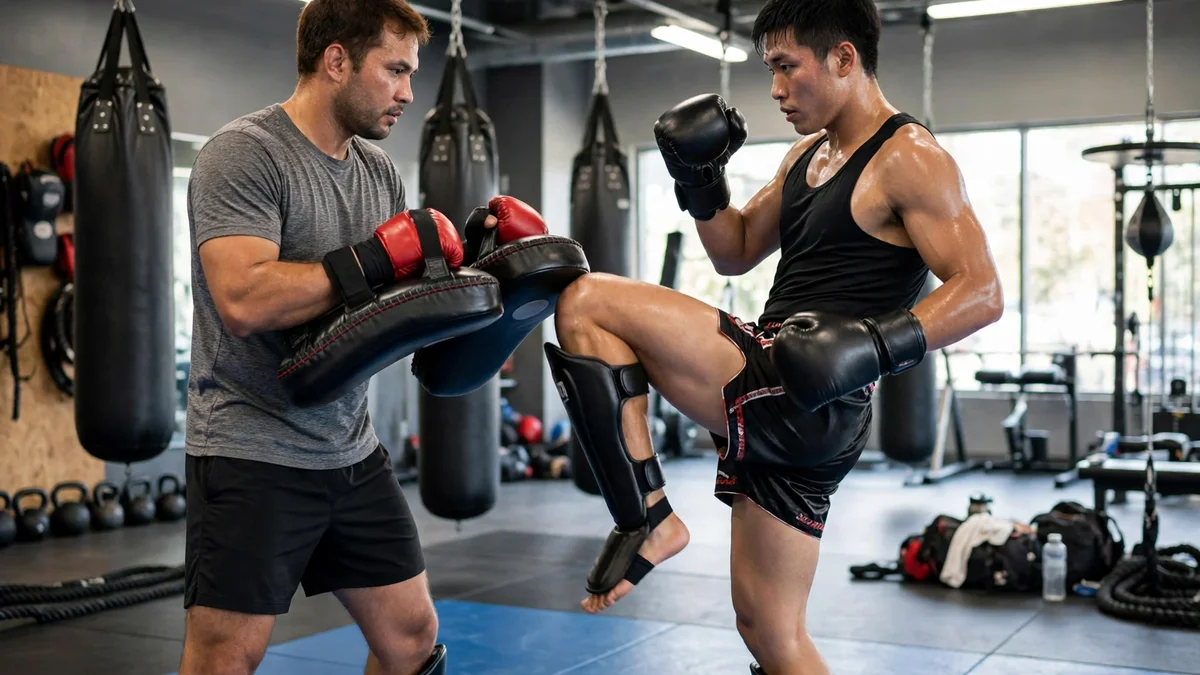

Thai boxing and Muay Thai are two names for the same martial art from Thailand, a striking discipline that uses punches, kicks, knees and elbows, and is often called the art of eight limbs. The confusion is understandable: one name describes where it comes from, and the other is the Thai name for it. There is no separate sport called Thai boxing that sits beside Muay Thai. This guide treats the topic once, as it should be treated, and explains the techniques, the training, the rules and how a beginner can start safely.
Key takeaways
- Thai boxing and Muay Thai are the same art; the first is the English name, the second is the Thai name.
- It is called the art of eight limbs because it uses two fists, two shins, two knees and two elbows.
- The clinch, where fighters control each other at close range, is what most sets it apart from other striking arts.
- Training combines pad work, bag work, shadowboxing, skipping and clinch drills.
- Competition bouts use rounds, weight classes, gloves and a referee, with scoring that rewards effective strikes.
- Beginners should learn at a reputable gym, build fitness gradually, and keep sparring light and supervised.
One art, two names
Muay Thai developed in Thailand over centuries, growing from battlefield skills into a ring sport with rules, rounds and weight classes. The name means Thai boxing in the Thai language, and English speakers use both terms for the same thing, sometimes in the same sentence. A gym that advertises Thai boxing classes and a gym that advertises Muay Thai classes are teaching the same art, and the difference is only in the words on the sign. That matters, because a beginner who searches for one name and finds the other should not assume they have found a different sport.
The core techniques
The jab and the cross are the foundation, as in boxing, and they set up everything else. The jab measures distance and interrupts an opponent, while the cross carries the power, driven by the turn of the hips and the shoulder. The hook and the uppercut work at close range, and the elbow, which can be thrown horizontally, diagonally, upwards or as a spinning strike, is one of the most distinctive weapons in the art. Elbows are short-range tools, and they demand good footwork to land safely, which is why coaches introduce them carefully and only after the basics are solid.
The roundhouse kick is the signature technique, thrown with the shin rather than the foot, and powered by a pivot on the standing leg and a swing of the hips. A well-thrown roundhouse lands with the whole shin across the thigh, body or head, and the difference between a kick thrown with the foot and one thrown with the shin is the difference between a slap and a strike. The teep, or push kick, is the other key kick: a straight thrust of the foot to the body or leg that keeps an opponent at distance, breaks their rhythm, and sets up heavier strikes. The low kick to the thigh is a patient weapon, thrown again and again until the leg stops working properly.
How training is structured
A typical class starts with a warm-up: skipping, running, shadowboxing and stretching, usually for fifteen to twenty minutes. Skipping is a staple of Muay Thai training, and it builds the calf endurance and rhythm that the rest of the session depends on. Shadowboxing follows, where students practise techniques in the air, working on form, balance and combinations without a partner. A coach will often call out combinations during shadowboxing, which teaches students to react to instructions rather than thinking through every strike.
Pad work is the heart of the session. One partner holds Thai pads, thick curved pads worn on the forearms, while the other throws combinations of punches, kicks, knees and elbows. The pad holder is not a passive target: they move, call combinations, and push back, so the striker learns timing, distance and power against a living partner. Good pad work is a conversation, and a good holder makes the striker better. The same patient repetition that improves a strike improves any practised movement, whether it is a roundhouse kick or a swing at a driving range, and the discipline is the same: repeat the basic movement until it is clean before adding power. Bag work comes next or instead, with students working on heavy bags to build power and conditioning, often in rounds with short rests in between.
Rules, rounds and scoring
Professional Muay Thai bouts are usually fought over five rounds of three minutes, with two minutes of rest between rounds, though amateur bouts are often shorter, with three rounds and longer rest periods. Fighters wear gloves, shorts, a groin guard and a mouthguard, and they compete in weight classes so that size is roughly matched. A referee controls the bout, and judges score each round. The traditional pre-fight ritual, the wai kru ram muay, is a dance of respect to teachers and tradition performed before the bout begins, and it remains a visible part of the sport in Thailand. The rules and history of Muay Thai have changed many times as the art moved from open-air contests to the modern ring.
Thai boxing and Muay Thai compared with other striking arts
Newcomers often ask how Muay Thai differs from kickboxing, boxing and karate, and the differences are real. Boxing uses only the fists, which makes its punching more refined but leaves a boxer without answers to kicks and knees. Kickboxing uses fists and feet, and some styles allow knees, but it generally forbids elbows and treats the clinch as a brief interruption rather than a skill. Karate uses punches, kicks and some close-range techniques, but its scoring and style are different again, with an emphasis on speed, control and point scoring rather than sustained damage.
| Art | Weapons | Clinch | Typical format |
|---|---|---|---|
| Muay Thai | Fists, elbows, knees, shins | Central skill, knees and sweeps | Five rounds, full contact |
| Kickboxing | Fists and feet, knees in some styles | Brief, quickly separated | Three to five rounds |
| Boxing | Fists only | Holding, quickly separated | Four to twelve rounds |
| Karate | Fists, feet, some close strikes | Limited | Point or continuous sparring |
| Taekwondo | Mainly kicks, some punches | Limited | Point sparring, three rounds |

Starting Muay Thai as a beginner
Equipment for a first class is simple. Most gyms lend gloves and pads to newcomers, so all you need is comfortable training clothes, a water bottle and hand wraps, which protect the hands and wrists inside the gloves. If you decide to continue, your own gloves, hand wraps, shin guards and a mouthguard are the sensible purchases, in that order. Shorts designed for Muay Thai are cut wide for kicking, and they are worth buying once you are training regularly, but they are not needed on day one. Many people discover the gym through a friend or a class, and the same spirit that makes a place to meet people through shared activity applies to a martial arts gym as well. Staying hydrated matters through all of it, so bring water along, and our guide to the best water bottle can help you choose one.
A checklist for your first month of training
- Visit two or three gyms and take a trial class before joining one.
- Buy hand wraps first, then your own gloves, shin guards and a mouthguard.
- Learn the stance, jab, cross, roundhouse kick and teep before anything advanced.
- Keep sparring light, technical and supervised until your coach says otherwise.
- Warm up properly, stretch after class, and rest when your body asks for it.
- Drink water through the session and eat properly afterwards.
- Ask your coach questions; good coaches expect them from beginners.
- Be patient: clean basics matter more than learning new techniques quickly.
Frequently asked questions
Is Thai boxing the same as Muay Thai?
Yes. Thai boxing is the English name for Muay Thai, which is the Thai name for the same martial art. There is no separate sport called Thai boxing. Both names describe the striking art from Thailand that uses punches, kicks, knees and elbows, and a gym advertising either name is teaching the same discipline.
What does the art of eight limbs mean?
It means the art uses eight striking surfaces: two fists, two elbows, two knees and two shins. Most other striking arts use fewer weapons, which is why Muay Thai fighters can strike from long range with kicks, from middle range with punches, and from close range with knees and elbows. The phrase captures the completeness of the system rather than any single technique.
Do I need to be fit before my first Muay Thai class?
No. Gyms expect beginners to arrive with ordinary fitness, and the training itself builds the rest. The first classes will be tiring, and your legs and shoulders will ache afterwards, but coaches scale the work to the student. If you can walk briskly, skip for a minute and hold a light squat, you can start. Tell the coach it is your first class so the session is scaled for you.
Is Muay Thai safe for beginners?
It is as safe as any contact sport can be when it is taught well. Beginners learn technique on pads and bags, sparring is light and supervised, and protective equipment is used. Bruises and sore shins are common; serious injuries are uncommon in well-run gyms. The main risks come from poor coaching, hard sparring too early, or training through pain, all of which a good gym avoids.
How long does it take to learn Muay Thai?
Basic competence takes several months of regular training, and real skill takes years. Most students can throw a clean jab, cross, roundhouse kick and teep after a few months, and can hold their own in light technical sparring within a year. The clinch, elbows and advanced footwork take longer. There is no belt system in traditional Muay Thai, so progress is measured by skill, fitness and the judgement of your coach rather than by grades.
What equipment do I need to start?
Comfortable training clothes, a water bottle and hand wraps are enough for a first class, and most gyms lend gloves and pads to newcomers. If you continue, buy your own gloves, hand wraps, shin guards and a mouthguard, in that order. Muay Thai shorts are useful once you are training regularly, but ordinary shorts are fine to begin with.
The bottom line
Thai boxing and Muay Thai are one art with two names, and it is a complete striking system: fists, elbows, knees and shins, a clinch that sets it apart, and a training method that builds fitness and skill together. Most people who train never compete, and that is fine; the art offers fitness, confidence and a demanding skill to learn whether or not a bout is ever on the horizon. Find a good gym, learn the basics properly, keep sparring light, and let the rest come in its own time.
Training note: Muay Thai is a contact sport, so train at a reputable gym with qualified coaches, wear hand wraps, gloves, shin guards and a mouthguard for sparring, and keep sparring light until your coach says you are ready for more. Stop and seek medical advice if you feel dizzy, notice swelling or pain that does not settle, or take a blow to the head.