
Crete in the Mediterranean is the largest island of Greece and the fifth largest island in the Mediterranean Sea, after Sicily, Sardinia, Cyprus and Corsica. It sits about 100 kilometres south of the Peloponnese, with the Sea of Crete to its north and the Libyan Sea to its south, and it is large enough to feel like a small country rather than a single island. The question most travellers ask is where to start, and the answer is that Crete rewards a slow trip built around two or three bases, not a race from one end to the other.
This guide covers the island’s geography, its four regions, the main towns, the ancient sites, the beaches and the practical side of getting around, using only the facts that can be checked. Crete is about 260 kilometres long from east to west and up to 60 kilometres wide, with a coastline of 1,046 kilometres, so distances are longer than they look on a map.
Key takeaways
- Crete is Greece’s largest island and the fifth largest in the Mediterranean.
- Heraklion is the capital and largest city; Chania, Rethymno and Agios Nikolaos are the other main towns.
- The island is divided into four regions: Chania, Rethymno, Heraklion and Lasithi.
- Knossos, near Heraklion, is the great palace of the Minoan civilisation.
- The Samaria Gorge runs through the White Mountains in the west.
- Crete is 260 kilometres long, so plan around two or three bases.
Where Crete sits in the Mediterranean
Crete forms the southern border of the Aegean Sea, and its position has shaped its history. It lies roughly 100 kilometres south of the Greek mainland and about 300 kilometres south-west of Anatolia, which put it at the crossroads of the eastern Mediterranean for thousands of years. Traders, invaders and settlers all left their mark, and the island’s food, music and architecture still carry those layers.
The island covers around 8,400 square kilometres and had a population of 624,408 in 2021. It is long and narrow, stretching 260 kilometres from west to east but only 60 kilometres at its widest point, and narrowing to as little as 12 kilometres near Ierapetra on the south coast. That shape matters for travellers: the north coast holds most of the towns, the airports and the main road, while the south coast is quieter and harder to reach.
The four regions of Crete
Crete is divided into four regional units, running from west to east: Chania, Rethymno, Heraklion and Lasithi. Chania, in the west, holds the White Mountains, the Samaria Gorge and the island’s most photographed harbour town. Rethymno, in the centre-west, is smaller and quieter, with a handsome old town and a long sandy beach. Heraklion, in the centre, is the capital region and the home of Knossos. Lasithi, in the east, holds Agios Nikolaos and the quieter eastern coast.
Each region has its own character, and each is worth at least two days. The mistake many first-time visitors make is trying to see all four in a week, which means spending most of the holiday on the road. A better plan is to choose two neighbouring regions and explore them properly, saving the rest for a return trip.
Heraklion, the capital
Heraklion is the capital and largest city of Crete, sitting on the north coast in the centre of the island. It is a working city rather than a resort, with a busy port, a long waterfront and a centre full of cafes, markets and museums. The Archaeological Museum of Heraklion holds the finest collection of Minoan finds anywhere, and it is the natural companion to a visit to Knossos.
Knossos is the great palace of the Minoan civilisation, which was centred on Crete from around 2700 to 1420 BCE and is regarded as Europe’s first advanced civilisation. The palace was excavated in the early twentieth century, and its courtyards, storerooms and painted rooms give the clearest picture anywhere of Bronze Age life on the island. Go early in the day if you can, when the light is softer and the crowds are thinner.
Chania and the west
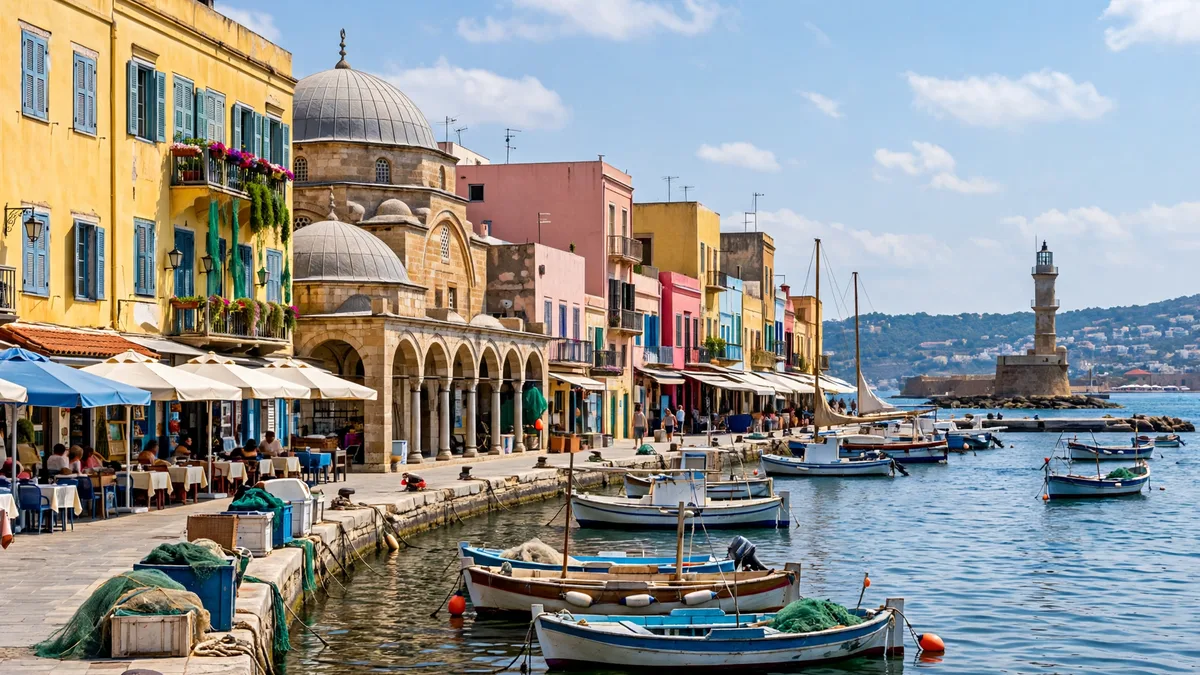
Chania is the largest city of western Crete and, for many visitors, the most beautiful town on the island. Its old Venetian harbour is ringed by colourful buildings, tavernas and cafes, with a lighthouse at the harbour entrance and the White Mountains rising behind the town.
West of Chania lie two of the island’s best-known beaches, Elafonisi and the Balos lagoon, reached by road and then on foot or by boat. The Samaria Gorge, a World Biosphere Reserve, runs through the White Mountains from the Omalos plateau down to the village of Agia Roumeli on the Libyan Sea, and the walk through it is one of the great hikes of the Mediterranean.
Rethymno and Agios Nikolaos
Rethymno sits between Chania and Heraklion on the north coast, and it is the easiest town on the island to enjoy without a plan. Its old town is compact and walkable, with a Venetian harbour, a long sandy beach and a slower pace than its larger neighbours. It suits families and travellers who want a base with restaurants and swimming close at hand.
Agios Nikolaos is the main town of Lasithi, in the east, and the capital of the region. It sits around a small lake connected to the sea, with a harbour, cafes and a relaxed atmosphere that is very different from the bustle of Heraklion. Eastern Crete is quieter than the west, with smaller villages and emptier beaches.

Crete in the Mediterranean compared
The four regions differ more than their size suggests. The table below sets out what each one offers, so you can choose where to base yourself.
| Region | Main town | Best for |
|---|---|---|
| Chania | Chania | Old harbour, gorges and western beaches |
| Rethymno | Rethymno | Old town, family beaches and a slow pace |
| Heraklion | Heraklion | Knossos, museums and city life |
| Lasithi | Agios Nikolaos | Quiet east coast and smaller villages |
| Chania | Kissamos | Reaching the Balos lagoon and Gramvousa |
| Heraklion | Hersonissos | Resort beaches east of the capital |
Mountains, gorges and beaches
Crete is predominantly mountainous, and a high range crosses the island from west to east. The highest point is Mount Ida, also known as Psiloritis, at 2,456 metres, and the White Mountains in the west reach 2,452 metres, with some thirty summits above 2,000 metres. The mountains shape the climate as well as the landscape: the north coast is milder and greener, while the south is drier and hotter.
The gorges are the island’s signature landscape. Samaria is the longest and best known, but there are others, including the Imbros Gorge and the Kourtaliotiko Gorge, which are shorter and quieter. The beaches are just as varied, from long sandy stretches on the north coast to small coves on the south that are reached only on foot or by boat.
Food, villages and daily life
Cretan food is simple and seasonal, built around olive oil, vegetables, pulses, bread, cheese and herbs, with meat as a smaller part of the meal than visitors often expect. Village tavernas serve what is in season, and the best meals are often the least elaborate: a salad, a grilled fish or a slow-cooked dish shared at the table.
The mountain villages are worth a detour from the coast. They move at a different pace, with kafeneia where the same faces gather each morning, and they are the best place to hear Cretan music and see the island’s craft traditions. If you drive into the hills, allow extra time: the roads are narrow and winding, and the views are worth stopping for.
Getting around Crete
Most visitors arrive by air, through Heraklion airport, the largest on the island, or Chania airport in the west, and both serve international flights. Ferries also connect the island with the Greek mainland, and the ports at Heraklion and Chania are the main arrival points by sea. Once on the island, the main road runs along the north coast from one end to the other, linking the four main towns.
A car gives the most freedom, especially for the south coast and the mountain villages, where buses are infrequent. Driving in Crete is straightforward on the main road but needs care in the mountains, where the roads narrow and the bends are sharp. Allow more time than the distance suggests, and keep an eye on fuel in the remoter areas.
Your Crete in the Mediterranean checklist
Use this checklist when you plan your trip.
- Choose two neighbouring regions as your bases rather than trying to see all four.
- Fly into Heraklion for Knossos and the east, or Chania for the west.
- Visit Knossos early in the day and pair it with the Archaeological Museum.
- Allow a full day for the Samaria Gorge, with an early start and plenty of water.
- Set aside an evening for the old harbour at Chania.
- Leave time for a mountain village and a taverna lunch away from the coast.
- Book accommodation near the town centre so you can walk in the evening.
- Carry sun protection and water, even on cloudy days.
- Check ferry and bus times before travelling to the south coast.
- Learn a few words of Greek: a greeting goes a long way in the villages.
Frequently asked questions
Where is Crete in the Mediterranean?
Crete is the largest island of Greece, sitting about 100 kilometres south of the Peloponnese. It forms the southern border of the Aegean Sea, with the Sea of Crete to its north and the Libyan Sea to its south.
What is the capital of Crete?
Heraklion is the capital and largest city of Crete, on the north coast in the centre of the island. It is the main port and the home of the Archaeological Museum and the nearby palace of Knossos.
How big is Crete?
Crete covers around 8,400 square kilometres, stretches about 260 kilometres from east to west, and has a coastline of 1,046 kilometres. It is the fifth largest island in the Mediterranean Sea.
What is Crete famous for?
Crete is famous as the centre of the Minoan civilisation, whose palace at Knossos is one of the great archaeological sites of Europe. It is also known for its mountains and gorges, its long beaches, its old Venetian harbours and its food.
How many days do you need in Crete?
Crete is large enough to fill two weeks, but a first trip of seven days works well if you base yourself in two neighbouring regions. Trying to see all four regions in a week means spending most of the holiday on the road.
Is Crete good for walking?
Yes, and the Samaria Gorge is the best-known walk, running from the Omalos plateau down to Agia Roumeli on the south coast. Shorter gorges, coastal paths and mountain village walks offer easier options, but all need sturdy shoes and water.
The bottom line
Crete in the Mediterranean is an island that rewards patience: a large, mountainous place with four distinct regions, a Minoan past that still shapes its museums and ruins, and a coastline that runs from busy harbours to empty coves. Base yourself in two neighbouring regions, give Knossos and Chania the time they deserve, and leave room for the villages and the gorges in between. If you are planning more travel, see our guide to the best places to visit in Norway, our round-up of the best places to visit in spring, and our look at the trending cities outside the home country for more ideas.
Safety note: the Samaria Gorge and other mountain walks are demanding in summer heat, so start early, carry water and sun protection, and check local conditions before you set out. Mountain roads are narrow and winding, so drive carefully and avoid them after dark if you are not used to them.