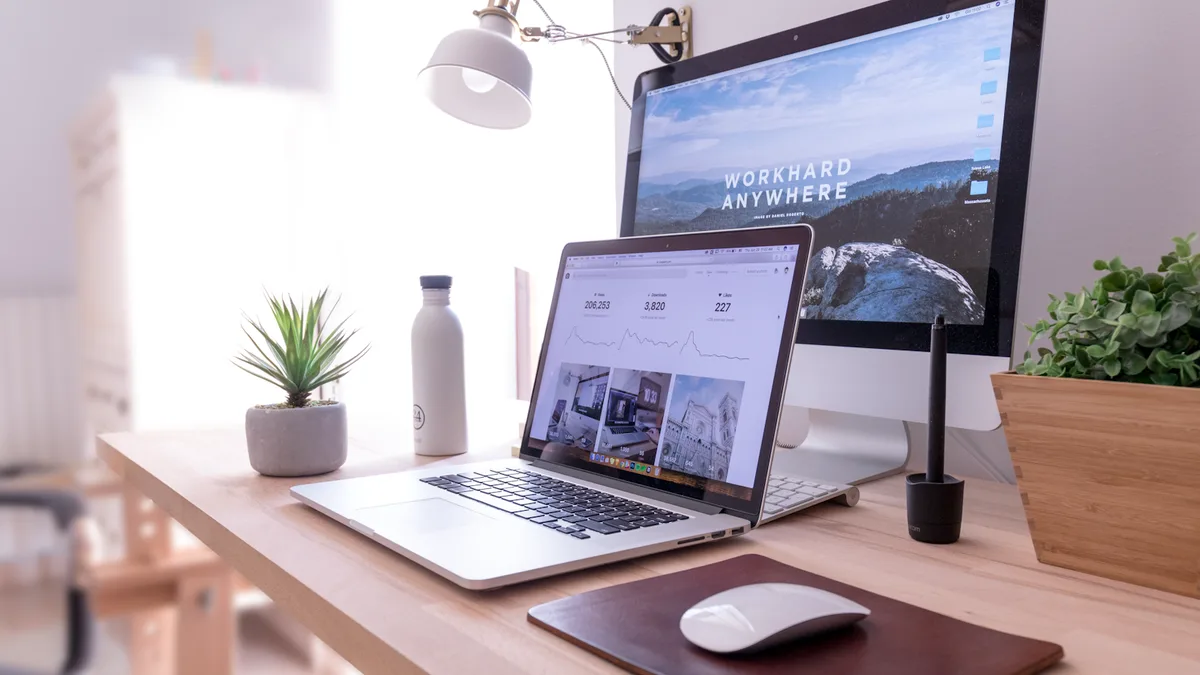

What is a riser desk? It is a platform that sits on top of your existing desk and lifts your monitor and keyboard to standing height, so you can work standing up without replacing your furniture. You raise it when you want to stand, lower it when you want to sit, and the whole change takes a few seconds. It is the simplest way to try a standing setup before committing to a full height-adjustable desk.
Riser desks are also called desktop converters or sit-stand converters, and they come in many shapes: a simple fixed shelf, a folding platform, or a two-tier unit with a separate keyboard tray that moves with the screen. The idea is the same in every version. Your desk stays where it is, and the riser does the moving, carrying your screen and keyboard up and down as one unit.
Key takeaways
- A riser desk is a platform that sits on your current desk and lifts your screen and keyboard to standing height.
- It lets you switch between sitting and standing in seconds, without replacing your desk.
- Two-tier models keep the screen and keyboard at different heights, which is better for posture.
- Check the weight limit, the footprint and the height range before buying.
- Set the screen at eye level and your elbows near a right angle when typing.
- A riser suits renters and small rooms, while a full standing desk suits a permanent setup.
How a riser desk works
Most riser desks use a scissor or gas-spring mechanism under the platform. You squeeze a lever or handle, lift or press the platform to the height you want, and release the lever to lock it in place. Gas-spring models glide smoothly and hold their position well; simpler folding models use a latch with a few fixed heights. Electric risers exist too, raising the platform at the push of a button, but they cost more and need a power socket nearby.
The platform carries everything you work with. A single-tier riser is one flat surface holding the monitor, keyboard and mouse together. A two-tier riser adds a lower keyboard tray that drops below the monitor level, so your screen can sit at eye level while your hands rest lower. That split is the main ergonomic advantage of the two-tier design, because a single flat surface forces a compromise: either the screen is too low or the keyboard is too high.
Riser desk or full standing desk
The choice comes down to how permanent you want the change to be. A riser desk is a converter: it adapts the desk you already own, costs less than a full standing desk, and can be removed in minutes if you move house or change your mind. That makes it the natural pick for renters, for shared desks and for anyone who wants to test standing work before spending more.
A full standing desk replaces the whole desk, with legs that raise and lower the entire surface. It gives you more room, a cleaner look and a wider height range, and it handles heavy monitor arms and large screens more easily. It also costs more, takes longer to set up and is harder to move. If you are setting up a dedicated home office for the long term, the full desk is usually the better buy; if you are adapting a desk you already like, the riser is the simpler answer.
What to check before you buy
Start with the measurements. Measure your desk’s depth and width, and compare them with the riser’s footprint, leaving room for a notebook or a cup beside it. Check the height range as well: the riser must lift your screen to your eye level when standing, and drop low enough that your elbows sit near a right angle when sitting. If you are tall, pay attention to the maximum height, since some compact risers run short.
Then check the weight limit. Add up the weight of your monitor, or monitors, plus anything else that will live on the platform, and make sure the total sits comfortably below the stated limit. A riser loaded near its limit will feel wobbly and wear out its mechanism faster. Stability matters too: a good riser feels solid at full height, with no sway when you type. Reading user reviews about wobble is worth the time, because makers rarely advertise it.
Single monitor or two
Most risers are built for one monitor, and a wide or curved screen can already fill the platform. Two-monitor setups need a wider riser, and the combined weight climbs quickly. Some people solve this with a single large ultrawide monitor instead, or with a monitor arm clamped to the riser. Measure your screens, including their stands, and check the platform width against them before ordering.
Keyboard tray or flat surface
A keyboard tray is worth having if you type for hours. It lets the screen sit high while your hands stay low, and it frees space on the main platform for papers or a second screen. The trade-off is that the tray adds weight and moving parts, and a shallow tray can feel cramped with a full-size keyboard. If you use a laptop as your main machine, a flat single-tier riser with a laptop stand can be the tidier option.

Setting up your riser desk well
Good setup is mostly about heights. When standing, the top of your screen should sit at or just below eye level, so you look slightly down rather than craning your neck up or hunching over. Your elbows should rest near a right angle when your hands are on the keyboard, with your shoulders relaxed and your wrists straight. If your screen is too low, raise it on a small stand or a stack of books; if your keyboard is too high, the tray needs to drop lower.
Your feet matter too. Stand with your weight even, avoid locking your knees, and keep a small mat underfoot if the floor is hard. Most people do best alternating: stand for part of the morning, sit for a while, then stand again. Standing all day brings its own aches, in the lower back and the feet, so the goal is movement and variety rather than replacing one fixed posture with another.
Common setup mistakes
The most common mistake is putting the riser on a desk that is already too high, which leaves no room for the keyboard tray to drop low enough when sitting. The second is overloading the platform, which makes it sway and shortens its life. The third is setting the monitor too low and working with a bent neck for hours. A quick check at the start of each day, screen at eye level and elbows at a right angle, catches all three.
Your riser desk checklist
Run through this list before ordering, and again on the day the riser arrives.
- Have you measured your desk’s width and depth against the riser’s footprint?
- Does the height range lift your screen to eye level when you stand?
- Does it drop low enough for comfortable typing when you sit?
- Have you added up the weight of your monitors and checked it against the limit?
- Will your monitor, or monitors, fit on the platform with their stands?
- Do you need a keyboard tray, or will a flat surface suit you?
- Is the mechanism smooth to raise and lower, and does it lock firmly?
- Does the riser feel stable at full height, with no sway while typing?
- Have you left space beside the riser for a notebook, phone or cup?
- Do you have a mat or comfortable shoes for standing sessions?
How a riser desk compares with other options
| Option | Cost | Setup effort | Space needed | Best suited to |
|---|---|---|---|---|
| Riser desk | Low to medium | Minutes, sits on your desk | Your current desk | Renters and anyone testing standing work |
| Full standing desk | Medium to high | An hour or more | A full desk footprint | A permanent home office |
| Fixed high desk | Low | None | A full desk footprint | Standing all day, short sessions |
| Laptop stand | Low | Seconds | A corner of your desk | Laptop users on a budget |
Frequently asked questions
Is a riser desk worth it?
It is worth it if you want to stand for part of your working day without replacing your desk. It costs less than a full standing desk, installs in minutes and can be removed just as easily. It is less suited to very heavy two-monitor setups or to anyone who wants a permanent, full-size standing desk.
Can I use a riser desk with a laptop?
Yes. A laptop sits on the platform just like a monitor, and a small laptop stand can lift its screen closer to eye level. A separate keyboard and mouse help, since the laptop’s own keyboard sits too high once the screen is at the right height.
How much weight can a riser desk hold?
It varies by model, and the stated limit is the number to trust. Compact risers often hold around 10 to 15 kg, while larger two-tier models can hold more. Add up your monitor, keyboard and anything else on the platform, and keep the total comfortably below the limit.
Will a riser desk damage my desk?
It should not, as long as the desk is sturdy and the riser’s weight stays within reason. Most risers have rubber feet that protect the surface. Very heavy setups on a thin or hollow desk can leave marks over time, so a protective mat underneath is a simple precaution.
How long should I stand each day?
There is no single right answer, and the evidence favours variety over any fixed target. Many people start with short standing sessions of twenty to thirty minutes, a few times a day, and build up from there. If your back, feet or knees ache, sit down and try again later.
Can I use two monitors on a riser desk?
Yes, if the riser is wide enough and its weight limit covers both screens. Measure both monitors with their stands and compare the total width and weight with the riser’s specifications. A single ultrawide monitor is often the simpler alternative.
The bottom line
A riser desk is a platform that turns the desk you already own into a sit-stand desk. It is the quickest and cheapest way to try standing work, and for many people it is all they ever need. Choose a two-tier model if you type for hours, check the footprint, height range and weight limit before ordering, and set it up so your screen sits at eye level and your elbows rest near a right angle.
Once the setup is right, the habit is what matters: alternate sitting and standing through the day rather than locking into either one. Keep water close by, and our guide to the best water bottles covers bottles that keep it cold at your desk, while our guide to stress-relief techniques covers short breaks that pair well with standing, and our guide to the best single-serve coffee maker covers quick coffee between sessions.