
The best baby toys are safe, washable and matched to your baby’s age, and the best baby toys in 2027 are the ones your baby reaches for again and again, not the ones with the most lights and sounds. What are the best baby toys? They are simple, sturdy toys that fit the stage your baby is in now: soft toys for cuddling, a play gym for tummy time, stacking rings for sitting up, and bath toys for splashing.
Babies learn through their hands and mouths, so a good toy is one a baby can grab, chew, shake and drop without coming to harm. That is why the age label on the box matters more than the toy’s cleverness: a toy made for a three-year-old can carry small parts that are dangerous for a baby under three.
Key takeaways
- The best baby toys match your baby’s age and stage, and the age label on the box is a safety guide, not a suggestion.
- Choose toys a baby can grab, chew and drop safely, with no small parts, long cords or sharp edges.
- Soft toys, play gyms, stacking toys and bath toys cover the first year between them.
- Check toys weekly for loose stitching, cracked plastic and worn parts, and throw away anything broken.
- Rotate toys in and out of a box to keep play fresh, and keep older siblings’ small-part toys out of a baby’s reach.
Soft toys and comforters: the first friends
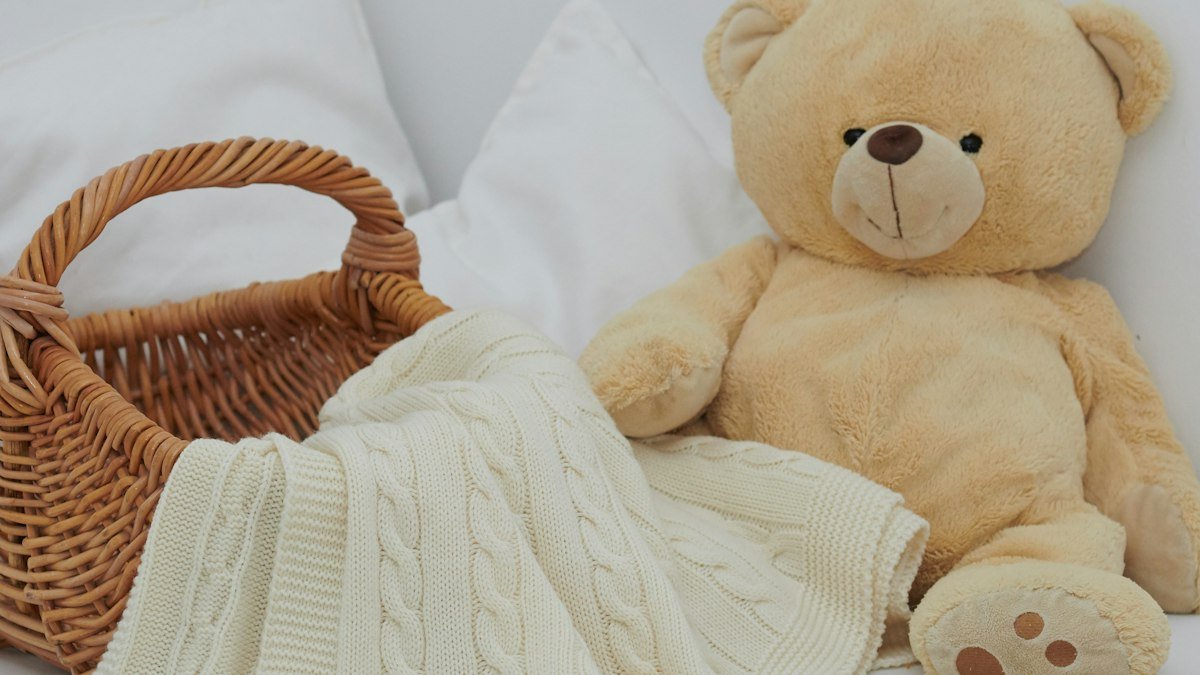
A soft toy is often a baby’s first possession, carried everywhere, chewed, dribbled on and loved until it falls apart. Look for one with embroidered eyes rather than plastic buttons, short pile rather than long fur that sheds, and seams that survive the washing machine, because a comforter that cannot be washed will not stay a comforter for long.
Buy two of the same comforter if you can, and rotate them so one is always clean. That way a lost or washed comforter does not cause a crisis at bedtime, and both wear evenly. Keep soft toys out of the cot while a baby sleeps: the sleep surface should stay clear of pillows, blankets and toys.
Best for: newborns and comfort at bedtime — a washable soft toy with embroidered features and no loose parts.
Activity gyms and play mats: tummy-time territory
An activity gym is a padded mat with arches overhead, hung with rattles, mirrors and soft shapes for a baby to bat at during tummy time. It is the best first toy for a newborn, because it gives a baby something to look at and reach for while lying on their front, which builds neck and shoulder strength.
Choose a mat that is thick enough to cushion a hard floor, with toys that unclip for washing and arches that fold flat for storage. A mirror is worth having: babies are fascinated by their own reflection long before they know what it is. Once your baby can roll and crawl, the arches come off and the mat becomes a soft floor for play.
Best for: newborns and tummy time — a padded activity gym with unclippable toys and a baby-safe mirror.
Stacking and sorting toys: hands and brains at work
Stacking rings, nesting cups and simple shape sorters are the classic toys for babies who can sit up, because they teach size, order and cause and effect with no batteries at all. A baby will stack the rings in the wrong order, knock the tower down and start again, and that repetition is the learning.
Check the size of the pieces: nothing should be small enough to fit inside a toilet-paper tube, which is the rough home test for a choking hazard. Wooden stacking toys are sturdy and easy to wipe clean, while plastic ones survive being dropped in the bath. Avoid sets with small pegs or balls that detach.
Best for: babies who can sit up — chunky stacking rings and nesting cups with no small detachable parts.
Bath toys: making wash time fun
Bath toys turn a chore into a game, and they suit babies from the first splashes to the toddler years. Simple floating animals, stacking cups and a small watering can are enough: they pour, float and squeak, and they dry quickly if you leave them on the side of the bath.
Watch out for toys that trap water inside, because mould grows in hidden chambers and is hard to clean. Choose toys with holes that drain, or solid toys with no openings at all, and rinse them after each bath. Throw away any bath toy that smells musty or shows black spots inside.
Best for: bath time from the first splashes — floating animals and stacking cups that drain fully and dry fast.
Push-and-pull toys: first steps and beyond
Once a baby is pulling up and cruising along the furniture, a push-along walker or a pull toy with a string gives them a reason to move. A sturdy push toy with a wide base and a handle at the right height helps a new walker practise without tipping forward, and a pull-along duck or dog rewards a toddler who is already walking.
Check the wheels and the handle before you buy: a push toy that rolls too freely will run away from a wobbly walker, while one with a brake or a weighted base stays steady. Avoid walkers with wheels that a baby sits inside, as paediatric guidance warns against them, and choose a push toy your baby stands behind instead.
Best for: babies pulling up and taking first steps — a sturdy push toy with a wide base that your baby stands behind.
Toy safety: the checks that protect your baby
Toy safety in the United States rests on two rules worth knowing. The small-parts rule bans toys for children under three that contain pieces small enough to choke on: a small part is anything that fits entirely inside a test cylinder about one and a quarter inches wide, roughly the size of a child’s throat. The federal toy standard, ASTM F963, is mandatory for toys sold in the US, and it covers sharp edges, small magnets and button batteries, which can burn through a child’s throat in as little as two hours if swallowed.
At home, the checks are simpler. Read the age label and treat a 3+ label as a stop sign for a baby, because toys for older children may legally contain small parts. Look for the warning “not for children under three” and take it literally, especially when older siblings have toys a baby can reach.
Strings and cords deserve a special mention: keep ribbons, cords and straps on toys short, and never tie a toy to a cot, a pram or a baby’s clothing. Wash soft toys regularly, wipe hard toys with warm soapy water, and store toys in a box with a lid that cannot trap small fingers.

| Age and stage | Best toy type | Watch out for | Best for |
|---|---|---|---|
| Newborn, 0 to 3 months | Soft toy and activity gym | Loose buttons and long fur | Tummy time and comfort |
| 3 to 6 months | Rattles and play mat | Small parts and long cords | Grasping and reaching |
| 6 to 9 months | Stacking rings and cups | Pieces that fit in a toilet tube | Sitting up and sorting |
| 9 to 12 months | Bath toys and push toys | Water trapped inside bath toys | Splashing and first steps |
| 12 to 18 months | Pull toys and shape sorters | Small balls and detachable pegs | Walking and problem solving |
| 18 months and up | Simple musical toys | Button batteries and loud sounds | Rhythm and pretend play |
How to choose: a quick checklist
- Read the age label on the box, and treat a 3+ label as a stop sign for a baby under three.
- Check for small parts, long cords, sharp edges and loose stitching before the toy reaches your baby.
- Choose toys that wash or wipe clean, and wash soft toys regularly.
- Check button-battery compartments need a tool to open, and keep spare batteries out of reach.
- Rotate a small set of toys in and out of a box, and store the rest out of sight.
- Keep older siblings’ small-part toys in a separate room or a high box a baby cannot reach.
- Check the CPSC recall list before buying second-hand, and throw away broken toys at once.
When playtime ends and your baby needs soothing, the guide to the best baby swing covers gentle motion for fussy afternoons, and the roundup of the best 1-year-old gifts covers presents for a baby moving into the toddler years. The guide to the best gifts for travellers covers small toys that pack well for a first holiday.
Frequently asked questions
What are the best baby toys in 2027?
The best baby toys in 2027 are safe, washable and matched to your baby’s age: a soft toy and an activity gym for a newborn, stacking rings and nesting cups for a baby who can sit up, and bath toys and a push toy for a baby taking first steps. Simple toys that a baby can grab, chew and drop are better than complicated ones with small parts.
How many toys does a baby need?
A baby needs only a small set of toys at a time: a soft toy, a rattle, a play gym, a stacking toy and a bath toy cover most of the first year. Too many toys overwhelm a baby and clutter the room, so rotate a few in and out of a box every week or two to keep play fresh without buying more.
What toys are safe for a newborn?
Safe newborn toys are soft, washable and too big to choke on: a soft comforter with embroidered features, a high-contrast black-and-white toy, an activity gym with unclippable rattles and a baby-safe mirror. Keep soft toys out of the cot while a baby sleeps, and check for loose stitching and shedding fur every week.
Are second-hand toys safe?
Second-hand toys can be safe if you check them carefully: wash or wipe them, look for cracks, loose parts and missing pieces, and check the CPSC recall list for the toy. Avoid soft toys you cannot wash, toys with button batteries in a compartment that opens without a tool, and any toy with flaking paint or a musty smell.
When should I worry about small parts?
Worry about small parts whenever a baby under three can reach a toy. A small part is anything that fits entirely inside a cylinder about one and a quarter inches wide, and a toilet-paper tube is a rough home test: if a piece fits inside one, keep it away from a baby. Toys labelled 3+ may legally contain small parts, so keep older siblings’ toys out of reach.
Do babies need electronic toys?
No, babies do not need electronic toys, and simple toys often teach more. A stacking ring teaches size and order, a rattle teaches cause and effect, and a soft toy teaches comfort, all without batteries. If you do buy an electronic toy, keep the volume low and check the battery compartment needs a tool to open.
The bottom line
The best baby toys in 2027 are simple, sturdy and matched to the stage your baby is in now, with the age label as your guide and safety checks as a habit. A small set of well-chosen toys — a soft toy, a play gym, stacking rings, bath toys and a push toy — will carry a baby from the first weeks to the first steps.
A quick safety note: read the age label, keep small parts away from babies under three, and check the CPSC recall list before buying second-hand. Throw away broken toys at once, keep cords short, and never tie a toy to a cot, a pram or your baby’s clothing.