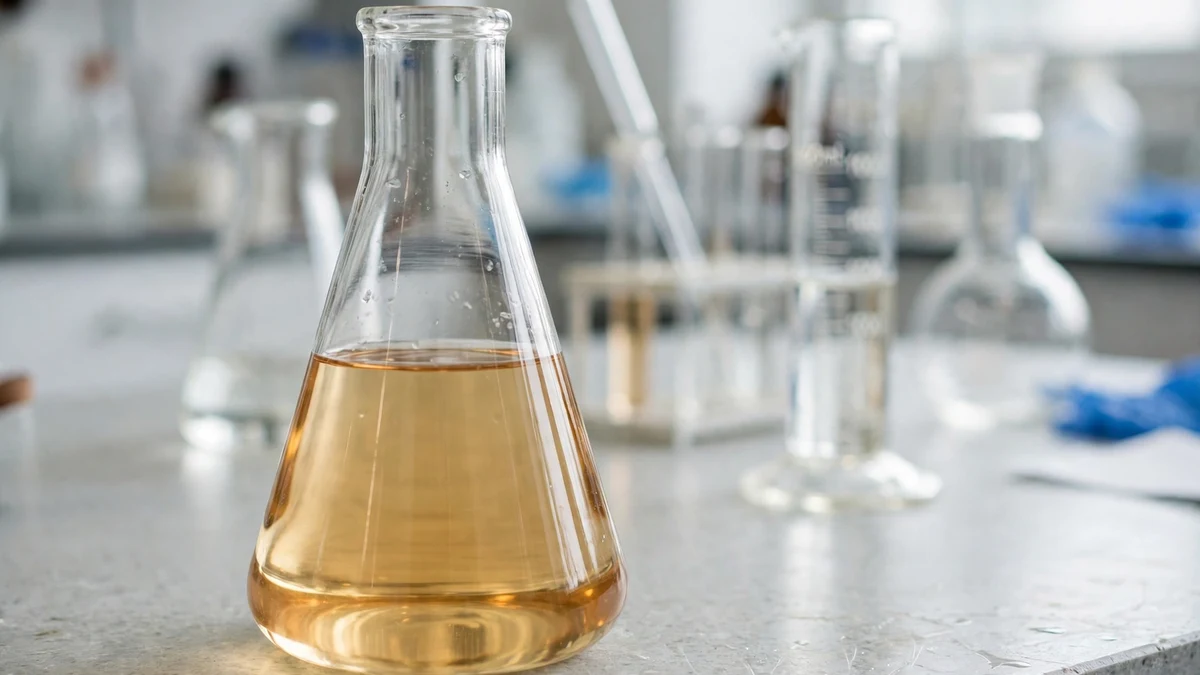

A conical flask is a piece of laboratory glassware with a flat bottom, a cone-shaped body and a narrow cylindrical neck, used for mixing, heating, storing and measuring liquids. It is also known as an Erlenmeyer flask, after the German chemist Emil Erlenmeyer, who designed it in 1861. The shape is the whole point: the wide base gives the liquid a large surface to heat evenly, the sloping sides let you swirl the contents without spilling them, and the narrow neck slows evaporation and makes the flask easy to stopper. If you have ever seen a scientist swirling a coloured liquid in a science lesson, the vessel in their hand was almost certainly a conical flask.
Conical flasks are used far beyond school laboratories. They appear in university research labs, hospital testing labs, breweries, home brewing kits and even kitchens, wherever a liquid needs to be mixed, heated or kept safely. This guide explains what a conical flask is, what it is used for, which sizes exist, how it differs from a beaker, and how to use and clean one safely.
Key takeaways
- A conical flask is also called an Erlenmeyer flask, after the chemist who designed it in 1861.
- Its cone shape lets you swirl liquids without spilling, and its narrow neck slows evaporation.
- Common sizes run from 50 millilitres to 5 litres, with 250 millilitres the most widely used.
- It is used for mixing, heating, titrations, culturing and storing liquids.
- Borosilicate glass flasks can be heated directly, but ordinary glass flasks cannot.
- Always check for chips and cracks before heating a flask, and never heat a sealed flask.
What a conical flask is, and why it is shaped that way
The conical flask has three parts: a flat circular base, a body that slopes inwards from the base to the neck, and a short cylindrical neck with a rim that can take a stopper. Most flasks carry printed graduation marks on the side, labelled in millilitres, and a white patch for writing on. The marks are approximate, which matters: a conical flask is made for mixing and heating, not for precise measurement, so a solution that needs an exact volume belongs in a volumetric flask or a measuring cylinder instead.
Each part of the shape does a job. The flat base lets the flask sit steadily on a bench or a heating plate, and it spreads heat evenly across the liquid. The sloping sides do two things at once: they let you swirl the contents in a circular motion without the liquid climbing over the rim, and they let vapour condense on the glass and run back down into the liquid instead of escaping. The narrow neck reduces the surface exposed to the air, which slows evaporation, and it makes the flask easy to close with a rubber stopper, a cork or a piece of foil.
Most conical flasks are made from borosilicate glass, a heat-resistant glass that can be placed directly on a hot plate or over a flame with a gauze mat. Borosilicate glass expands very little when heated, so it is far less likely to crack from sudden temperature changes than ordinary glass. Some flasks are made from plastic instead, usually for work where breakage is a risk or where the contents would attack glass, but plastic flasks cannot be heated. The material is usually printed on the flask itself, so check before you apply heat.
What a conical flask is used for
The most common use is mixing. The cone shape lets you swirl two or more liquids together, or dissolve a solid in a liquid, with little risk of splashing. In a school or university lab, that might mean preparing a solution, mixing reagents before a reaction, or dissolving a salt in water. In a brewery or a home brewing kit, a conical flask is often used to grow a yeast starter, where the yeast is mixed with sugary water and swirled regularly so it stays oxygenated and multiplies before it is added to the brew.
The second common use is heating. A borosilicate conical flask can be heated on a hot plate or over a Bunsen burner, and the shape helps here too: the wide base heats evenly, the sloping sides guide vapour back into the liquid, and the narrow neck lets you fit a condenser or a thermometer. Heating a liquid in a flask is safer than heating it in a beaker, because the narrow neck reduces the chance of the liquid boiling over or spitting out. Even so, a flask should never be heated while it is sealed, since pressure can build up and crack the glass.

The third common use is titration, the laboratory technique for finding the concentration of a solution. A measured amount of one liquid is placed in the flask, a few drops of indicator are added, and a second liquid is added slowly from a burette until the colour changes. The flask is swirled after each addition, and its shape makes that easy without spilling. Conical flasks are also used for storing solutions, for growing cultures of bacteria or yeast, and for collecting the liquid that comes out of a filtration setup. A flask with a side arm, known as a Buchner flask, is made for vacuum filtration, where a pump pulls liquid through a filter into the flask.
Conical flask sizes and how to choose one
Conical flasks are sold in a range of sizes, usually from 50 millilitres up to 5 litres, with 100, 250, 500 and 1,000 millilitre sizes the most common. The 250 millilitre flask is the workhorse of school and university labs, large enough for most school experiments and small enough to handle easily. A 500 millilitre or 1 litre flask suits larger preparations and yeast starters, while the small 50 and 100 millilitre sizes are used for small-scale work and for titrations where only a little solution is needed.
Choosing a size is a matter of headroom. A flask should never be filled to the top: a good rule is to fill it to no more than half its capacity when you plan to swirl or heat the contents, and to no more than two thirds when you are simply storing a liquid. A flask that is too full cannot be swirled without spilling, and a liquid that is heated in an overfull flask is likely to boil over. If you are buying your first flask for home brewing, a 1 litre or 2 litre size is a practical choice, since a yeast starter needs room to foam and swirl.
| Flask size | Best for | Safe working volume |
|---|---|---|
| 50 millilitres | Small-scale tests and titrations | About 25 millilitres |
| 100 millilitres | Titrations and small preparations | About 50 millilitres |
| 250 millilitres | School and university lab work | About 125 millilitres |
| 500 millilitres | Larger preparations and cultures | About 250 millilitres |
| 1 litre | Yeast starters and large batches | About 500 millilitres |
| 2 to 5 litres | Brewing and industrial preparation | About half the capacity |
Conical flask or beaker: which one to use
Beginners often confuse a conical flask with a beaker, because both are glass vessels used in labs, but they do different jobs. A beaker is a straight-sided cylinder with a pouring lip, and it is better for measuring approximate volumes, for holding liquids while they are stirred with a rod, and for pouring. A conical flask is better for swirling, for heating without boiling over, and for storing a liquid that needs to be stoppered. If you need to swirl the contents, reach for the flask; if you need to pour from it, reach for the beaker.
The two are often used together. A solution might be prepared in a beaker, where it is easy to stir, then transferred to a conical flask for heating or for a titration. A filtration setup might collect liquid in a conical flask while the mixture sits in a funnel above it. Knowing which vessel suits which step is part of basic laboratory practice, and it is one of the first things students are taught in a practical science course.
How to use and clean a conical flask safely
Use this checklist whenever you work with a conical flask.
- Inspect the flask before use, and discard it if it is chipped or cracked.
- Check that the flask is borosilicate glass before you heat it.
- Never fill a flask more than half full when you plan to swirl or heat it.
- Never heat a sealed flask, since pressure can build up and crack the glass.
- Use a heatproof mat or tongs when moving a hot flask.
- Swirl gently in a circular motion, keeping the flask upright.
- Wear eye protection and gloves when the contents are hot or corrosive.
- Label the flask with its contents and the date before you store it.
- Rinse the flask soon after use, before residues dry and harden.
- Wash with warm soapy water and a bottle brush, then rinse and dry it upside down.
Frequently asked questions
What is a conical flask used for?
A conical flask is used for mixing, heating, storing and measuring liquids in a laboratory. Its cone shape lets you swirl contents without spilling, and its narrow neck slows evaporation and makes it easy to stopper.
Is a conical flask the same as an Erlenmeyer flask?
Yes, they are the same piece of glassware. Erlenmeyer flask is the formal name, after the German chemist Emil Erlenmeyer, who designed it in 1861, while conical flask describes its shape.
What sizes do conical flasks come in?
Common sizes run from 50 millilitres to 5 litres, with 100, 250, 500 and 1,000 millilitre sizes the most widely used. The 250 millilitre flask is the standard size in school and university labs.
Can you heat a conical flask directly?
Only if it is made from borosilicate glass, which is heat resistant and printed on the flask. Ordinary glass flasks can crack from sudden temperature changes. Never heat a sealed flask, and use a gauze mat or hot plate rather than a naked flame where possible.
How is a conical flask different from a beaker?
A beaker is a straight-sided cylinder with a pouring lip, better for stirring and pouring. A conical flask has sloping sides and a narrow neck, better for swirling, heating without boiling over, and storing liquids with a stopper.
How do you clean a conical flask?
Rinse it soon after use, then wash it with warm soapy water and a bottle brush, rinse it thoroughly, and leave it to dry upside down. For stubborn residues, soak it in warm soapy water first, and avoid abrasive scourers that can scratch the glass.
The bottom line
A conical flask is one of the simplest and most useful pieces of laboratory glassware: a flat base, sloping sides and a narrow neck that together make mixing, heating and storing liquids safer and easier. Choose the right size, fill it no more than half full when swirling or heating, check that it is borosilicate glass before applying heat, and never heat it sealed. For more science and home guidance, see our article on the difference between flu A and B, our guide to composting dos and don’ts, and our round-up of the best tea for a sore throat.
Take care with hot glassware and chemicals. If you are working with hazardous substances, follow your laboratory’s safety rules and wear the protective equipment they require.