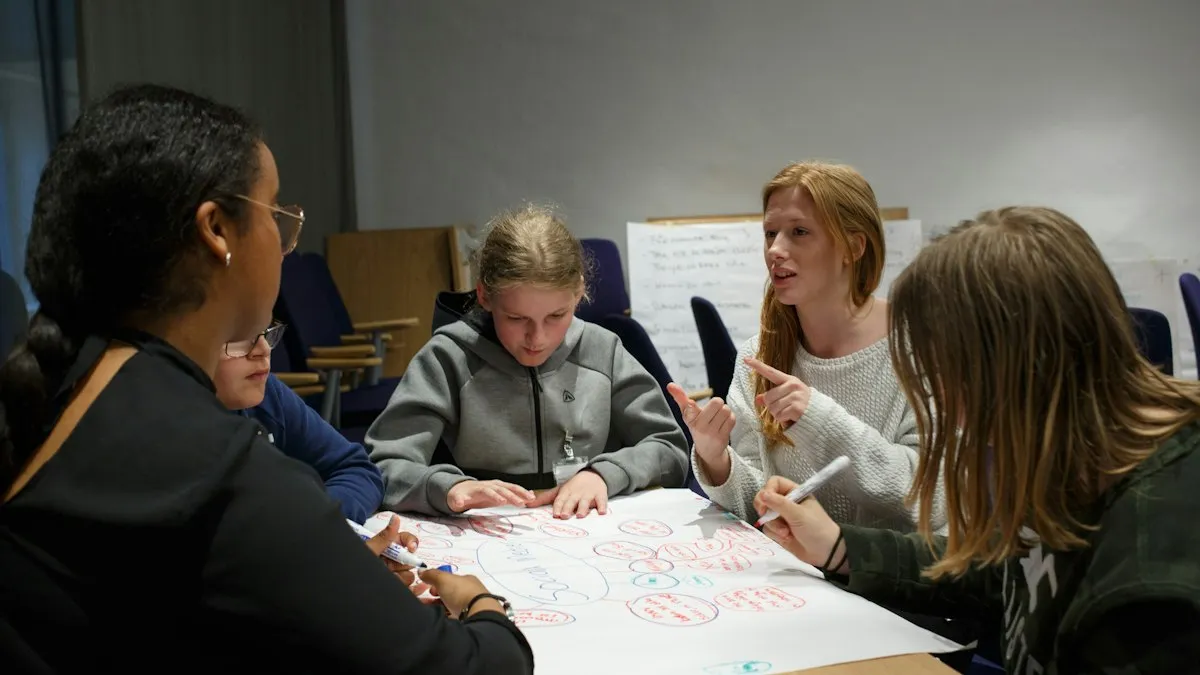

A classroom center is a small, defined area of a classroom where children work on one kind of activity, usually in a small group and often by choice. What is a classroom center, and why do teachers use them?
It is a way of turning a classroom into several small learning spaces at once, so that while one group reads, another builds, another draws and another explores. Centers let children practise skills hands-on, work at their own pace and make choices about what they do, while the teacher works closely with one small group at a time.
Centers are most common in early years and primary classrooms, but the idea works anywhere children need to learn by doing. The best centers are simple to set up, clear about what children should do there, and easy to tidy, which matters more than it sounds, because a center that takes twenty minutes to reset will not be used twice. This guide covers the centers that work, how to set them up, and how to keep them running.
Key takeaways
- A classroom center is a small, focused area for one kind of activity, used by a small group at a time.
- Start with four or five centers, and add more only when the routines are working.
- Every center needs a clear task, the materials to do it, and a visible way to know when it is finished.
- Rotate activities weekly, but keep the center itself in the same place.
- Teach the routines before expecting independence, and model exactly what good work looks like.
- Observe children at centers: what they choose and how they work tells you what they need next.
The reading center: the heart of the room
The reading center is the most important center in most classrooms, and it deserves the best spot in the room: a quiet corner with soft seating, good light and books at the children’s level. Fill it with a mix of picture books, simple chapter books, magazines and books about the current topic, and change the selection regularly so there is always something new to discover.
Give children a clear purpose at the reading center, not just free reading. A basket of books with a question card, a reading log to fill in, or a partner-reading routine turns browsing into learning. A cosy rug, a few cushions and a low shelf make the space inviting, and a simple rule, such as four children at a time, keeps it calm enough for reading.
Best for: every classroom, from early years to the upper primary years, where independent reading time builds fluency and a love of books.
The maths center: hands-on numbers
Maths is easier to learn with objects in hand, and the maths center is where that happens. Stock it with counting materials, dice, cards, measuring tools, clocks and simple games, and set tasks that match what the class is learning that week. A child who counts with real objects, measures with a real ruler or plays a number game understands the idea faster than one who only sees it on a worksheet.
Keep the tasks short and self-checking, so children know whether they got it right without waiting for the teacher. Answer cards in an envelope, a matching game with a finished picture, or a task card with the answer on the back all work. Change the activities weekly, but keep the materials familiar, so children spend their time on the maths rather than learning how the center works.
Best for: children who find written maths hard, and for any class where number facts need regular, low-pressure practice.
The writing center: a place to put words down
The writing center is a small table with everything a child needs to write: paper in different sizes and colours, pencils, pens, envelopes, cards, word lists and a few interesting objects to write about. Children can write stories, letters, lists, labels and signs, and the variety matters, because a child who will not write a story may happily write a birthday card or a shop list.
Model the writing first, and leave examples on display, so children know what good work at the center looks like. A word wall with the words the class is learning, a tray of picture prompts, and a finished-work display all help. Keep the center stocked and tidy, and celebrate the writing that comes out of it by displaying it, not by marking every word.
Best for: reluctant writers, who often write more freely at a center than at their desk, and for classrooms where writing needs daily practice.
The art center: making and exploring
The art center is where children make things, and it should look like a small studio rather than a cupboard of supplies. Set out paints, crayons, paper, scissors, glue and collage materials in labelled trays, so children can find what they need and put it back without help. A drying rack or a line with pegs keeps wet work safe, and an apron hook by the door keeps clothes clean.
Link the art center to what the class is learning, but leave room for free making too. A still-life table, a colour-mixing task or a seasonal project gives the center a purpose, while open access to materials lets children follow their own ideas. Cover the table, protect the floor, and set a clear rule about how many children can use the center at once, since art spreads fast.
Best for: creative children, and for any class where fine motor skills and imagination need regular exercise.
The science and discovery center: questions first
The science center is built around questions rather than answers. Fill it with magnifying glasses, magnets, shells, leaves, simple measuring tools and objects to sort, and change the contents with the topic and the season. A tray of autumn leaves, a set of magnets and metal objects, or a collection of rocks gives children something real to investigate.
Add a question card that asks children to predict, observe and record what they find, and a simple recording sheet they can complete on their own. A plant growing on the windowsill, a weather chart or a nature table keeps the center alive between changes. The point is not to teach a lesson at the center, but to give children the tools and the time to ask questions and test ideas.
Books make every center stronger, so our guide to the best baby books covers first books for the youngest readers, and our guide to the best 1-year-old gifts has ideas for toys that build early skills. For play that supports learning, our guide to the best baby toys compares toys that encourage exploration and problem-solving.
Best for: curious children, and for topics like seasons, materials and living things, where hands-on exploration beats a picture in a book.
Setting up centers that actually work
Centers fail for predictable reasons, and most of them are easy to avoid. The first is too many centers at once: four or five working centers beat ten half-finished ones, because children need to learn the routines for each one. Start small, teach each center properly, and add more only when the first ones run smoothly.
The second is unclear tasks. Every center needs a task card with a picture or a few simple words that says what to do, and a clear way to know when the task is finished. The third is poor organisation: materials in labelled trays, a visible limit on how many children can use a center, and a tidy-up routine that takes minutes, not a lesson. Get those three right, and centers run themselves for much of the time.
Best for: new teachers and anyone setting up centers for the first time, where a slow, careful start saves weeks of fixing later.

Your classroom center checklist
Work through this list when you set up a new center, and again when one stops working.
- Does the center have one clear purpose, and can children say what it is?
- Is there a task card with a picture or simple words that explains what to do?
- Are all the materials in the center, in labelled trays, so nothing needs fetching?
- Is there a visible limit on how many children can use the center at once?
- Can children tell when the task is finished, without asking the teacher?
- Is the center in the right place: quiet ones away from busy areas, messy ones near a sink?
- Have you modelled the center, showing exactly what good work looks like?
- Do children know how to tidy the center, and does tidying take only a few minutes?
- Are the activities changed weekly, while the center itself stays in the same place?
- Are you observing children at the center, and using what you see to plan next steps?
Comparing the main classroom centers
| Center | Main skill | Key materials | Group size | Best for |
|---|---|---|---|---|
| Reading | Reading fluency | Books, cushions, reading logs | 2 to 4 | Daily independent reading |
| Maths | Number and measuring | Counters, dice, cards, rulers | 2 to 4 | Hands-on number practice |
| Writing | Writing for purpose | Paper, pens, word lists, envelopes | 2 to 4 | Reluctant writers |
| Art | Creativity and fine motor skills | Paints, paper, scissors, glue | 3 to 4 | Free making and projects |
| Science and discovery | Observation and questioning | Magnifiers, magnets, natural objects | 2 to 4 | Curiosity and investigation |
| Block and construction | Problem-solving and cooperation | Blocks, cars, figures, mats | 3 to 5 | Building and teamwork |
Frequently asked questions
How many classroom centers should I have?
Four or five centers is a good start. That is enough to give children real choice without overwhelming them, and it lets you teach the routines for each one properly. Add more only when the first ones are running smoothly.
How long should children spend at a center?
Most centers work well in blocks of 15 to 20 minutes for younger children, and up to 30 minutes for older ones. Shorter blocks keep children focused, and a timer or a song helps them know when it is time to rotate.
How do I manage behaviour at centers?
Teach the routines first, model exactly what you expect, and keep groups small. A visible limit on numbers, a clear task and a tidy-up routine prevent most problems, and a quiet word with one child beats stopping the whole class.
Should centers be free choice or assigned?
Both work, and many teachers mix the two: some centers are free choice, while one is a teacher-assigned task that every child visits during the week. Free choice builds independence, while assigned centers make sure every child practises the key skills.
How often should I change center activities?
Change the activities weekly, or when the class topic changes, but keep the center in the same place and keep the materials familiar. Children learn faster when the place stays the same and only the task changes.
What is the difference between a center and a station?
The two words are often used for the same thing. A center is usually a permanent area of the room with a theme, such as reading or art, while a station is often a temporary task set up for one lesson. In practice, most classrooms use the words interchangeably.
The bottom line
A classroom center is a small space with a clear purpose, the right materials and a task children can do on their own. Start with four or five centers, teach the routines properly, keep the tasks clear and the tidying quick, and change the activities weekly. Done well, centers give children choice, practice and independence, while giving the teacher time to work closely with one small group at a time, which is the real reason they exist.