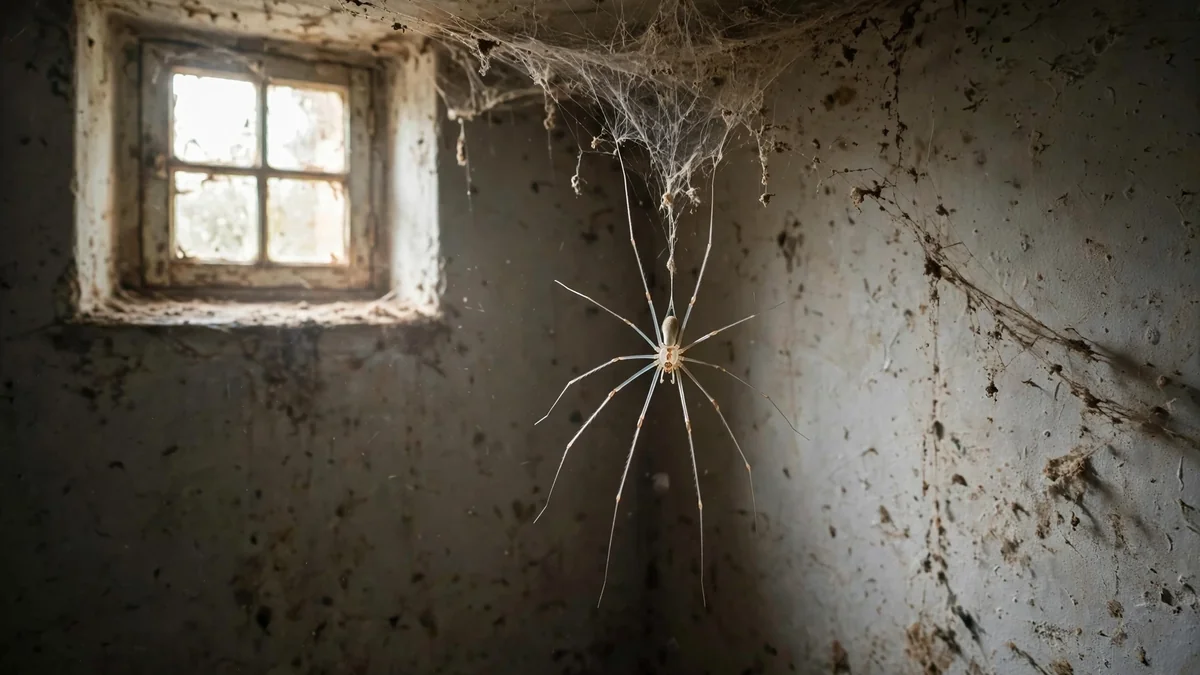

The cellar spider is the long-legged spider that hangs upside down in the corner of a basement, garage or quiet bathroom, and it is one of the least troublesome spiders to share a house with. It does not want your food or wander the floor at night, and it spends most of its life in one small patch of web, waiting for something to blunder in. If you have found one, you can leave it alone, and if you would rather not, a glass and a piece of card will move it outside without any fuss.
Key takeaways
- A cellar spider is a small-bodied spider with extremely long, thin legs, usually hanging upside down in a messy, tangled web.
- The common house species is Pholcus phalangioides, also called the long-bodied cellar spider.
- Cellar spiders are not dangerous to people, and bites are very rare and mild.
- The claim that they are the most venomous spider of all is a myth, tested and disproved.
- They eat insects and other spiders, including larger house spiders, which makes them useful housemates.
- A glass and a stiff piece of card is the simplest way to move one outside.
How to recognise a cellar spider
The first thing you notice is the legs. A cellar spider has a tiny body, only about the length of a grain of rice, carried on eight legs so long and thin that the whole animal can span the width of a coffee mug. Females measure about 7 to 10 millimetres, males about 6 to 7, and the leg span can reach 50 to 70 millimetres, with legs five to six times the body length. The body is usually pale yellowish-brown to grey and slightly see-through, with a cylindrical abdomen about three times longer than wide, and a grey blotch on the back said to look like a skull, hence the nickname skull spider. It has eight eyes, in two groups of three with a small pair in front.
That upside-down pose is the best clue. Most house spiders sit the right way up in a tidy orb web or hide in a funnel, but the cellar spider builds a loose, tangled web with no pattern at all and hangs beneath it, waiting. The silk has no sticky coating, so prey is caught by the tangle itself rather than by glue. If you touch the web, the spider will often shake it hard, blurring into a trembling smudge that is hard for a predator to grab, which is why it is also called the vibrating spider. People sometimes confuse them with harvestmen, also called daddy longlegs, but harvestmen have one round body segment and no web at all.
Where cellar spiders live, and why they pick your house
Cellar spiders like the places in a house that people leave alone. A cellar is ideal, which is where the name comes from, but a garage, a garden shed, a loft, the corner behind a boiler or a little-used bathroom ceiling will do just as well. They want still air, a bit of damp and somewhere their web will not be disturbed for weeks at a time. They live on every continent except Antarctica, outdoors in caves, under rocks and loose bark and in abandoned animal burrows, as well as indoors.
The family behind them is a large one: the Pholcidae family on Wikipedia lists 97 genera and 2,055 species, and the one in most homes is Pholcus phalangioides, first described in 1775 by Johann Kaspar Füssli. If you would rather keep spiders out altogether, the guide to pest control sets out the simple housekeeping steps that make a home less inviting to them.
| Creature | How to tell it apart | Web | Venom risk to people |
|---|---|---|---|
| Cellar spider | Tiny pale body, very long thin legs; hangs upside down | Messy tangle with no sticky silk | Not medically significant; bites are rare |
| Harvestman | One round body segment, not two; also called daddy longlegs | No web at all | No venom and no fangs |
| Crane fly | A fly with very long legs, not a spider at all | No web at all | No venom |
| Redback spider | A genuinely venomous spider | Its own web; cellar spiders invade it | Venomous |
| Huntsman spider | A large wandering spider that cellar spiders are known to hunt and eat | No web; it hunts on foot | Venomous |

Do cellar spiders bite? And the most venomous spider myth
This is the question most people ask first, and the answer is reassuring. Cellar spiders are not dangerous to people. Their fangs are short, about a quarter of a millimetre, and hooked in shape, their venom is made for subduing tiny insects, and they would much rather shake their web, drop to the floor or play dead than bite. Bites are so rare that most stories about them come from people squeezing a spider against their skin by accident, for example by putting on a shoe where one had settled.
There is also a stubborn myth that the cellar spider has the most potent venom of any spider but fangs too small to pierce human skin. It is not true, and it has been put to the test. MythBusters tried it in 2004, and found the venom far weaker than black widow venom in mice, while Adam Savage took a bite that broke the skin and felt only a mild, short-lived burning sensation. Spider expert Rick Vetter has said the daddy long-legs spider has never harmed a human physically, and there is no evidence that they are dangerous to humans. The legend probably grew because cellar spiders kill genuinely venomous spiders such as redbacks, and people assumed the killer must be more venomous than its victim. The same myth is repeated about harvestmen and crane flies, and it is untrue for them too. If one is on your hand, stay calm, hold your hand low and let it walk off, or tip it gently into a glass.
What cellar spiders eat, including other spiders
A cellar spider eats whatever blunders into its web, mostly small flies, gnats and moths. But the more surprising part of its diet is other spiders. A cellar spider will happily invade the web of a larger spider, pluck at the silk to imitate a trapped insect, and then attack when the owner comes to investigate. It casts silk onto its prey from a safe distance before moving in. It has been seen taking house spiders bigger than itself, including Tegenaria funnel weavers, as well as redbacks and huntsman spiders. The fennec fox is another small hunter that works alone and keeps to itself.
Cellar spiders, cobwebs and housekeeping
The main complaint people have about cellar spiders is not the spider itself but the web. A cellar spider web collects dust quickly, and after a few months it looks like a grey, cobwebby clump in the corner. Regular dusting with a duster or a vacuum cleaner keeps them tidy, and it also removes the egg bundles, which the female carries in her jaws. One female can produce several bundles, so a web that is never dusted can quietly become a nursery.
If you want fewer spiders without reaching for sprays, start small. Seal gaps around windows and doors, fix dripping taps and damp patches, and clear clutter from cellars and garages. A dehumidifier in a damp cellar helps too. The guide to best aquarium fish for beginners makes the same point in a very different setting: animals settle where the conditions suit them.
Moving a cellar spider on, step by step
If you would rather the spider lived somewhere else, catching it is easy, because it does not run fast and it rarely leaves its web. Work slowly, keep the glass steady, and choose a dry, sheltered spot outside, such as a shed or a log pile, rather than open lawn where birds will spot it at once.
- Take a large glass or a clear tub and a stiff piece of card that is wider than the mouth of the glass.
- Hold the glass over the spider and the web around it, moving slowly so it does not drop away.
- Slide the card gently across the mouth of the glass until the spider and its web are inside.
- Lift the glass away from the wall, keeping the card pressed flat against the rim.
- Carry it outside to a sheltered spot, lift the card, and let the spider walk out on its own.
Do not try to pick a cellar spider up by a leg. The legs are fragile and will come away in your fingers, and a spider that loses legs will struggle to build and hunt. The glass method keeps the animal whole, and it keeps your hands away from the web.
Your cellar spider checklist
- Check the legs first: a tiny pale body on very long, thin legs is a cellar spider.
- Look for the upside-down pose in a messy, tangled web in a high corner.
- Remember that cellar spiders are not dangerous, and bites are very rare.
- Do not believe the most venomous spider myth.
- Expect them in damp, quiet places: cellars, garages, sheds, lofts and bathrooms.
- Leave the web alone if you can; the spider eats flies and other spiders.
- Dust webs regularly if the grey, cobwebby look bothers you.
- Move a spider with a glass and card, never by a leg, and release it somewhere sheltered.
Are cellar spiders dangerous?
No. Cellar spiders are not dangerous to people. Their venom is made for small insects, they are shy, and they would rather shake their web or drop to the floor than bite.
Why do cellar spiders hang upside down?
They hang upside down beneath their webs because that is how they wait for prey. The position lets them feel vibrations in the silk from every direction, and they can reach a trapped insect quickly from below.
Do cellar spiders eat other spiders?
Yes. Cellar spiders often eat other spiders, including house spiders larger than themselves. They pluck at another spider’s web to lure it out, then attack.
How long do cellar spiders live?
A cellar spider takes about a year to mature, and can live for up to two years after that. Females carry their egg bundle in their jaws, and can produce several bundles during their life.
Should I kill a cellar spider in my house?
There is no need to. Cellar spiders are harmless, they eat flies and other spiders, and they stay in one corner. If you would rather not share the room, a glass and card will move one outside safely.
Why do I have so many cellar spiders in my cellar?
Cellars suit them: still air, a little damp, few disturbances and a steady supply of small insects. A quiet cellar gives each spider its own corner, so numbers can build up unnoticed.
The bottom line
The cellar spider is a quiet, long-legged housemate that asks for a dusty corner and gives back a home with fewer flies and fewer spiders. It is easy to recognise by its tiny body, very long legs and upside-down pose in a tangled web, and it is not dangerous to people, whatever the old myth says. Dust the webs if they bother you, seal the gaps and dry out the damp, and if one needs to go, a glass and a piece of card will do the job.
This article is general information only and is not medical advice. Spider bites are rare and usually mild, but if you have pain, swelling or a reaction that worries you, or if a bite does not settle within a day or two, speak to a pharmacist or a doctor for advice.