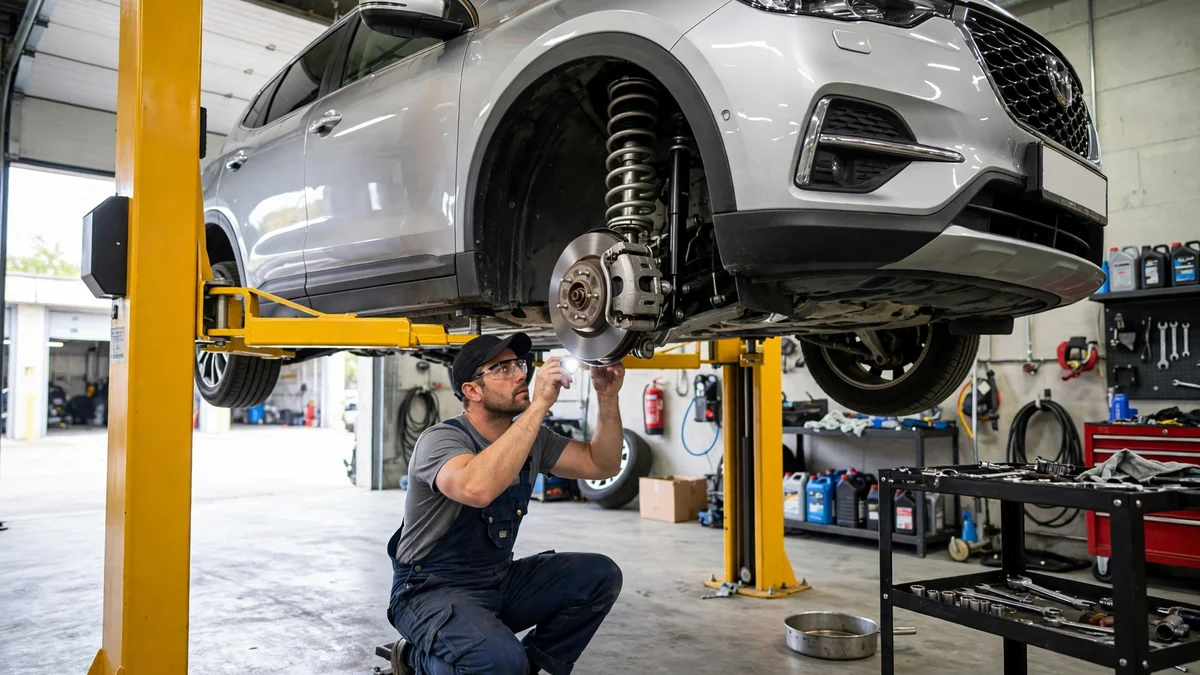

Suspension repair is the work of restoring the parts that connect your car to its wheels and keep the tyres in contact with the road, and it becomes necessary when shocks, springs, bushes or joints wear out. A healthy suspension absorbs bumps, keeps the car level in corners and lets the brakes work at their best. When it starts to fail, the signs are usually easy to feel: a ride that has turned harsh or bouncy, knocking over small bumps, uneven tyre wear, or a car that leans heavily in corners. None of these signs should be ignored, because the suspension is part of the safety system, not a comfort extra.
Key takeaways
- The suspension links the car to its wheels, absorbing bumps and keeping the tyres in contact with the road.
- Knocking over bumps, a bouncy ride, uneven tyre wear and leaning in corners are the classic warning signs.
- Shock absorbers damp movement; springs carry the weight; bushes and joints hold everything together.
- A broken spring or a loose joint is a safety fault that should not be driven on.
- Garages usually replace suspension parts in pairs across an axle so the car handles evenly.
- Costs vary widely by car and part, so always get a written quote that names each part and the labour.
How a car suspension works
Every wheel on a car is connected to the body through a suspension system, and the system has three jobs: to carry the weight of the car, to absorb bumps from the road, and to keep the tyres pressed against the surface so steering and braking work properly. The main parts are the springs, which carry the weight and absorb large movements, and the shock absorbers, also called dampers, which control how quickly the springs move and stop the car bouncing after every bump. Around them sit bushes, ball joints, control arms and anti-roll bars, which hold the wheel in the right position and let it move up and down without wobbling sideways.
The warning signs worth knowing
The most common sign of suspension trouble is noise. A knocking or clunking sound over speed bumps, potholes or uneven roads often points to worn bushes, a loose anti-roll bar link or a tired ball joint. A squeaking or creaking sound when turning or going over bumps can mean dry or worn bushes. A rattling from one corner of the car that changes with road speed is worth investigating promptly, because a loose suspension part can damage other components if it is left to knock around.
The second sign is how the car feels. A car that bounces several times after a bump, or that feels floaty and unsettled at speed, usually has worn shock absorbers that are no longer controlling the springs. A car that leans heavily in corners or dives sharply under braking has the same problem in a different form. A steering wheel that feels vague, or a car that wanders and needs constant correction on a straight road, can point to worn joints or bushes letting a wheel move where it should not. Checking the tyres for uneven wear is one of the cheapest ways to catch suspension wear early, and the habit of looking closely before a small problem grows is the same one that serves any careful inspection, from tyre treads to the patient searching described in our guide to the metal detector.
What a garage checks during suspension repair
A proper suspension inspection starts with the car on a lift, where a technician can see the whole system and test each part by hand. They will look for broken springs, leaking dampers, cracked bushes, torn rubber boots and rust on load-bearing parts. They will grip each wheel and rock it to feel for play in the ball joints and wheel bearings, and they will check the anti-roll bar links and mounts for looseness. This hands-on check is the heart of the diagnosis, because many suspension faults cannot be found by looking alone. Bring water if you are waiting at the garage while the work is done; our guide to the best water bottle can help you choose one.
Once the fault is found, the repair itself is usually straightforward but physically demanding. Shock absorbers and struts are unbolted and replaced, springs are compressed with a special tool before they are removed, and bushes are pressed out and new ones pressed in. Wheel alignment is checked afterwards, because any work on the suspension changes the angles at which the wheels sit, and a car that leaves the garage with poor alignment will wear its tyres quickly. A good garage will show you the worn parts it removed, explain what failed, and give you a written quote before starting work. The shock absorber is the component most drivers have heard of, and understanding what it does makes the garage’s explanation much easier to follow.
Repair in pairs, and what affects the cost
What you can do is control how the cost is presented. Ask for a written quote that names each part, its price, and the labour separately, and ask whether the parts are original manufacturer parts or quality aftermarket parts. Ask whether the quote includes wheel alignment afterwards, since it should. And ask the garage to keep the old parts for you to see, which is a reasonable request and a good check that the work described was the work done. Comparing quotes from two or three garages is sensible, but the cheapest quote is not always the best one if it leaves out the alignment or uses parts with a short warranty. The same care that goes into choosing a tradesperson for the home applies here, and our guide to heat pump repair makes the same point about written quotes and named parts.
Suspension parts compared
| Part | What it does | Typical symptoms | Urgency |
|---|---|---|---|
| Shock absorber | Controls spring movement and stops bouncing | Bouncy ride, leaning in corners, cupped tyres | Book soon |
| Coil spring | Carries the weight of the car | Car sits low on one corner, knocking, harsh ride | Do not drive if broken |
| Ball joint | Lets the wheel steer and move up and down | Knocking, vague steering, uneven tyre wear | Do not drive if loose |
| Bushes | Cushion joints and absorb vibration | Clunking, creaking, wandering steering | Book soon |
| Anti-roll bar link | Reduces body lean in corners | Knocking over small bumps, more lean | Book soon |
| Top mount and bearing | Joins the strut to the body and lets it turn | Knocking when steering, stiff steering | Book soon |

Can you repair suspension yourself?
Spring work deserves particular respect. A coil spring stores a large amount of energy, and a spring compressor is needed to remove and refit one safely. A spring that slips out of a compressor can cause a serious injury, and this is not a job to improvise. For most drivers, the sensible line is to handle inspection and simple checks at home, and to leave spring replacement, strut work and anything involving the steering joints to a garage with a lift and the right equipment.
A checklist before you book suspension repair
- Note when the noise or symptom started, and whether it comes from one corner or the whole car.
- Check the tyres for uneven or cupped wear, and note which tyres are affected.
- Look at the car’s stance: does one corner sit lower than the others?
- Try the bounce test on each corner and note which corners keep bouncing.
- Listen for knocks over bumps and for creaks when turning at low speed.
- Ask the garage for a written quote naming each part and the labour separately.
- Confirm the quote includes wheel alignment after the work is done.
- Ask the garage to keep the old parts so you can see what failed.
Frequently asked questions
How do I know if my shock absorbers are worn?
The usual signs are a bouncy or floaty ride, a car that keeps bouncing after a bump, heavy leaning in corners, and cupped or scalloped wear on the tyres. A garage can confirm the diagnosis by inspecting the dampers for leaks and testing each corner by hand. The bounce test, pressing down firmly on a corner and watching how it settles, is a rough guide at home, but it is not a substitute for an inspection on a lift.
Can I drive with a broken coil spring?
No, you should not. A broken spring can shift position, damage the tyre, affect the steering, and in the worst case puncture a tyre or drop the car onto the road. If you suspect a spring has broken, because the car sits low on one corner or you hear a sharp knock, stop driving and arrange recovery or a garage visit. A broken spring is a safety fault, not a repair that can wait for a convenient week.
Should suspension parts be replaced in pairs?
Usually, yes. Shock absorbers, springs and bushes are normally replaced on both sides of an axle together, so the car handles evenly and both sides wear from the same starting point. A new damper on one side and a worn one on the other will make the car pull or lean unevenly. The exception is damage confined to one side, such as a kerb strike, where only the damaged side needs attention.
How long does suspension repair take?
It depends on the job. A pair of rear shock absorbers can be a short job, while a pair of front struts with new top mounts takes longer, and seized or rusted bolts can add time to any of them. A garage should be able to give you a time estimate when it quotes, and it should tell you if the estimate changes once the work starts.
Will worn suspension fail an MOT?
It can. Inspectors check for broken springs, leaking dampers, excessive play in joints and bushes, and insecure mountings, and serious faults in any of these will fail the test. Worn but not yet dangerous parts may be recorded as advisories, which are a warning to repair them before they become a failure. An advisory is worth acting on rather than filing away, because suspension wear only moves in one direction.
What causes suspension parts to wear out?
Age, mileage and road conditions are the main causes. Rubber bushes harden and crack over time, dampers lose fluid and wear internally, and springs corrode, especially where road salt is used in winter. Potholes, speed bumps taken at speed and kerb strikes speed the process up, and a car that regularly carries heavy loads will wear its rear suspension faster. There is no way to stop wear entirely, but gentle driving over rough surfaces and regular tyre checks help it arrive later.
The bottom line
Suspension repair is not a mystery, and it is not a job to put off once the signs are clear. Learn the symptoms, check your tyres, and get a proper inspection on a lift when something changes. A worn damper can be planned for, but a broken spring or a loose joint cannot be driven on, and the difference between the two is worth knowing before you turn the key. A written quote, parts replaced in pairs, and an alignment afterwards will leave the car riding the way it should, and your tyres will last longer for it.
Safety note: never work under a car supported only by a jack. Always use rated axle stands on solid, level ground, chock the wheels that stay on the ground, and treat coil springs as stored energy: use a proper spring compressor and never improvise. If you are unsure about any part of the job, leave it to a qualified garage.