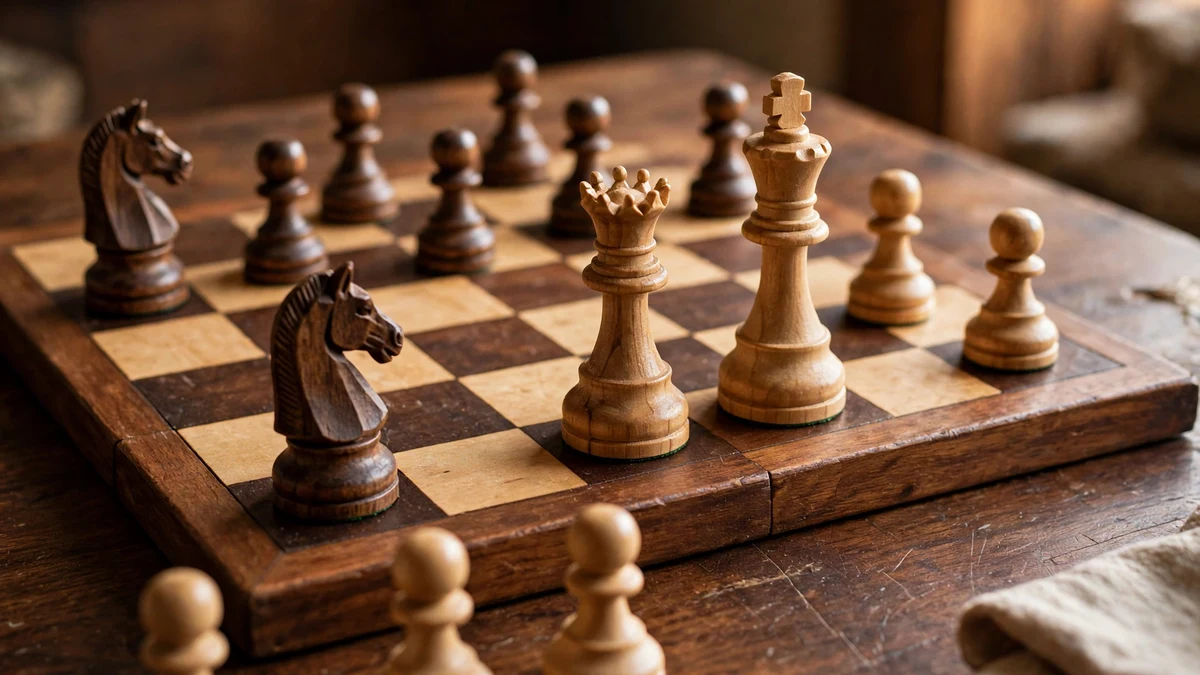

Chess pieces are the six types of playing pieces used in chess: the king, the queen, the rooks, the bishops, the knights and the pawns. Each player starts with sixteen pieces, eight pawns and eight other pieces, and each type moves in its own way, which is what gives the game its depth. The aim is to checkmate the opposing king, which means attacking it in a way that cannot be escaped. If you are learning the game, the fastest route to a first proper match is to learn the six moves, set the board up correctly, and play a few slow games while the rules settle in.
Chess has been played in recognisable form for centuries, and the pieces have kept their names and moves through countless changes of style and material. A wooden set, a plastic set and a digital board all follow the same rules.
Key takeaways
- Each player starts with sixteen chess pieces: one king, one queen, two rooks, two bishops, two knights and eight pawns.
- The queen is the most powerful piece, moving any number of squares in any direction.
- The king moves one square in any direction and must never be left in check.
- Pawns move forward one square and capture diagonally, and can be promoted on the last rank.
- White always moves first, and the queen always starts on a square of her own colour.
- Castling and en passant are the two special moves that confuse most beginners.
The six chess pieces and how they move
The king is the most important piece, and the whole game revolves around it. It moves one square in any direction: forwards, backwards, sideways or diagonally. The king cannot move into check, which means it cannot move to a square attacked by an enemy piece. If the king is attacked and cannot escape, block the attack or capture the attacker, the game ends in checkmate and the player whose king is trapped loses.
The queen is the most powerful piece on the board. She moves any number of squares in any direction: along ranks, files and diagonals, combining the movement of a rook and a bishop. A queen placed in the centre of an open board can attack a large part of it, which is why losing a queen early usually costs the game. Beginners often bring the queen out too soon, where she can be chased around by smaller pieces, so a good habit is to develop the knights and bishops first and let the queen join the attack once the position is more open.
Rooks move any number of squares horizontally or vertically, but never diagonally. They are strongest on open files and ranks, and they become more powerful as the game goes on and pieces are exchanged, because the board opens up and gives them room. Rooks work well in pairs, and they are the piece that joins the king in castling.
Bishops move any number of squares diagonally, and each bishop stays on the same colour of square for the whole game. A bishop is strongest on a long open diagonal, where it can reach across the board. Two bishops working together are famously powerful, because together they cover every square on the board. Knights move in an L shape: two squares in one direction and then one square to the side. The knight is the only piece that can jump over other pieces, which makes it useful in crowded positions.
Pawns are the smallest pieces, and the most misunderstood. A pawn moves one square straight forward, or two squares forward on its first move, but it captures one square diagonally forward. A pawn cannot move backwards, and it cannot capture straight ahead, so a pawn blocked by an enemy piece directly in front of it is stuck. When a pawn reaches the far side of the board, it is promoted: the player replaces it with a queen, rook, bishop or knight, usually a queen.
How to set up the chess board
Setting the board up correctly takes less than a minute once you know the rules. First, place the board so that a light-coloured square sits on the right-hand side of each player. The saying to remember is white on the right. If the corner square nearest your right hand is dark, turn the board around. This is the most common setup mistake, and it matters, because the whole starting position depends on it.
Next, place the pawns on the second rank from each side: eight white pawns on the second rank from White’s side, and eight black pawns on the seventh rank. Then place the back-rank pieces in this order, from the corner inwards: rook, knight, bishop, queen, king, bishop, knight, rook. The queen always starts on a square of her own colour, which is the easy way to check you have it right: the white queen starts on a light square and the black queen on a dark square. White always makes the first move.

Once the board is set, take a moment to check it before the first move. Both kings should face each other across the board, with the queens beside them, and the knights should sit between the rooks and the bishops. If a piece looks out of place, it is usually the queen and king that have been swapped, or the board that has been turned the wrong way. A quick check saves confusion later, because a game played from a wrong starting position is not a real game of chess.
The value of each piece
Players and teachers give each piece a rough point value to help beginners judge trades. A pawn is worth one point, a knight and a bishop are each worth three, a rook is worth five, and the queen is worth nine. The king has no point value, because it cannot be captured. These numbers are a guide, not a law: a bishop on a long open diagonal can be worth more than a knight stuck behind its own pawns, and a pawn about to be promoted can be worth more than a rook.
| Piece | How it moves | Point value |
|---|---|---|
| King | One square in any direction | Priceless, cannot be captured |
| Queen | Any distance, any direction | Nine points |
| Rook | Any distance, straight lines only | Five points |
| Bishop | Any distance, diagonally only | Three points |
| Knight | Two squares one way, one to the side | Three points |
| Pawn | Forward one square, captures diagonally | One point |
Special moves: castling, en passant and promotion
Castling is the only move in which two pieces move at once, and it is the way to get the king to safety while bringing a rook into play. To castle, the king moves two squares towards a rook, and the rook jumps over the king to the square beside it. Castling is only allowed when neither the king nor the rook has moved yet, when no pieces stand between them, and when the king is not in check, does not pass through check, and does not end in check. Most players castle early, usually within the first ten moves, because a king left in the centre is exposed to attack once the board opens up.
En passant is the rarest move in chess, and it only involves pawns. When a pawn moves two squares forward from its starting position and lands beside an enemy pawn, that enemy pawn may capture it as if it had only moved one square, by moving diagonally to the square the pawn passed over. The capture must be made immediately, on the very next move, or the chance is lost. En passant looks strange the first time you see it, because the captured pawn is not on the square the capturing pawn lands on, but it is a real rule, and it exists to stop a pawn from using the two-square move to slip past an enemy pawn.
Promotion, covered above, is the third special rule, and it is the one that most often decides games between beginners. A pawn that reaches the last rank must be promoted immediately, and it can become a queen, rook, bishop or knight of the same colour. There is no limit on how many queens a player can have, so a game can end with two or even three queens on the board. Promotion is almost always to a queen, because she is the strongest piece, but there are rare positions where a knight is better, usually because a knight can give check in a way a queen cannot.
Your first games: a simple plan
Use this checklist for your first few games, so the rules become habits rather than things to look up.
- Set the board with a light square on your right and the queen on her own colour.
- Develop your knights and bishops before your queen.
- Castle early to protect your king and bring a rook into play.
- Control the centre with pawns and pieces rather than moving the same piece twice.
- Count material before every capture, and check what is defended.
- Look for checks, captures and threats on every move, for both sides.
- Watch for pawns that can reach the last rank and be promoted.
- Keep your king safe in the middlegame, then bring it out in the endgame.
- Play slowly, and review your games afterwards to find the turning point.
- Do not worry about losing: every strong player lost hundreds of games while learning.
Frequently asked questions
How many chess pieces does each player have?
Each player starts with sixteen pieces: one king, one queen, two rooks, two bishops, two knights and eight pawns. The board therefore holds thirty-two pieces at the start of a game.
Which chess piece is the most powerful?
The queen is the most powerful piece, because she moves any number of squares in any direction. The king is the most important piece, because the game ends if he is checkmated, but the queen is the strongest attacker.
How does the knight move in chess?
The knight moves in an L shape: two squares in one direction, then one square to the side. It is the only piece that can jump over other pieces, which makes it useful in crowded positions.
What is castling in chess?
Castling is a special move in which the king moves two squares towards a rook and the rook jumps over to the other side of the king. It is allowed only when neither piece has moved, nothing stands between them, and the king is not in check or passing through check.
What happens when a pawn reaches the other side?
The pawn is promoted: it is replaced immediately with a queen, rook, bishop or knight of the same colour, chosen by the player. Promotion is almost always to a queen, because she is the strongest piece.
Can the king be captured in chess?
No, the king is never captured. A game ends in checkmate when the king is attacked and cannot escape, block or capture the attacker. If neither side can checkmate, the game can end in a draw or stalemate.
The bottom line
Chess pieces are simple to learn and take a lifetime to master: six types, each with its own move, arranged in the same starting position every time. Learn the moves, set the board up with the queen on her own colour, castle early, and play slowly enough to check what is defended before you move. The rest comes from practice, and every game teaches something new. For more games and puzzles, try our 4-4s puzzle, our guide to Stranger Things characters, and our article on where to meet people.