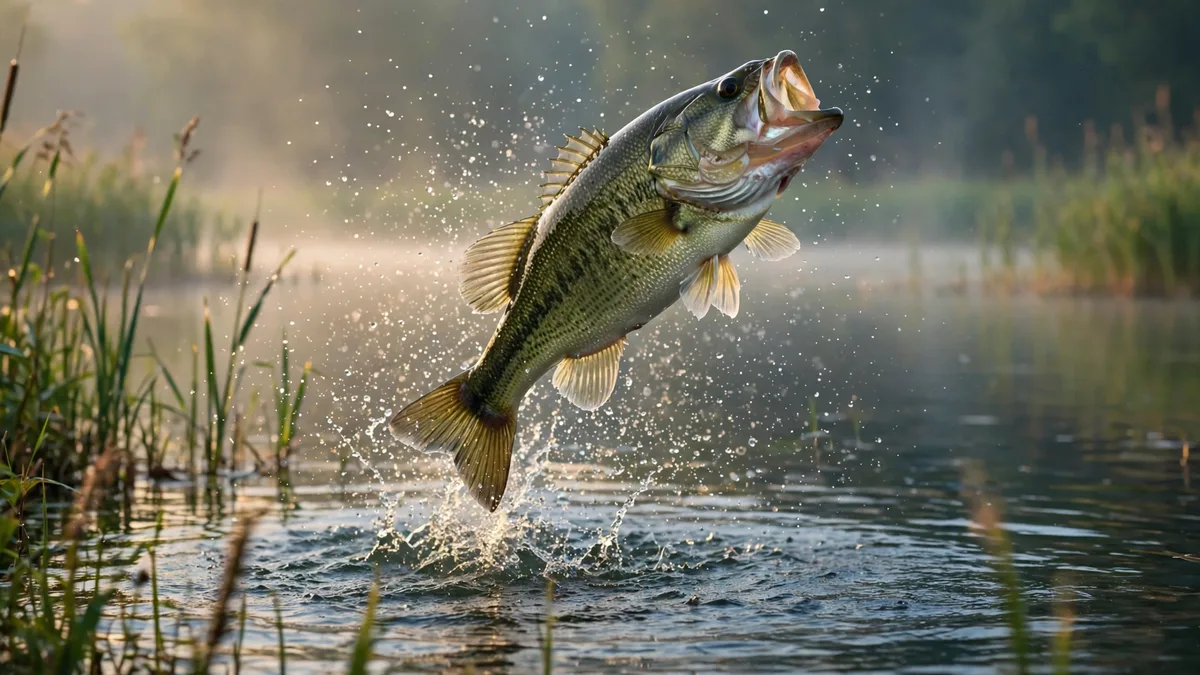

Largemouth bass are the most popular freshwater game fish in North America, and the reason is simple: they live in waters close to where people live, they strike hard, and they fight well on light tackle. If you want to know how to recognise one and catch one, the short answer is to fish slowly around weed, docks and fallen trees with a soft plastic worm, and to look for the large mouth whose upper jaw extends past the eye. This guide covers identification, habitat, seasons, tackle, technique and care for the fish.
The largemouth belongs to the sunfish family, and its scientific name is Micropterus salmoides. It is native to the eastern and central United States and southern Canada, and it has been introduced so widely around the world that it now swims in lakes and reservoirs on several continents. For many anglers it is the first serious freshwater fish they learn to catch, and for many it stays the favourite.
Key takeaways
- Largemouth bass are identified by a large mouth whose upper jaw extends past the eye.
- They favour warm, weedy lakes, ponds, reservoirs and slow rivers with cover.
- Spring and autumn are usually the most productive seasons for bank and boat anglers.
- Soft plastic worms, crankbaits, spinnerbaits and topwater lures all catch bass.
- Fish slowly around cover: docks, weed edges, fallen trees and lily pads.
- Handle bass with wet hands, support the body, and release them quickly.
How to identify largemouth bass
The largemouth is a greenish, deep-bodied fish with a dark, broken horizontal stripe running along each side. Its back is dark olive green, fading to a pale belly, and its fins are dusky rather than brightly coloured. The single most useful field mark is the mouth: when closed, the upper jaw extends clearly past the rear edge of the eye. That is the feature that separates it from its close cousin, the smallmouth bass, whose jaw ends around the middle of the eye.
Size varies a great deal with the water. In most lakes a catch of one to two pounds is common, and a fish over five pounds is a good one anywhere. The species can grow much larger in warm, fertile waters with plenty of prey, and the largest recorded fish are well into double figures. Age, food and water temperature all shape how fast a bass grows, so a small pond and a large reservoir can produce very different fish.
Where largemouth bass live
Largemouth bass are warm-water fish. They prefer water temperatures in the range of roughly 15 to 27 degrees Celsius, and they do best in lakes, ponds, reservoirs and slow-moving rivers with plenty of cover. Weed beds, lily pads, fallen trees, docks, brush piles and rocky points all give bass places to hide and ambush prey. In a new lake, look for the greenest, weediest water first.
They also follow depth with the seasons. In spring they move shallow to feed and spawn, often in water only a metre or two deep. In summer heat they drop deeper or hold tight to shade and weed edges during the day, feeding more actively at dawn and dusk. In winter they go deep and slow, holding near structure on the bottom.

What largemouth bass eat
Bass are opportunistic predators. Young bass eat insects, small crustaceans and tiny fish, while adults take minnows, shad, bluegill, frogs, crayfish and anything else that fits in that large mouth. They hunt mainly by sight and by sensing movement through the lateral line, the row of sensory pores along each side of the body. That is why a lure that wobbles, flashes or twitches often draws a strike when a still bait is ignored.
Matching the local prey is the most reliable approach. If the lake is full of small shad, a silver crankbait or spinnerbait is a natural choice; if frogs are common around the lily pads, a frog lure worked across the surface can be deadly. Watch the water before you cast: baitfish flickering near the surface or a bass swirling at a frog both tell you what is on the menu.
Fishing tips that actually help
Start simple. A medium spinning rod, a reel loaded with eight to twelve pound line, and a small box of soft plastic worms, a couple of crankbaits and a spinnerbait will catch bass in most waters. Rig a plastic worm weightless or on a light Texas rig, cast it tight to cover, and let it sink before moving it in short hops. Many bites come on the fall, so watch the line for any twitch or sudden slack.
Fish the cover, not the open water. Cast past a dock piling or a weed edge and bring the lure back along it. Work a fallen tree from several angles before moving on. In the early morning and late evening, try a topwater lure over weed beds and listen for the strike, which is often louder than the splash suggests. When the sun is high, slow down, fish deeper, and put the lure right against the shade line where bass wait out the heat.
Largemouth bass at a glance
The table below sums up the main facts about the species.
| Topic | What to know | Why it matters |
|---|---|---|
| Identification | Upper jaw extends past the eye; dark side stripe | Separates largemouth from smallmouth at a glance |
| Habitat | Warm, weedy lakes, ponds and slow rivers | Start your search in the greenest water |
| Food | Minnows, shad, frogs, crayfish, bluegill | Match your lure to the local prey |
| Best seasons | Spring and autumn; dawn and dusk in summer | Bass feed hardest in mild water |
| Tackle | Medium spinning rod, 8 to 12 pound line | Light enough for sport, strong enough for cover |
| Handling | Wet hands, support the body, quick release | Keeps the fish alive for the next angler |
Seasons: when to fish for bass
Spring is the classic bass season. As the water warms, bass move shallow to feed heavily and then to spawn, and they are often catchable from the bank in water you can see into. This is also the season to be most careful: a bass guarding a nest will strike almost anything, but taking it far from the nest leaves the eggs unguarded. Many anglers release spring fish quickly and close to where they were caught.
Summer means early starts and late finishes. Fish the first two hours of daylight and the last two before dark, and spend the middle of the day fishing deep structure or dense shade. Autumn is often the most forgiving season, as cooling water brings bass shallow again to feed before winter, and they will chase lures aggressively. Winter fishing is slow and deep: fish small lures very slowly near the bottom, and expect fewer bites but sometimes a larger fish.
Catch and release done properly
Most bass anglers release most of what they catch, and doing it well matters. Wet your hands before touching the fish, because dry hands strip away the protective slime that guards against infection. Hold the fish by the lower lip with one hand and support the belly with the other; never hold a heavy bass vertically by the jaw alone, as that can damage its jaw and spine. Barbless hooks or pinched barbs make release faster and kinder.
Keep the fish out of the water for as short a time as possible. A quick photograph is fine, but a long photo session on a hot day is not. If the fish is lively, return it head-first and let it swim away on its own; if it is sluggish, hold it gently in the water until it kicks away strongly. Always check local rules before you fish: size limits, bag limits and closed seasons vary by state and by water, and some waters are catch-and-release only.
Your largemouth bass checklist
Run through this list before your next trip to the water.
- Check local fishing rules, licences, size limits and closed seasons first.
- Pack a medium spinning rod with eight to twelve pound line.
- Carry soft plastic worms, a crankbait, a spinnerbait and a topwater lure.
- Start in the weediest, greenest water with the most cover.
- Cast tight to docks, weed edges, fallen trees and lily pads.
- Let a worm sink fully and watch the line for twitches on the fall.
- Fish dawn and dusk in summer; fish shallow in spring and autumn.
- Wet your hands before handling any bass you catch.
- Support the body and never hang a heavy fish by the jaw alone.
- Release the fish quickly, close to where you caught it.
Frequently asked questions
How can you tell a largemouth bass from a smallmouth bass?
Look at the jaw. On a largemouth, the upper jaw extends past the rear edge of the eye when the mouth is closed. On a smallmouth, the jaw ends around the middle of the eye. Largemouth also have a dark horizontal stripe along the side, while smallmouth are browner with vertical bars, and largemouth prefer weedy, warm water where smallmouth prefer cooler, rockier water.
What is the best bait for largemouth bass?
There is no single best bait, because bass eat what is available in their water. Soft plastic worms are the most reliable all-round choice for beginners, while crankbaits, spinnerbaits and topwater lures all have their days. The best approach is to match the local prey: silver lures where shad are common, green and brown plastics where crayfish live, and frog lures around lily pads.
Where do largemouth bass hide?
Bass hide wherever they can ambush prey while staying out of sight. Good spots include weed edges, lily pads, fallen trees, brush piles, docks, rocky points and drop-offs. In summer they also use shade from overhanging trees and boat houses. If a spot has cover, food and the right water temperature, bass will use it.
What time of day is best for bass fishing?
Dawn and dusk are usually best, especially in summer when the midday sun pushes bass deep or into shade. In spring and autumn, bass often feed well through the middle of the day too, since the water is mild. Overcast days can extend the morning bite, and a light breeze that ripples the surface often helps.
Do largemouth bass bite in winter?
Yes, but slowly. In cold water bass move less, feed less often and hold deep near structure on the bottom. Fish small lures very slowly, keep the lure close to the bottom, and be patient. Bites are often gentle, little more than a slight weight on the line, so stay alert.
Is catch and release safe for the fish?
Yes, when it is done properly. Wet hands, quick handling, barbless hooks and a fast return to the water all help a bass survive. Avoid holding a heavy fish vertically by the jaw, keep it out of the water only briefly, and revive a sluggish fish in the water before letting go. Check local rules, since some waters require release.
The bottom line
Largemouth bass are popular for good reason: they are widespread, they live in the kind of weedy, warm water that is easy to reach, and they fight hard enough to make even a modest fish memorable. Learn the jaw and the side stripe, fish the cover slowly, match the local prey, and handle every fish with wet hands and a quick release. Do that, and the same waters will keep giving you good fishing for years. For more outdoor reading, see our guide to the best aquarium fish for beginners, our notes on the Saguaro National Park, and our guide to the best seafood restaurants in Boston.
Fish safely: watch your footing on slippery banks, handle hooks with care, wear a life jacket when fishing from a boat, and check local rules and water conditions before you go.