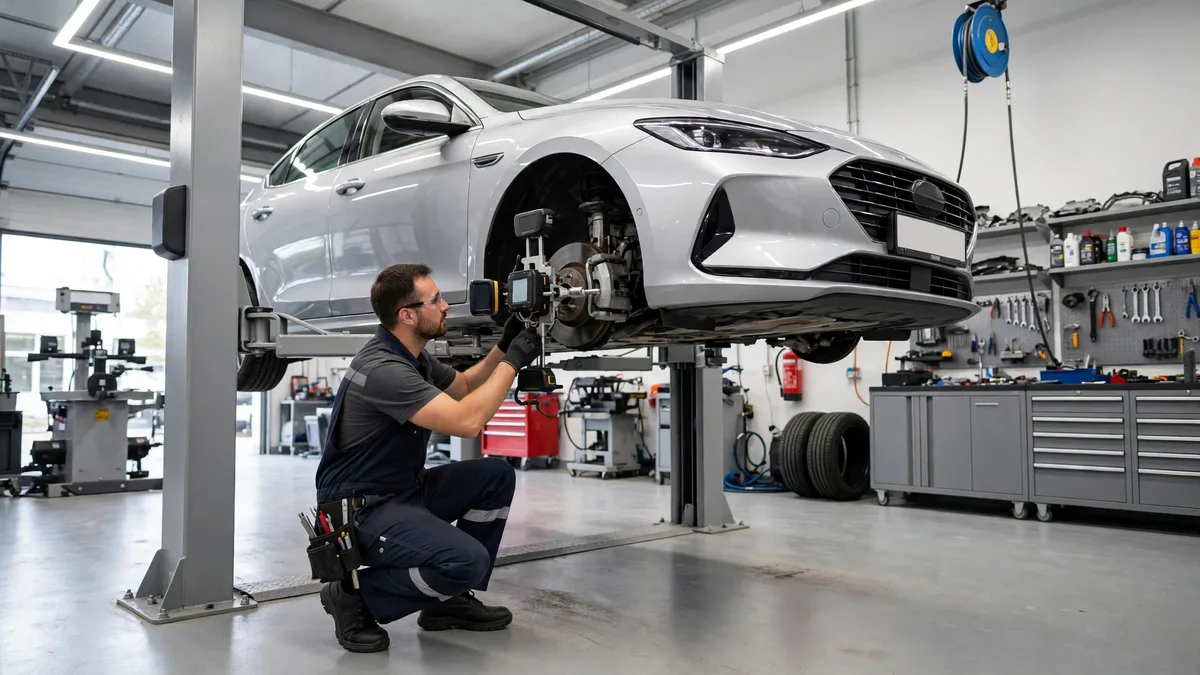

Alignment close to me is what most drivers type into their phone the moment their car starts pulling to one side, or the steering wheel sits crooked on a straight road. The short answer is that wheel alignment is the adjustment of the angles at which your wheels meet the road, and you need it checked when the car drifts, the steering feels off, or your tyres start wearing unevenly. A good garage nearby can measure those angles in under an hour and put them right.
It is a small job that makes a large difference. Correct alignment keeps the car travelling straight, helps the tyres last longer, and makes the steering feel steady and predictable. This guide explains the signs that your alignment needs attention, what a check actually involves, and how to choose a garage with confidence.
Key takeaways
- Wheel alignment sets the angles of your wheels against the road.
- A car pulling to one side is the most common sign of trouble.
- Uneven tyre wear is often the first clue, and the cheapest to spot.
- A crooked steering wheel on a straight road means something is off.
- Alignment is not the same as wheel balancing, though both matter.
- Check the alignment after hitting a pothole or a kerb, and when fitting new tyres.
Signs your wheels need alignment
The clearest sign is a car that pulls. On a straight, level road, with your hands light on the wheel, the car should travel straight ahead. If it drifts steadily to the left or the right, and you have to hold the wheel off-centre to keep it in lane, the alignment is the first thing to suspect. A slight drift can have other causes, such as uneven tyre pressure or a road that slopes for drainage, so check your tyre pressures first, but a strong or constant pull deserves a proper check.
The steering wheel itself tells a story. If it sits visibly crooked while the car travels straight, something in the angles has shifted. The same goes for a wheel that does not return to centre after a turn, or steering that feels vague and loose. Then there are the tyres: run your hand across the tread, and if one edge feels smooth while the other still has tread, or if the wear forms a feathered or saw-tooth pattern, the wheels are not meeting the road squarely. Vibration through the steering wheel, squealing tyres on corners, and a car that feels unstable at speed can all point the same way.
What wheel alignment actually is
Wheel alignment, sometimes called tracking, is the adjustment of three angles: camber, caster and toe. Camber is the tilt of the wheel when seen from the front: if the top of the wheel leans in or out, the tyre meets the road on one edge more than the other. Caster is the angle of the steering pivot when seen from the side, and it affects how the steering feels and how the wheel returns to centre after a turn. Toe is the direction the wheels point when seen from above: if they point slightly towards each other or away from each other, the tyres scrub sideways as they roll.

Manufacturers set target values for each of these angles, and they differ from car to car. When the angles are within their target range, the tyres roll straight, wear evenly, and grip as they should. When they drift outside it, usually after a knock, the car starts to show the signs described above. Alignment is not a single adjustment but a set of small corrections, and on many cars only the front wheels can be adjusted, while on others all four can be set.
What happens during an alignment check
A wheel alignment check is a measured, methodical job, and it helps to know what to expect before you book. The table below sets out the usual steps.
| Step | What happens | What to know |
|---|---|---|
| Inspection | The car is checked for worn parts and damage | Worn parts must be fixed before alignment |
| Tyre check | Pressures and wear are measured on all four tyres | Uneven wear confirms the diagnosis |
| Measurement | Sensors are fitted and the angles are read | Readings are compared with the maker’s figures |
| Adjustment | The angles are set back to their targets | Some cars allow front adjustment only |
| Test drive | The car is driven to check it runs straight | The wheel should sit level on a straight road |
| Report | You receive the before and after readings | Keep the report with your service records |
The whole job usually takes well under an hour, and most garages will show you the readings before and after, so you can see what was out and what was corrected. If the technician finds a worn ball joint, a bent arm, or a damaged bush, they should tell you before doing anything else, because alignment cannot fix a worn part: the part has to be replaced first, and the alignment done afterwards.
Alignment, balancing and tracking: what is the difference
Drivers often confuse alignment with wheel balancing, and garages sometimes use the terms loosely, which does not help. Alignment sets the angles of the wheels. Balancing corrects the distribution of weight around the wheel and tyre, usually by fitting small weights to the rim, and it cures vibration at speed rather than pulling. If your steering wheel shakes at motorway speed but the car runs straight, the likely cause is balance, not alignment. If the car pulls but does not shake, the likely cause is alignment.
Tracking is simply the older British word for alignment, and it usually refers to the front wheels only, particularly the toe angle. A “tracking check” at a tyre shop is generally a front-wheel alignment check, while a “four-wheel alignment” measures and adjusts all four corners. For most modern cars, a four-wheel check is the more thorough option, since the rear wheels affect how the car behaves too, but a front-only check is enough when the problem is clearly at the front. If you are unsure which you need, describe the symptoms and let the garage advise.
When to get your alignment checked
There is no single mileage for alignment checks, because the need depends on the roads you drive and the knocks your car takes. The sensible triggers are events rather than dates. Hit a deep pothole or a kerb hard, and the angles can shift in an instant. Fit new tyres, and it is worth having the alignment checked so the new rubber wears evenly from the start. Have suspension or steering work done, and the alignment should be checked as part of the job. Notice any of the signs in this guide, and do not put it off: uneven wear only gets worse, and a tyre worn down on one edge cannot be unworn.
A yearly check is a reasonable habit for most drivers, often combined with a service or a tyre change. It is a small job, and catching a misalignment early is far cheaper than replacing tyres that have worn out on one side. If your driving is mostly on smooth roads and the car feels fine, there is no need to chase the calendar, but if you drive on rough roads regularly, a check after the winter months is worth the trouble.
How to choose a garage near you
Searching for alignment close to me will return plenty of options, from tyre shops to main dealers, and the choice is less about the brand on the sign than about the equipment and the attitude. Look for a garage with a modern laser or camera-based alignment system rather than old manual gauges, since the measurements are finer and the results are easier to read. Ask whether they will show you the before and after readings: a good garage is glad to, and the printout is your proof that the job was done.
Read recent reviews with the same eye you would use for any service: look for mentions of honest advice, of garages that found nothing wrong and said so, and of cars that ran straight afterwards. A garage that insists on replacing parts before showing you the readings is worth questioning. Main dealers know your car well but are rarely the cheapest option; independent tyre specialists often do alignments all day, every day, and their experience shows. Wherever you go, a clear quote before the work starts and a written report afterwards are the marks of a garage worth returning to.
Your alignment close to me checklist
Use this list the next time your car feels wrong.
- Check tyre pressures first: uneven pressure can mimic a pull.
- Note the symptoms: pulling, a crooked wheel, vibration, or uneven wear.
- Run your hand across each tyre tread and feel for uneven wear.
- Book a check after any hard pothole or kerb strike.
- Have the alignment checked when you fit new tyres.
- Ask for a four-wheel check if your car allows rear adjustment.
- Ask to see the before and after readings in writing.
- Fix worn suspension parts before the alignment, not after.
- Keep the report with your service records for next time.
- Re-check if the car still pulls after the adjustment.
Frequently asked questions
How do I know if my car needs wheel alignment?
The usual signs are pulling to one side, a steering wheel that sits crooked on a straight road, uneven tyre wear, vibration, and squealing on corners. If you notice any of these, book a check rather than waiting.
What is the difference between alignment and balancing?
Alignment sets the angles of the wheels against the road, while balancing corrects the weight distribution around the wheel and tyre. Alignment cures pulling and uneven wear; balancing cures vibration at speed.
How long does a wheel alignment take?
Most alignment checks take well under an hour, including the measurement, the adjustment, and a short test drive. If worn parts are found, the repair takes longer, and the alignment is done afterwards.
Can I drive with bad wheel alignment?
You can, but it is unwise to put it off. Bad alignment wears tyres unevenly, makes the car harder to control, and can lengthen stopping distances in the wet. It is a small job, and delaying it usually costs more in tyres than the check itself.
Does hitting a pothole affect alignment?
Yes. A hard impact with a pothole or a kerb can knock the wheels out of alignment in an instant, and it can also damage suspension parts. If the car feels different after an impact, have it checked.
How often should I get my wheels aligned?
There is no fixed interval. A yearly check is a reasonable habit, and you should always have it checked after a hard impact, when fitting new tyres, and after any suspension or steering work.
The bottom line
Alignment close to me is a search worth making the moment your car starts pulling, your steering wheel sits crooked, or your tyres wear on one edge. The check is quick, the measurements are precise, and the result is a car that runs straight and tyres that last longer. Choose a garage with modern equipment, ask for the readings in writing, and keep the report for next time. For more on keeping your car in good order, see our guide to how to check car fluids, our notes on car AC repair, and our guide to buying a used car.