
Wabi sabi is a Japanese way of seeing that finds beauty in things that are imperfect, impermanent and incomplete. A cracked bowl repaired with gold, a wooden floor worn smooth by decades of footsteps, a garden where moss has been allowed to colonise the stone — these are not flaws to be corrected but qualities to be noticed. In a culture that rewards the new, the polished and the symmetrical, wabi sabi offers a quieter standard: that a thing can be beautiful precisely because it bears the marks of time and of human hands.
The idea is older than its name in English. Wabi sabi entered the language in the early 1960s, borrowed directly from Japanese, but the sensibility behind it reaches back to the tea masters of the fifteenth and sixteenth centuries. It is not a style you buy or a trend you follow for a season. It is a way of paying attention.
Key takeaways
- Wabi sabi finds beauty in imperfection, impermanence and incompleteness.
- It combines wabi, the beauty of simplicity and austerity, with sabi, the beauty of age and patina.
- Its roots lie in Zen Buddhism and the Japanese tea ceremony.
- Sen no Rikyu, the great tea master, made rough, simple vessels the ideal.
- Kintsugi, repairing broken pottery with gold, is its most famous expression.
- Wabi sabi is a way of seeing, not a decorating style — it applies to objects, homes and ageing itself.
What the words actually mean
Wabi sabi is not a single word but a pairing of two, each with a long history. Wabi once carried connotations of loneliness and poverty — the cold, exposed feeling of having little. Over centuries, particularly through Zen Buddhist sensibility and the culture of the tea ceremony, that meaning softened and deepened into something else: the sparse, the quiet, the sufficient. A simple room, a single flower in a plain vase, a bowl with no decoration — wabi is the beauty of having exactly enough.
Sabi is older still, rooted in classical Japanese poetry, where it described the patina of age: the rust on iron, the lichen on a garden stone, the way a thing becomes more itself as time works on it. Sabi is time made visible, and it asks us to see that passage as beauty rather than decay. Together, the compound names a way of seeing that finds beauty precisely where conventional taste would not think to look: in the cracked, the faded, the lopsided, the almost.
It helps to know that wabi sabi is not, strictly speaking, a philosophy with a founding text or a formal doctrine. It is better understood as an aesthetic sensibility, rooted in Buddhist teaching about impermanence, and it is famously hard to define in words — which is why it is best understood by looking.
The tea masters who shaped it
Wabi sabi began to shape Japanese culture when the Zen priest Murata Juko, who lived from 1423 to 1502, modified the tea ceremony. Juko rejected the fashion for expensive, perfect Chinese vessels and argued for simple, rough Japanese ware instead. The idea was radical at the time: that refinement could run inward rather than outward, and that a humble bowl could be more beautiful than a flawless one.
The idea was carried further by Sen no Rikyu, the great tea master of the sixteenth century, who lived from 1522 to 1591. Rikyu codified wabi aesthetics in the tea ceremony: tiny thatched tearooms, rough-textured bowls, a single seasonal flower. His preference for irregular Raku ware over symmetrical porcelain was itself a kind of argument — that restraint was its own sophistication, and that a bowl’s small warping or uneven glaze was evidence of the hand that made it, not a defect to be hidden.
The seven principles
Scholars of Japanese aesthetics, including the philosopher Hisamatsu Shin’ichi, and later writers such as Leonard Koren, whose book Wabi-Sabi for Artists, Designers, Poets and Philosophers appeared in 1994, have described wabi sabi through a set of principles. They are not rules, but they give the idea a grammar. The best known are asymmetry, simplicity, austerity, naturalness, and the appreciation of the weathered and the modest.
Asymmetry, or fukinsei, is perfection through deliberate imbalance: a single branch placed off-centre, a tea bowl that refuses to be round. Simplicity, or kanso, is nothing unnecessary and nothing missing — the precise point where addition would ruin and subtraction would empty.
Austerity, or koko, is the beauty of the withered, the aged and the worn: a cracked glaze, bark stripped silver by decades of weather, moss on a stone path. Naturalness, or shizen, means without pretence or artificiality — the grain in a plank, the irregular weave of hand-spun cloth, a material allowed to be what it is. Together with modesty, intimacy and the appreciation of natural objects, these principles describe not just a style but a way of perceiving.
Kintsugi: the crack as gold
The most famous expression of wabi sabi is kintsugi, the traditional Japanese art of repairing broken pottery with lacquer mixed with powdered gold, silver or platinum. A broken bowl is not thrown away and not repaired invisibly; it is mended so that the repair is visible, and the gold seams become part of the object’s beauty. The bowl is more valuable after the break than before it, because the break is now part of its story.
Kintsugi is often used as a metaphor for healing, and it is easy to see why. But it is worth remembering that it began as a practical craft, not a symbol. A tea bowl was expensive, and repairing it was better than replacing it. The philosophy grew out of the practice, not the other way round — which is a very wabi sabi way for a philosophy to work.
Wabi sabi at home
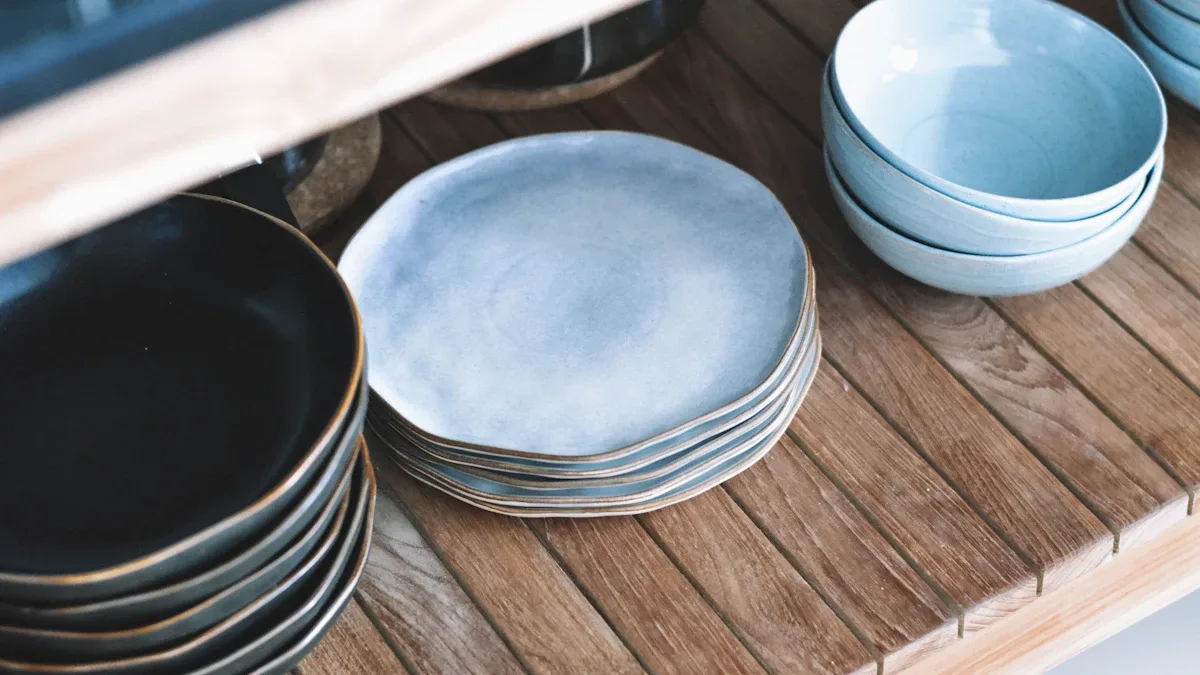
In the home, wabi sabi shows up in textures and materials more than in shapes. A glazed ceramic bowl with an uneven rim. A linen cloth worn thin at the fold. A wooden floor whose grain has deepened with use. A garden where moss has been allowed to grow between the stones. The handmade ceramics tradition takes this seriously: the thumb-print left in the clay, the kiln-blush that was never planned, the small warping that makes the piece unmistakably singular.
Applied to a home, wabi sabi means choosing fewer things and keeping them longer. It means buying a solid wooden table and letting it acquire scratches, rather than replacing it when the first mark appears. It means mending what breaks, keeping what ages well, and resisting the urge to make every surface look new. A home lived in this way accumulates a patina of its own, and that patina is the point.
It also means accepting asymmetry and emptiness. A room does not need to be filled to be finished. This is where wabi sabi differs from the minimalism it is often confused with: minimalism is a style, often expensive and precise, while wabi sabi is an attitude towards what you already have.
Wabi sabi and the art of ageing
Wabi sabi is not only about objects. The same way of seeing can be turned on people, and on ageing itself. The writer and philosopher Leonard Koren put it plainly: wabi sabi is the beauty of things that are imperfect, impermanent and incomplete, modest and humble, unconventional. That description, written about pottery, could equally describe the ageing face or hand of a grandparent — the lines, the spots, the asymmetry that come from a life lived.
This is why the idea has found a second life in conversations about beauty and wellbeing. Where modern culture often treats ageing as a problem to be corrected, wabi sabi treats it as a process to be noticed — not giving up on care, but stopping measuring a face against a standard it was never meant to meet.
There is a related Japanese idea, mono no aware, often translated as the pathos of things: the bittersweet feeling that arises when beauty and fleetingness are perceived at once. The cherry blossom is beautiful partly because it falls. The two ideas are not identical, but they breathe the same air, and together they describe a way of living that is gentler on the things — and the people — that change.

Your wabi sabi checklist
These are small practices, not a programme. Try one, and see whether the way you look at things changes.
- Keep one chipped or worn object you love, instead of replacing it.
- Repair something broken rather than throwing it away.
- Choose natural materials: wood, linen, clay, stone.
- Leave one surface empty instead of filling it.
- Notice the patina on something old in your home.
- Buy one good thing instead of several cheap ones.
- Let a garden grow a little wild at the edges.
- Accept asymmetry: place one thing off-centre.
- Photograph something beautiful because it is worn.
- Ask whether a thing is finished, or only new.
Wabi sabi and its neighbours
| Idea | What it values | Where it comes from | How it differs from wabi sabi |
|---|---|---|---|
| Wabi sabi | Imperfection, impermanence, simplicity | Japanese Zen and tea ceremony | The reference point itself |
| Minimalism | Less, but perfectly ordered | Modern design | A style; wabi sabi is an attitude |
| Kintsugi | Visible repair as beauty | Japanese craft | A practice within wabi sabi |
| Mono no aware | The pathos of fleeting beauty | Japanese literature | A feeling; wabi sabi is a way of seeing |
| Hygge | Comfort, warmth, cosiness | Danish culture | Seeks comfort; wabi sabi seeks truth in age |
| Shabby chic | Distressed, vintage looks | Modern interiors | Imitates age; wabi sabi accepts real age |
Frequently asked questions
What does wabi sabi mean in simple terms?
It means finding beauty in things that are imperfect, impermanent and incomplete — a cracked bowl, a worn floor, a faded cloth — rather than only in things that are new and flawless.
Is wabi sabi a religion?
No. It has roots in Zen Buddhism and the Japanese tea ceremony, but it is an aesthetic sensibility, not a religion. Anyone can practise it, whatever they believe.
What is the difference between wabi sabi and minimalism?
Minimalism is a design style that values less, usually with clean lines and perfect order. Wabi sabi is an attitude towards what you already have, and it welcomes asymmetry, wear and imperfection.
What is kintsugi?
Kintsugi is the Japanese art of repairing broken pottery with lacquer mixed with powdered gold, silver or platinum, so the repair is visible and becomes part of the object’s beauty.
Can wabi sabi apply to people, not just objects?
Yes. The same way of seeing can be turned on ageing and physical imperfection, valuing the marks of a life lived rather than measuring a face against an ideal of symmetry.
How do I bring wabi sabi into my home?
Start small: keep things longer, repair what breaks, choose natural materials, leave some space empty, and notice the patina on what you already own. It is a way of seeing, not a shopping list.
The bottom line
Wabi sabi is the Japanese art of finding beauty in imperfection, impermanence and incompleteness — in the cracked bowl repaired with gold, the worn floor, the garden left a little wild. It grew from Zen Buddhism and the tea ceremony, through masters like Murata Juko, Sen no Rikyu and the poet Basho, and it offers a gentler standard than the polished and the new: that nothing lasts, nothing is finished, and nothing is perfect, and that this is not a problem to be fixed but a beauty to be noticed. For the quiet rituals that go with it, our guide to the best tea brands covers a slow cup of tea, our guide to the best single-serve coffee maker covers a simple morning brew, and our guide to the best dog breeds for families covers a companion for unhurried walks.