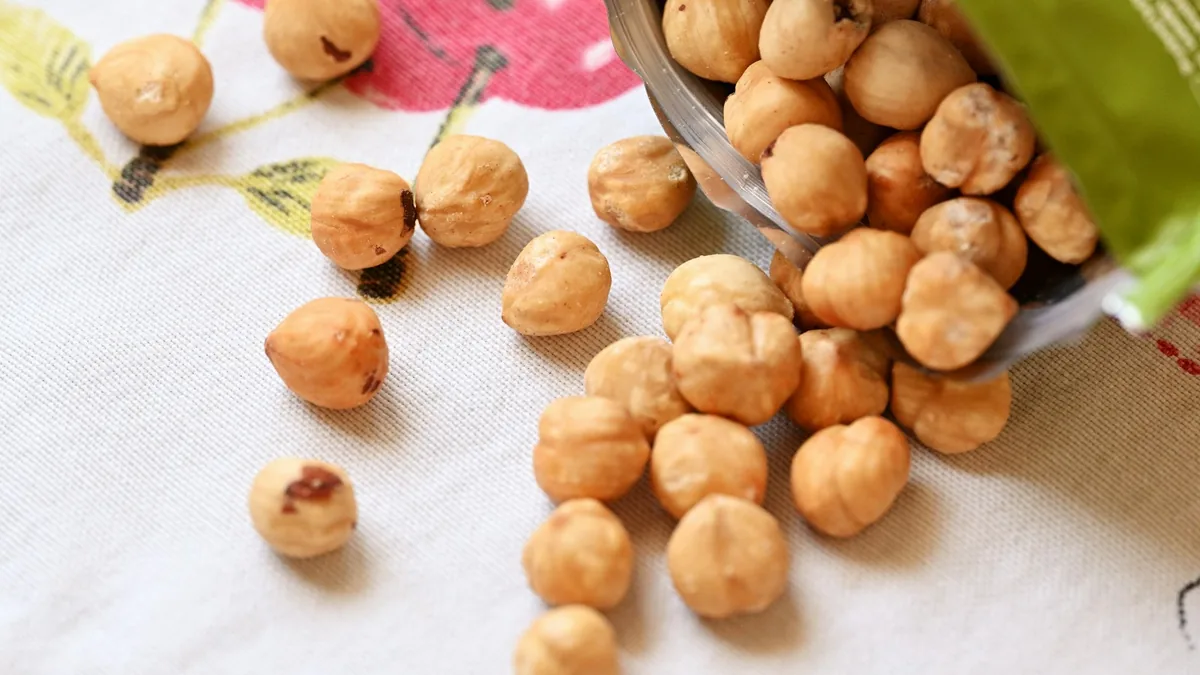

Filbert nuts hazelnuts is the search that brings shoppers to one nut sold under two names, and the confusion comes from history, not from botany. Are filbert nuts and hazelnuts the same thing? Yes: both are the fruit of the hazel tree, mostly Corylus avellana, and the name on the packet says more about where the nut was sold than about what is inside it.
The difference, where one exists at all, is shape. A nut sold as a filbert is usually more elongated, about twice as long as it is wide, while a rounder nut is more often called a cobnut.
Key takeaways
- Filberts and hazelnuts are the same nut, the fruit of the hazel tree, mostly Corylus avellana.
- A filbert is the elongated form; a rounder nut is usually called a cobnut.
- Per 100 grams, raw hazelnuts provide about 628 calories, 15 grams of protein and 61 grams of fat.
- Roasting at 175 degrees Celsius for 10 to 12 minutes deepens the flavour and loosens the skins.
- Buy shelled for baking, in the shell for freshness, blanched for chocolate work.
Filberts and hazelnuts: the same nut
The hazelnut is the fruit of the hazel tree, and it includes any of the nuts from species of the genus Corylus, above all the common hazel, Corylus avellana. The nut grows inside a fibrous husk and a smooth shell, and falls from the husk when ripe, about seven to eight months after pollination. The kernel inside is edible raw or roasted, whole or ground into a paste.
The naming split is a matter of shape and region. A cobnut is roughly spherical to oval, about 15 to 25 millimetres long, while a filbert is more elongated, about twice as long as its diameter. In American shops the word filbert is common, in British shops hazelnut is the usual term, and cobnut appears for the rounder Kentish varieties, while Turkey grows more hazelnuts than any other country, and the nut has been eaten in Europe since long before farming began.
Best for: cooks who want one nut that works raw, roasted, ground and pressed, and shoppers who want to stop paying twice for the same ingredient under two names.
Why two names for one nut?
The word filbert has two common explanations, and both are probably part of the truth. One traces it to Saint Philbert, whose feast day falls on 22 August, around the time the nuts ripen. The other traces it to the phrase full beard, for the long, leafy husk that covers the nut like a beard.
Hazelnut is the older and simpler name, from the hazel tree itself, and it is the name used in most of the world. Cobnut comes from cob, an old word for a round head or lump, which suits the rounder nuts. None of these names marks a different species: a recipe that calls for hazelnuts will work with filberts, and the other way round.
Best for: anyone who has stood in the nut aisle wondering whether two packets hold two different nuts: they do not, so buy the better value.
What is inside a hazelnut
Hazelnuts are rich in protein, monounsaturated fat, vitamin E, manganese and fibre. Per 100 grams, raw hazelnuts provide about 628 calories, 16.7 grams of carbohydrate, 9.7 grams of fibre, 60.75 grams of fat and 14.95 grams of protein. A single ounce, about 21 whole nuts, provides about 178 calories, 4 grams of protein, 17 grams of fat and 3 grams of fibre.
Vitamin E is the standout: 100 grams provide the full daily value, and a single ounce provides about a fifth of it. The fat is mostly monounsaturated, with oleic acid, the same fatty acid that dominates olive oil, making up about three quarters of it. Manganese is also high, at nearly the full daily value in a single ounce, alongside useful amounts of copper, thiamin, magnesium and folate, which is why hazelnuts are filling in small amounts.
Best for: snacking in small handfuls, and for cooks who want a nut that brings richness without needing much of it.
Buying hazelnuts: in the shell, shelled, blanched or roasted
Hazelnuts are sold in four main forms, and the right one depends on what you plan to do with them. In the shell, they keep longest, since the shell protects the kernel from air and light, and they suit anyone who enjoys cracking nuts at the table. Shelled whole kernels are the most versatile form, ready for roasting, grinding or snacking, and the form most recipes mean.
Blanched hazelnuts have had their brown skins removed, giving a cleaner flavour and a paler colour for baking and chocolate work. Roasted hazelnuts are ready to eat, with a deeper, warmer flavour than raw ones, and they suit salads, toppings and snacking without further work. Ground hazelnuts, or hazelnut flour, substitute for almond flour at roughly a one-to-one ratio in gluten-free baking, with a richer flavour and a slightly heavier texture, so whatever form you buy, check the smell first: fresh hazelnuts smell sweet and nutty, while stale ones smell flat or paint-like.
Best for: bakers, who should buy shelled or blanched kernels, and snackers, who should buy roasted nuts and eat them within a few weeks.
Roasting and skinning hazelnuts at home
Roasting is the single most useful hazelnut skill, and it takes about ten minutes. Spread shelled kernels in a single layer on a tray, roast at 175 degrees Celsius for 10 to 12 minutes, and take them out when the skins have darkened and the kitchen smells nutty. Let them cool for a few minutes, then rub them in a clean kitchen towel while still warm: the skins come away easily, and you are left with pale, sweet kernels.
The skin is edible but carries a mild bitterness from natural tannins, so removing it matters most for smooth work such as chocolate spread, praline and fine baking, while for trail mix, salads and pesto, the skins can stay on. Do not over-roast: hazelnuts go from golden to burnt quickly. Once roasted, hazelnuts grind easily in a food processor: pulse them for flour, or keep the machine running until they release their oils and form a smooth butter, and a handful of toasted hazelnuts also lifts a slow-cooked dish, with the best slow cooker guide covering the pots that suit that kind of cooking.
Best for: home bakers making chocolate-hazelnut spread or praline, and anyone who wants the flavour of roasted nuts without paying for the ready-roasted packet.
Cooking with hazelnuts
Hazelnuts and chocolate are the classic pairing. They are ground into praline, blended into gianduja, the chocolate-hazelnut confection developed around Turin, and folded into spreads, truffles and chocolate bars. The combination works because the nut’s warm, earthy flavour rounds out chocolate’s bitterness, and the fat in both carries the flavour further.
In baking, hazelnuts appear in tortes, dacquoise and meringues, where hazelnut flour adds flavour without wheat, and in biscuits such as the Italian brutti ma buoni, while in savoury cooking, toasted hazelnuts replace pine nuts in pesto at a one-to-one ratio, giving a richer, earthier sauce, and they work as a topping for salads, grain bowls and roasted vegetables. Hazelnut oil is strongly flavoured and suits dressings and finishing rather than frying, while blended into a smoothie, hazelnut butter adds richness, and the best smoothie blender guide covers the machines that handle nuts well. Like other nuts, hazelnuts take well to a little salt, and salted cashews show how a pinch of salt changes a nut’s flavour.
Best for: chocolate baking above all, and for cooks who want one ingredient that works in desserts, salads and sauces alike.
Storing hazelnuts so they stay fresh
Hazelnuts keep better than walnuts or pecans, because their natural skin acts as a barrier against oxidation, but their high fat content still makes them perishable. In the shell, they keep for several months in a cool, dry place, while shelled kernels keep for about three months in an airtight jar, and six months or more in the fridge or freezer. Keep them away from heat, light and strong smells, since nuts absorb odours easily, and if you buy in bulk, freeze what you will not use within a month: frozen hazelnuts roast and grind well straight from the freezer.
| Form | Best use | Storage | Notes |
|---|---|---|---|
| In the shell | Snacking and the table | Months, cool and dry | Freshest, but needs cracking |
| Shelled, raw | Roasting and grinding | About 3 months, airtight | The most versatile form |
| Blanched | Chocolate and fine baking | About 3 months, airtight | Skins removed, cleaner flavour |
| Roasted | Snacking and salads | A few weeks, airtight | Ready to eat, deepest flavour |
| Ground or flour | Gluten-free baking | About 1 month, or freeze | Goes stale fastest |
Your hazelnut checklist: which form to buy
Buy by what you will cook, not by the name on the packet.
- Buy shelled raw kernels if you bake, roast or grind, since they do everything.
- Buy blanched kernels if you make chocolate spread, praline or pale cakes.
- Buy roasted nuts if you want a snack or a salad topping with no extra work.
- Buy in the shell if you want the longest storage and enjoy cracking nuts.
- Buy ground hazelnuts only in small amounts, and freeze the rest.
- Smell before you use: sweet and nutty is fresh, flat or paint-like means the oils turned.

Frequently asked questions
Are filbert nuts and hazelnuts the same thing?
Yes. Filberts and hazelnuts are the same nut, the fruit of the hazel tree, mostly Corylus avellana. Filbert is the name for the more elongated form, while a rounder nut is often called a cobnut, but the flavour, nutrition and cooking uses are the same.
Why are they called filberts?
There are two common explanations. One traces the name to Saint Philbert, whose feast day falls on 22 August, around the time the nuts ripen. The other traces it to the phrase full beard, for the long, leafy husk that covers the nut.
Are hazelnuts good for you?
Hazelnuts are nutrient-rich, high in monounsaturated fat, vitamin E, manganese and fibre. Per 100 grams they provide about 628 calories, so they are energy-dense, and the benefit comes from small amounts: a handful a day is the usual pattern.
How do you remove the skins from hazelnuts?
Roast shelled kernels at 175 degrees Celsius for 10 to 12 minutes, until the skins darken and the kitchen smells nutty. Let them cool briefly, then rub them in a clean kitchen towel while still warm, and the skins come away.
Can you substitute hazelnuts for almonds?
Yes, in most baking. Hazelnut flour substitutes for almond flour at roughly a one-to-one ratio, with a richer flavour and a slightly heavier texture. Whole hazelnuts can also replace almonds in toppings and salads.
How long do hazelnuts last?
In the shell, hazelnuts keep for several months in a cool, dry place. Shelled kernels keep for about three months in an airtight jar, and six months or more in the fridge or freezer. Ground hazelnuts go stale fastest, in about a month.
The bottom line
Filbert nuts and hazelnuts are the same nut, and the two names are a historical accident rather than a real distinction. Buy them shelled for baking, blanched for chocolate work, and roasted for snacking, roast them at home for the best flavour, and store them airtight and cool. A small handful goes a long way, in a torte, a pesto, or a salad, and that versatility is why the hazelnut has been a European staple for thousands of years, with one caution: hazelnuts are tree nuts, so anyone with a tree nut allergy should avoid them entirely, and check labels, since hazelnuts appear in chocolate, baking and spreads where they are not always obvious.